
If one accessible pipe leaks and the rest of the system is healthy, a spot repair is usually the right call. If leaks keep returning, water runs discolored, or galvanized pipes are past their prime, whole-house repiping saves money over time. Water supply pipes are the pressurized lines that carry potable water from the meter to every fixture, and the repair-or-repipe choice comes down to pipe material and corrosion extent matched against the age and condition of the whole system.
What is the difference between pipe repair and repiping?
Pipe repair fixes one failed section while repiping replaces most or all of the supply lines in a home. Water supply pipes are a residential plumbing pipe class that operates under constant pressure, typically 40 to 80 psi, so a single bad joint can be cut out and coupled while the rest of the network stays in service. That distinction decides everything that follows.
A repair makes sense when the damage is local. A pinhole in an exposed copper run, a cracked CPVC elbow behind a vanity, or one split PEX fitting gets cut out and replaced, often in a single visit for $150 to $800 for accessible work. The rest of the system keeps its remaining life, which is a good deal when the pipes are mid-life and the failure has an obvious one-time cause like a frozen elbow or an overtightened connection.
Repiping is a system reset. A whole-house repipe replaces supply lines throughout the home, usually with PEX tubing or new copper, and typically costs $4,000 to $15,000 depending on home size, material, stories, and wall restoration. Homeowners choose it when failures are systemic rather than isolated. Three leaks in two years, brown water from multiple taps, or visible corrosion along long runs all point to a network that is wearing out together, not one unlucky joint.
How do pipe age and corrosion decide the outcome?
Pipe age vs material lifespan is the most reliable predictor of whether a repair will hold. Copper supply lines commonly last 40 to 70 years, PEX 40 to 50, CPVC 25 to 40, and older galvanized steel 20 to 50, with water chemistry and installation quality shifting results within those bands. A 10-year-old copper system with one pinhole is a repair. A 55-year-old galvanized system with low flow at several fixtures is a repipe candidate even if only one joint is dripping today.
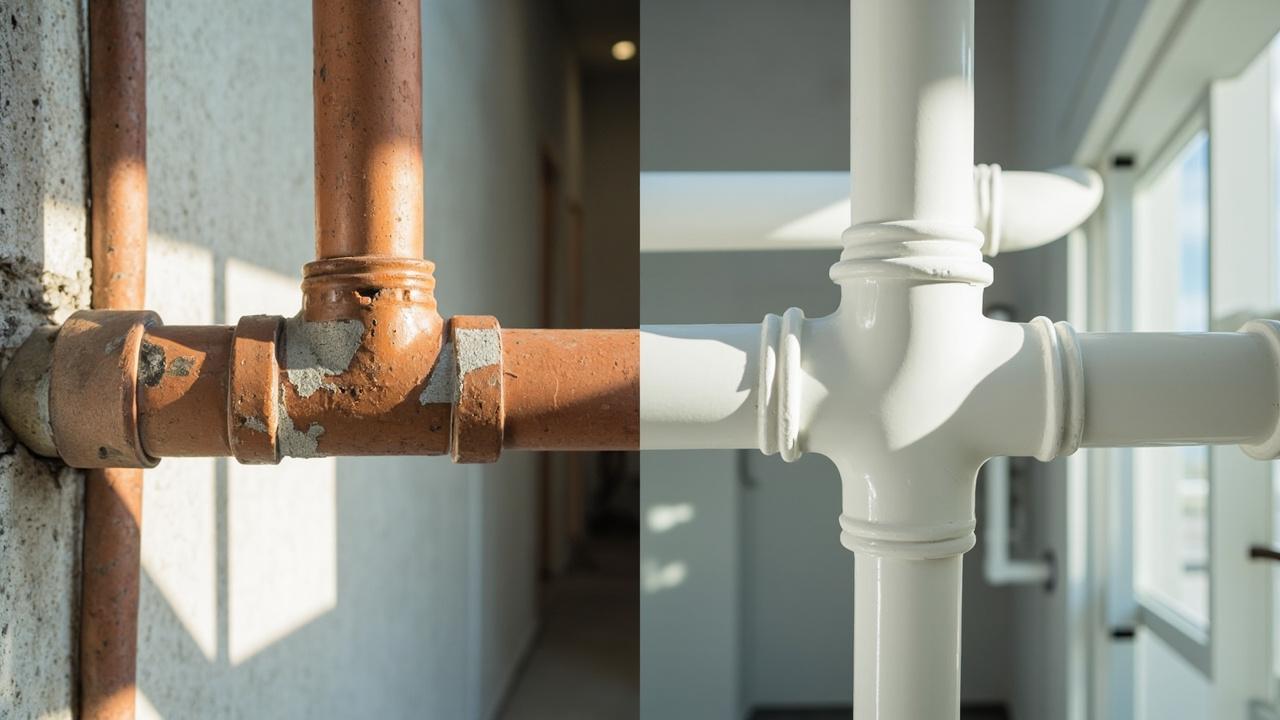
Corrosion tells you which stage the system is in. Surface patina on copper is normal. Flaking, green-blue crust at joints, or pinhole leaks that appear months apart mean the wall thickness is failing from the inside out. On galvanized pipe the signature is different. Rust constricts the bore, so flow drops, water runs yellow-brown after sitting overnight, and threads crumble when a plumber tries to unthread a fitting. Once that pattern spreads across several runs, each repair disturbs brittle neighbors and can trigger the next leak.
Water pressure accelerates the verdict in both directions. Pressure above 80 psi strains joints, appliance hoses, and weak spots, and it can turn a borderline pipe into a repeat leaker. A gauge on a hose bib costs little and reads in minutes. If pressure runs high, a pressure regulator adjustment or replacement belongs in the plan whether you repair or repipe, because new pipe connected to punishing pressure inherits the old problem. For background on how supply lines, drains, and vents work as one network, read what a home plumbing system includes.
Which option fits your situation and budget?
The honest comparison is not which method is better in the abstract but which one matches the condition of your pipes, your tolerance for repeat disruption, and your budget horizon. The table below uses the same criteria for both paths so the trade-off stays visible, with typical US ranges before wall and finish restoration.
| Criterion | Spot repair | Whole-house repipe |
|---|---|---|
| Best for | One leak, mid-life pipes, clear one-time cause | Repeat leaks, widespread corrosion, aging galvanized or polybutylene |
| Typical cost | $150 to $800 accessible; $1,000 to $4,000+ for slab work | $4,000 to $15,000 by size, stories, and material |
| Disruption | Hours, one area opened | 2 to 5 days typical, multiple rooms opened and patched |
| Lifespan gained | Extends local section, rest keeps old clock | Resets system clock, 25 to 70 years by material |
| Risk after work | Neighboring weak spots may fail next | Low pipe risk, punch-list risk shifts to patch and paint |
| Resale signal | Neutral, documented repair | Strong, new supply system buyers trust |
Two field examples sharpen the choice. A homeowner with 12-year-old copper and a single split elbow from a hard freeze pays a few hundred dollars for a section replacement and moves on. The remaining pipe has decades left, so repiping would discard good capital. Contrast that with a 1960s ranch on original galvanized steel pipe where the shower trickles, the laundry water runs rusty each morning, and two repairs in 18 months each cost $500. The third leak is already forming inside the wall. The repipe costs more once and ends the cycle.
Budget changes the math without changing the diagnosis. A tight budget can justify one well-executed repair as a bridge, provided you treat it as a bridge. Bank the difference, watch for water discoloration and pressure drops at other fixtures, and plan the repipe within a year or two. What fails is the accidental strategy, repairing every six months at full emergency rates until the cumulative bill passes the repipe price with nothing to show for it. If your current problem is a single active drip, start with plumbing leak repair cost ranges to size the spot fix before deciding.
What does each job involve, and what goes wrong?
A spot repair follows a short sequence that any homeowner can supervise. The plumber shuts water at the nearest valve, verifies zero pressure, opens the smallest access that exposes sound pipe on both sides of the failure, cuts back to clean material, and joins the new section with the correct coupling for that material. Then comes the step people skip, a pressure test and a drying period before the wall closes, so a weeping joint is caught while it is still visible.
A repipe is a small project, not a service call. The crew maps runs, protects floors, opens chases and small wall sections, pulls new lines (PEX manifolds home-run or trunk-and-branch, or soldered and press-fit copper pipe), ties in fixtures and the water heater, pressure tests the whole network, then closes walls for patch and paint. Most single-story homes finish the plumbing in two to five days, with patching adding days after. Permits and inspections apply in many jurisdictions, so confirm requirements before pipe is ordered.
Common mistakes cluster around material transitions and impatience. Joining CPVC pipe to copper or PEX without the listed transition fitting, burying a concealed joint without test time, or closing a damp cavity that needed drying all invite callbacks. On repipes, the classic error is approving the plumbing price without pinning down who patches drywall, matches texture, and repaints. Get that scope in writing, with fixture and valve brands stated. Any work inside slabs, near panels, or involving the main water shutoff replacement should be handled or checked by a licensed professional.
When should you stop repairing and call a licensed plumber?
Three honest limits should end the repair streak. A slab leak under concrete, polybutylene or badly corroded galvanized throughout, and any pattern of three or more supply leaks in about two years all signal systemic failure. Low flow at many fixtures plus rusty morning water is the galvanized end-of-life signature. A single repair cannot restore bore that rust has already narrowed, and each opening of brittle pipe risks the next joint.
Edge cases still deserve a repair-first answer. A nearly new PEX system with one faulty fitting, a clearly mechanical injury like a drywall screw through a line, or a single failed valve on otherwise young pipe should be fixed locally and watched. Sun-exposed runs are a special case worth checking. PEX degrades under prolonged UV, so an attic or exterior section baked by sunlight may fail while indoor runs stay sound. Shield or reroute the exposed section rather than condemning the system.
Use a simple decision rule. If the pipes are under roughly two-thirds of expected life, the failure is local, and pressure tests normal, repair. If they are past that mark, corrosion shows at multiple points, or disruption costs are stacking up, price the repipe. Either way, get two written quotes stating material, scope, permit handling, and restoration, and ask each bidder what condition would flip their recommendation. A plumber who can name the flip point is the one to trust, and a licensed professional should confirm any plan that touches slabs, mains, or water quality concerns. When the plumbing decision is part of a larger project, our renovation vs repair guide helps you decide between a targeted repair and a full renovation.