
Should you repair your furnace or replace it? Here is the short answer: repair it if it is under 12 years old and the fix costs less than half of a new system, replace it if it is past 15 years, needs a major component, or keeps breaking down. A new gas furnace runs $2,500 to $7,500 installed, while most repairs land between $150 and $1,200. A furnace repair vs replacement decision ultimately turns on age, repair cost, and the condition of the heat exchanger.
Repair or Replace: The Direct Answer
A gas furnace is a forced-air heating appliance that burns fuel inside a sealed heat exchanger and blows household air across it, and the repair-or-replace question is really a question about remaining useful life. If your furnace is under 12 years old, has been reliable, and the repair is a minor part, fix it. That repair buys you years of service at a low cost per year. If it is over 15 years old, has needed two or more repairs in the last two seasons, or the quote approaches half the price of a new unit, replacement is the smarter money. The single factor that overrides everything else is heat exchanger condition: a cracked heat exchanger on an out-of-warranty furnace means replace, not repair, because the part alone costs $1,500 to $3,500 and the failure carries a carbon monoxide risk. When the exchanger is sound and the cabinet, blower, and controls are healthy, even a mid-life furnace deserves another chance.
How a Furnace Fails: Parts, Costs, and Warning Signs
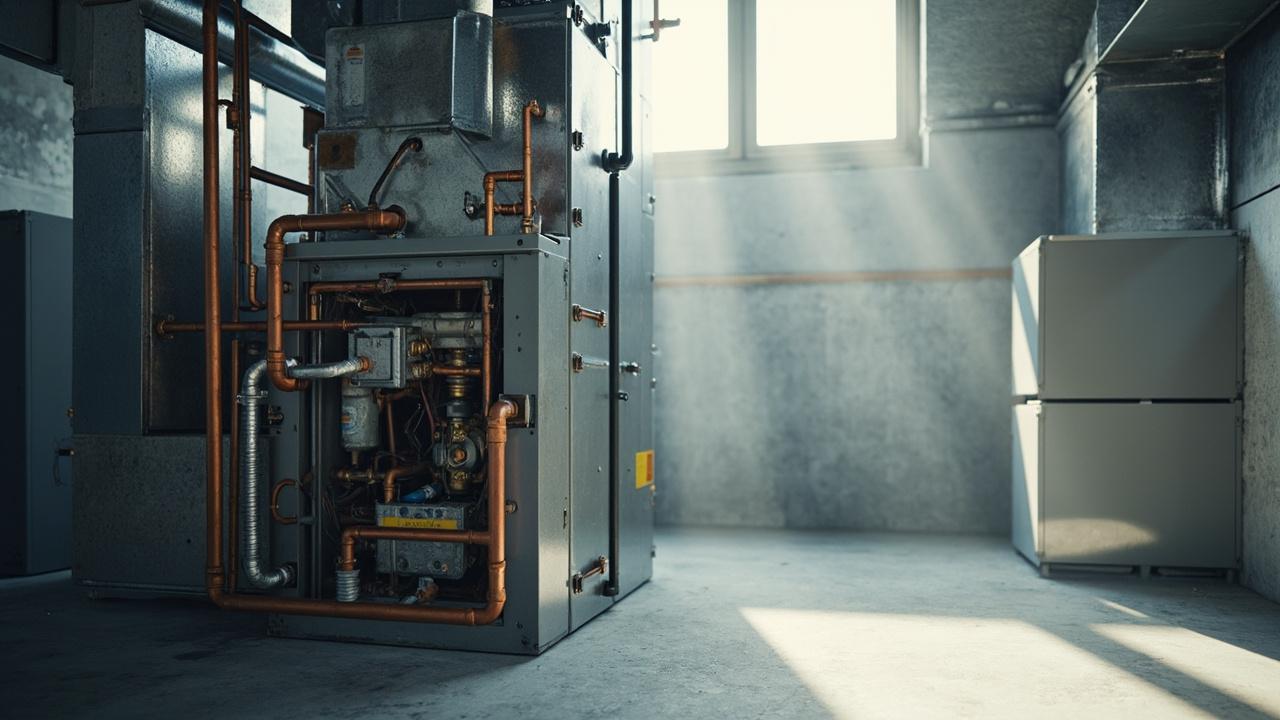
Furnaces rarely die all at once; they fail one component at a time, and each part tells you something about what comes next. The flame sensor is the most common culprit: carbon buildup makes the furnace light, then shut off seconds later, fixed by a $150 to $300 cleaning or swap. Ignitors ($200 to $500 installed) crack every three to seven years and are a routine repair at any age. Mid-range failures include the blower motor at $500 to $1,100, the inducer motor at $500 to $900, the control board at $400 to $900, and the gas valve at $400 to $800: worth fixing on a younger furnace, worth questioning past year 15. The AFUE rating shapes the background economics the whole time: an 80 percent unit wastes 20 cents of every fuel dollar up the flue, while a 96 percent condensing unit wastes about 4 cents, saving roughly $200 to $400 a year on typical gas bills. Watch for the warning signs that point toward replacement rather than another repair: rising gas bills with no rate change, rooms that never quite warm up, new rattling or booming on startup, a yellow or flickering burner flame instead of steady blue, and any carbon monoxide alarm event, soot around the registers, or rust streaks on the flue; those mean shut it down and call a licensed professional before anything else.
Repair vs Replacement Compared Side by Side
Run your situation through the two rules contractors actually use, then check the table. The 50% rule says a single repair costing half or more of a comparable new system favors replacement; on a $5,800 mid-tier 96 percent furnace, that threshold sits near $2,900. The $5,000 rule multiplies the repair quote by the furnace age: a $600 repair on a 9-year-old unit scores 5,400 and leans replace-or-think-hard, while the same repair on a 6-year-old unit scores 3,600 and clearly favors repair. Neither rule is absolute, which is why the 15- to 20-year service life of a typical furnace is the tiebreaker: expensive repairs on equipment with only a few seasons left rarely pay back.
| Criteria | Repair | Replace |
|---|---|---|
| Typical cost | $150 to $1,200; major parts up to $3,500 | $2,500 to $7,500 gas; $5,000 to $9,000 premium variable-speed |
| Best when | Under 12 years old, first or second repair, minor part | Over 15 years, repeated breakdowns, cracked exchanger |
| Efficiency outcome | Keeps existing AFUE, 80 to 96% | Chance to jump to 95 to 98% AFUE |
| Warranty outcome | Part warranty only, 1 to 5 years | Full system warranty, 10 years parts typical |
| Risk | Next failure months away on old equipment | Higher upfront cost, possible venting or ductwork extras |
Two field examples make the math concrete. A 7-year-old 92 percent furnace with a failed ignitor quoted at $350 is an easy repair: the unit has a decade of life left and the fix costs a fraction of replacement. A 17-year-old 80 percent furnace quoted at $1,400 for a blower motor, after $900 in repairs the previous winter, is a replacement: the $5,000-rule score is 23,800, the efficiency jump to 96 percent saves hundreds a year, and the new warranty resets the breakdown clock. If you are weighing a different heating technology altogether rather than a like-for-like furnace, our gas furnace vs heat pump comparison prices out the fuel-switch path honestly.
Replacement Realities: Sizing, Venting, and Costly Mistakes
A good replacement starts with a Manual J load calculation, not a rule of thumb based on the old unit’s size: insulation, windows, and air sealing done since the original install often mean the right new furnace is smaller than the one leaving. A condensing furnace at 95 percent AFUE or higher cannot reuse an old masonry chimney without a liner; budget $800 to $1,500 for PVC venting and a condensate drain, and confirm the drain has a freeze-safe route in cold climates. A variable-speed blower adds $1,500 to $3,000 over a single-stage box but delivers steadier temperatures, quieter operation, and longer filter hours that allergy sufferers notice. The mistakes that turn a new furnace into a disappointment are depressingly consistent: skipping the load calculation and oversizing, which short-cycles the unit and kills efficiency; reusing leaky, undersized returns and wiping out the rated AFUE on day one; and accepting the cheapest bid that skips permits, combustion testing, and a written commissioning checklist. Get three itemized bids, demand the checklist, and have the installer verify gas pressure and venting at startup. Our home insulation guide shows how sealing and insulation shrink the load your new furnace must meet.
When Replacement Can Wait, and When It Cannot
Replacement can honestly wait when the furnace is under 12, the exchanger tests sound, repairs are minor and infrequent, and bills are stable. Keep up annual tune-ups at $120 to $200 and bank the replacement fund for later. The limits are equally honest: never repair a cracked heat exchanger on an expired warranty, never ignore a carbon monoxide alarm or the smell of gas, and never sink major money into a unit past 20 years no matter how tempting the quote looks. Households on tight budgets should weigh the timing too: a planned spring or fall replacement bids $500 to $1,500 less than a midwinter emergency swap, so a modest repair that safely bridges one mild season can be rational if a licensed HVAC contractor confirms the exchanger and venting are safe. Fuel-switch curiosity belongs in the same conversation: if your furnace and air conditioner are aging out together, or you heat with pricey propane or oil, a heat pump may beat a like-for-like furnace on lifetime cost. Run both quotes before committing. Whatever you choose, get combustion safety verified, keep detectors current, and consult a licensed professional for anything involving gas, venting, or electrical upgrades. If this furnace question is part of a bigger project, our renovation vs repair decision framework helps you choose between a targeted repair and a full renovation.