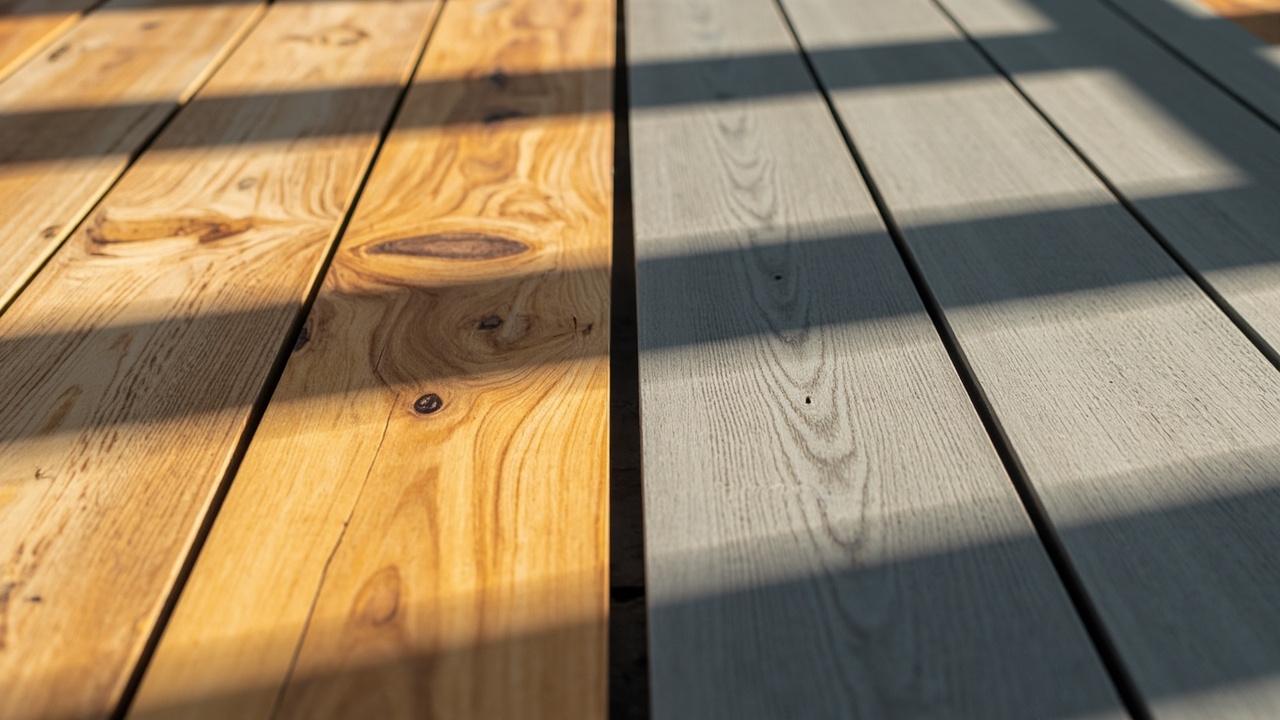

Composite and wood decking cost about the same over 20 years, but the year-by-year trade-off is sharp. Wood is cheaper to install and easier to repair on the spot. Composite costs more upfront but does not need refinishing for 25+ years. For most US/Canada homeowners building a 300 to 500 sq ft deck, the decision is whether to spend an extra $1,500 to $3,000 now to skip the maintenance for the next two decades.
Here is the direct answer: in most US climates (zones 3 to 7), pressure-treated southern yellow pine runs $15 to $25 per square foot installed, while composite decking (Trex, TimberTech, Fiberon) runs $25 to $45 per square foot installed. Wood needs staining or sealing every 2 to 3 years at $3 to $7 per square foot in materials and labor. Composite needs only an annual soap-and-water wash. Over 20 years, the total cost of ownership lands within 10 to 15% of each other on a typical 400 sq ft deck. The decision is really about how much weekend maintenance you want.
| Cost / spec | Wood (pressure-treated pine) | Composite (Trex / TimberTech / Fiberon) | |
|---|---|---|---|
| Material, per square foot | $3 to $6 | $10 to $18 | |
| Labor (install), per square foot | $8 to $15 | $10 to $20 | |
| Installed total, per square foot | $15 to $25 | $25 to $45 | |
| 400 sq ft deck, installed | $6,000 to $10,000 | $10,000 to $18,000 | |
| Annual maintenance, per square foot | $1 to $3 (DIY) / $3 to $7 (pro) | $0.10 to $0.30 (soap wash) | |
| Refinish / reseal cycle | Every 2 to 3 years | None | |
| Lifespan (typical US climate) | 15 to 20 years (PT pine) / 25+ (cedar, tropical hardwood) | 25 to 30 years | |
| Slip resistance when wet | Moderate; slick after 3+ years if not sealed | High (capped products); stays consistent | |
| Heat retention (full sun, 90 F day) | Up to 110 to 130 F surface | Up to 140 to 160 F surface (darker colors hotter) | |
| Repairability (replace one board) | Easy; any homeowner with a circular saw | Moderate; need matching product line for current generation | |
| Sustainability note | Renewable; FSC-certified pine available | Recycled content 50 to 95% (Tre…[truncated> | Not recyclable in most US markets |
Where Wood Wins
Wood is the right pick when any of the following applies:
- You want a deck that can be refinished, not replaced. A pressure-treated pine deck that has been maintained can be sanded and re-stained at year 8, year 12, year 16, and still hit 25 years. A composite deck with deep gouges or surface fading is a replacement, not a refinish.
- You are in a freeze-thaw zone with road salt splash. Northern US and Canadian decks take road salt in winter. Wood tolerates salt well if hosed off in spring; composite can pit at the salt line and the damage is permanent.
- You want a specific color or grain pattern. Real wood grain is unique to every board. Composite is consistent, but the pattern repeats every 4 to 6 feet and is visible up close.
- You want to DIY the install. Wood cuts with any saw, fastens with deck screws or hidden clips, and forgives small measurement errors. Composite requires specific hidden-clip systems, gapped end cuts, and manufacturer-matched fasteners.
- Your budget is the constraint. For a 400 sq ft deck, the installed price gap between wood and composite is $4,000 to $8,000. That is the cost of a kitchen appliance, a roof section, or two years of property tax in many US markets.
The standard detail for wood: pressure-treated southern yellow pine (SYP) #2 or better, 5/4″ x 6″ decking boards, kiln-dried after treatment (KDAT) to reduce shrinkage, fastened with coated deck screws or stainless hidden clips. Cedar and tropical hardwood (ipe, cumaru) are premium upgrades at $25 to $45 per square foot installed and last 25+ years with the same maintenance cycle.
Where Composite Wins
Composite is the right pick when any of the following applies:
- You will not maintain the deck. Be honest. A wood deck that is not sealed every 2 to 3 years turns gray, splinters, and loses 5 to 10 years of life. If you know you will not seal it, composite is the cheaper long-term call.
- You have a pool or hot tub. Bare feet on splintered wood is a safety issue. Capped composite (Trex Transcend, TimberTech Azek, Fiberon Paramount) has a built-in slip-resistant texture that stays consistent for the deck’s life.
- You want a single color that holds. Wood fades to gray in 6 to 18 months without seal. Composite fades 5 to 10% in the first 3 months and then holds. For dark colors (espresso, walnut), this is a real difference in curb appeal.
- You have pets or kids who drag grit. Composite resists scratching and staining from pet nails, patio furniture, and BBQ grease far better than wood. Wine, grease, and leaf tannins wash off composite with soap; on wood, they leave a permanent stain unless sealed.
- You are in coastal California, Florida, or anywhere with high UV and humidity. Composite handles UV and humidity cycles without warping, cupping, or checking. Wood in those climates needs constant sealing.
The standard detail for composite: capped composite from a major line (Trex, TimberTech, Fiberon, MoistureShield), 5/4″ x 6″ grooved-edge boards with manufacturer-matched hidden clips, end caps on every cut, and gapping per spec (typically 1/8″ side, 1/8″ end). Avoid builder-grade uncapped composite (first-generation products from the late 1990s and early 2000s); they fade, stain, and mildew.
Side-by-Side: What 20 Years Looks Like
Here is the realistic 20-year cost breakdown for a 400 sq ft deck in climate zone 5 (typical US Midwest or Northeast):
- Wood (pressure-treated pine, DIY sealing): install $7,000, sealing every 2 to 3 years at $400 to $600 per pass (DIY materials), total over 20 years: $11,000 to $13,000. Refinish sand at year 12 adds another $1,500.
- Wood (pressure-treated pine, pro sealing): install $7,000, sealing every 2 to 3 years at $1,500 to $2,500 per pass (pro labor + materials), total over 20 years: $17,000 to $23,000. Refinish at year 12 adds $3,000.
- Composite (mid-range line, DIY install): install $12,000 (materials $7,500 + DIY labor $4,500 hidden in weekend time), annual wash $40 in soap and water, total over 20 years: $13,000. No refinish.
- Composite (premium line, pro install): install $16,000, annual wash $80, total over 20 years: $17,500. No refinish.
The crossover point lands around year 8 to 12 for DIY-maintained wood, year 4 to 6 for pro-maintained wood. After crossover, composite is cheaper. The question is whether you can maintain the wood on schedule , most homeowners cannot, which is why composite now holds about 50% of the US deck market.
When to Call a Pro
Call a licensed deck builder if any of the following applies, because the fix is structural, not material:
- Existing deck frame is more than 15 years old. The frame (posts, beams, joists) may be the limiting factor, not the decking. Reframing with pressure-treated lumber and adding composite on top is the standard retrofit.
- Ledger board (where deck meets house) is failing or not flashed. This is the number-one cause of deck collapse in the US. The ledger must be bolted (not nailed) to the house rim joist with 1/2″ lag screws or through-bolts, and flashed with metal or PVC tape.
- Soil is expansive clay or fill. Footings must be below the frost line (12 to 48 inches depending on US zone, 48 to 72 inches in Canadian zones). This is a code requirement and a structural call, not a material choice.
- You want a multi-level deck or a roof over the deck. Both involve load calculations that need a structural engineer or an experienced deck builder. The material is the smallest part of the cost.
The Bottom Line
Pick wood if your budget is the constraint, you are willing to seal every 2 to 3 years, and you want the option to refinish the deck in 10 years. Use pressure-treated pine for budget builds, cedar for a 25-year deck with the same maintenance, or ipe for a 30-year premium deck.
Pick composite if you will not maintain the deck, you have a pool or coastal exposure, or you want a single dark color that holds. Stick to capped composite from a major manufacturer (Trex, TimberTech, Fiberon, MoistureShield, Azek) and avoid first-generation products.
For most US homeowners in 2026, composite is the right call by total cost of ownership , but only if you actually would not have maintained the wood. If you are the type who will seal the deck on schedule, wood is the better 20-year value, and the deck will look better at year 15 than composite at year 15.
For related comparisons, see Wood vs Engineered Siding and Asphalt vs Metal vs Tile Roofing.