
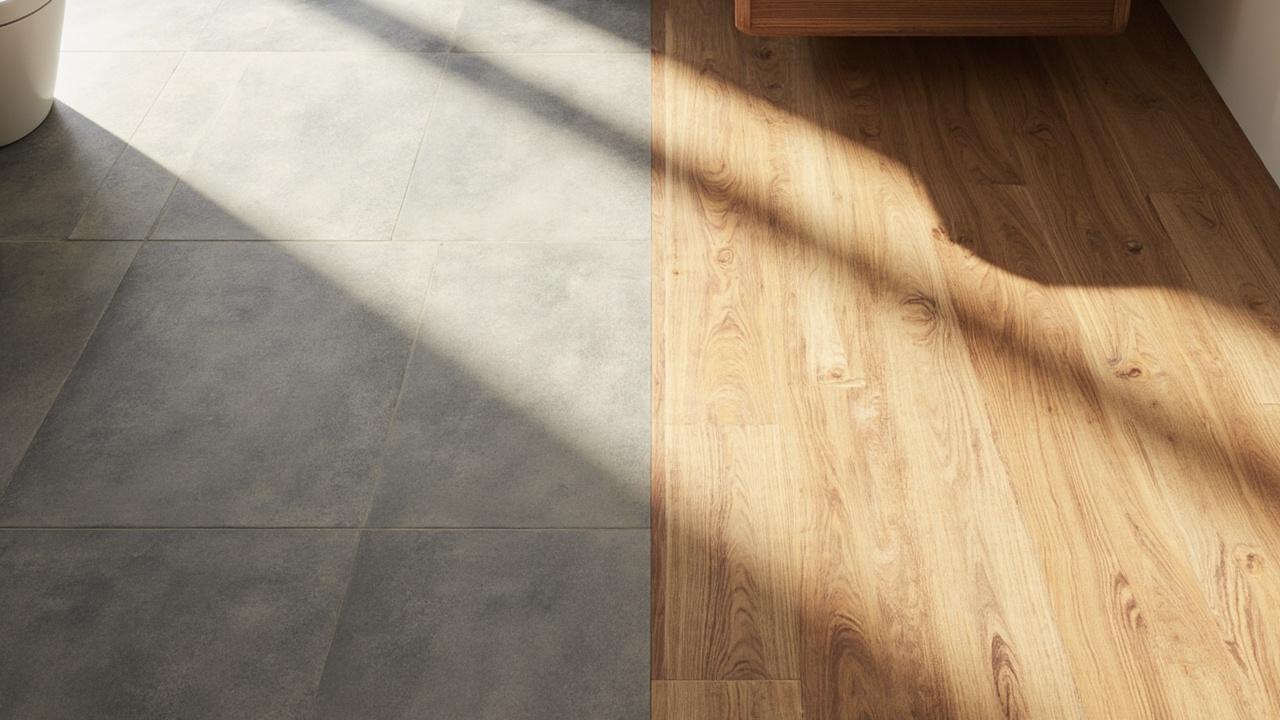
For a bathroom floor, choose water resistance first, look later. In Indonesia’s humidity, ceramic/porcelain tile is safer for wet shower areas — it tolerates slope 1–2% and 24-hour ponding without swelling. Vinyl (SPC/LVT) can work in the dry toilet/wash area only if the seams are welded, the subfloor is flat within 2 mm per 2 m, and you accept that any standing water will find the seam.
Both can look good. Only one forgives mistakes in slope, drainage, and drying time. This comparison uses the same criteria for both — durability, slip, water, maintenance, cost, and repair — so you can decide based on your bathroom’s wet versus dry zones.
At a Glance: Direct Answer by Zone
Shower + splash zone (floor stays wet 20–40 min/day): Porcelain tile wins — waterproof body, no swelling, compatible with membrane 0.8–1.2 mm and slope 1–2%.
Dry toilet/basin zone (occasional splash, dries in 10 min): High-quality SPC vinyl is acceptable — warmer underfoot, softer, but seams remain the weak point.
Deciding factor: If you cannot guarantee fast drying (no exhaust 25 L/s or open window), the answer defaults to tile. Vinyl’s comfort advantage disappears when seams hold moisture and grow mold at the edge.
Comparison With the Same Criteria
| Criteria | Porcelain Tile (glazed, PEI 3–4) | SPC Vinyl (4–6 mm, wear 0.3–0.5 mm) |
|---|---|---|
| Water resistance | Excellent — body water absorption <0.5%, handles ponding | Good surface, seams vulnerable — water wicks at click joints |
| Slip (wet) | R10–R11 matte / textured; glossy R9 is slippery — avoid in shower | R10 typical, warmer; still slippery when soapy — use anti-slip mat |
| Slope & drainage | Tolerates 1–2% slope easily, grout hides small flatness errors | Needs flat subfloor 2 mm/2m and precise slope — plank bridging telegraphs dips |
| Mold & grout | Grout can stain/mold if not ventilated, but tile itself inert | Seams and perimeter silicone trap moisture — edge mold is common |
| Comfort & sound | Cold, hard, noisy — needs rug in dry area | Warmer, softer, quieter underfoot |
| Durability (wet use) | 10–20 years; chips can be patched | 3–7 years in wet use; swelling at joints shortens life |
| Maintenance | Mop, grout brush, re-grout every 5–8 years | Mop damp, not wet; reseal perimeter yearly; no harsh bleach on seams |
| Repair | Replace single tile (keep 2–3 spares, same batch) | Replace planks — needs same dye lot; color match fades |
| Cost 2025 (material installed, per m², Jakarta ref) | Rp 350k–650k (tile + adhesive + grout + labor) | Rp 400k–700k (SPC + underlay + labor; vinyl sheet welded higher) |
| Best use | All wet areas, any bathroom | Dry bathroom zones, powder rooms, warm/comfort priority |
What Changes the Answer: Humidity, Ventilation, and Subfloor
High humidity or no exhaust: Tile’s lead widens. Vinyl seams in a room that stays above 75% RH for hours will discolor at the edge within 6–12 months. If you only have a small fixed window, count ventilation as the deciding attribute.
Existing slab flatness: Vinyl click requires a very flat screed (2 mm deviation per 2 m). Old bathrooms with a wavy screed telegraph through vinyl as soft spots and cause the click to unlock. Tile with thick-bed adhesive tolerates 4–5 mm dips more forgivingly.
Underfloor heating or sunlight: Not common in Indonesian homes, but direct sun through a skylight can raise vinyl surface to 45°C and accelerate discoloration. Porcelain is inert to that range.
House type 36/45 with one drain: One drain + linear layout + tile is the safest minimum-work option. Adding vinyl often forces you to add a threshold and second drain — extra cost that erases vinyl’s price appeal.
Practical Installation and Failure Points
Example A — 1.6×2 m family bathroom, window 300×600 mm, daily showers: Membrane 1.0 mm, slope 1.5%, 300×300 mm matte porcelain (R10) in shower, 400×400 mm in dry zone. One stainless drain 100 mm, P-trap to block odor. Dries in 20 min with a 25 L/s fan.
Tile: Slope must be checked with a 1 m level (10–15 mm fall). Grout width 2–3 mm, flexible grout in wet areas. Keep 2–3 spare tiles from the same production lot.
Vinyl: Subfloor must be primed, moisture content below 2%, expansion gap 8 mm at walls. Never flood the floor to clean — damp mop only. Never place vinyl over a failed membrane hoping to hide the leak.
Decision Framework — Choose by Condition, Not by Photo
Choose porcelain tile if:
- the bathroom has a shower or frequent wet use
- ventilation is limited (no exhaust to outside)
- the subfloor is not perfectly flat
- you want the longest life with the lowest surprise cost
Consider vinyl (dry zone only) if:
- the bathroom is a dry powder room or you can strictly separate wet/dry with a curb and second drain
- comfort and noise matter more than absolute waterproofing
- you will maintain seams, keep the floor dry, and keep spare planks
Hybrid that often works best in Indonesia: Porcelain in the shower + SPC in the dry vanity area, separated by an 8–10 mm aluminum threshold strip. You get tile where water lives and warmth where you stand to brush your teeth.
Costs, Limits, and Next Steps
Both options sit in Rp 350k–700k per m² installed (2025 Jakarta reference, tile 300×300–600×600 mm, SPC 4–6 mm; excludes membrane and slope correction). Add Rp 120k–250k per m² for membrane 0.8–1.2 mm + screed correction if your slab is uneven — do not skip this to save budget.
Limitations: No floor survives a wrong slope or a missing membrane. Tile hides ponding a bit longer; vinyl reveals it faster through swelling. Neither replaces proper drainage — if water stands more than 30 mm wide for more than an hour, the fix is slope or drain position, not material change.
Next: if your current floor already shows dark grout, edge swelling, or a musty smell, read Bathroom Leaks and Mold Diagnosis. For spacing and fixture positions that make your chosen floor work, see Bathroom Layout and Fixtures. If you need to move a waste pipe or cut the slab, consult a licensed contractor before ordering material.