
Water damage restoration cost is the price of getting a wet house back to how it was, and it is not one number. It is two jobs billed separately: emergency mitigation that gets the water out, and reconstruction that puts the building back together, and the gap between those two halves is where most surprises live.
Most homeowners meet that number through a bad surprise. A flood that seemed like a cleanup turns into a five-figure project once the drywall comes off the wall.
Here is what actually sets the price. It comes down to how contaminated the water was, how much of the structure it reached, how fast it was stopped, and what had to be thrown out rather than dried.
What Water Damage Restoration Actually Costs: Two Jobs, One Bill
Published cost guides put a national average of water damage restoration at roughly $3,455, with a typical range from about $1,305 to $5,707. That number is useful for sanity-checking a quote, and useless for planning one.
The range is wide because the work splits into two phases that behave nothing alike. Mitigation is the emergency response: extraction, drying, monitoring, and the removal of anything that cannot be guaranteed clean. It is priced by the square foot, and its rate depends entirely on what kind of water you had.
Reconstruction is the rebuild: drywall, flooring, ceilings, paint, fixtures, plumbing. It is priced by material and by trade, and it is where a small flood can quietly become an expensive project, because reconstruction scales with what the mitigation phase revealed.

Ask any contractor for the two phases itemized separately and you will immediately see whether you are comparing like with like. Two estimates can differ by thousands and both be honest, because one of them priced only the drying.
Water Category Decides the Price More Than Room Size Does
The single biggest lever on a restoration bill is not how many rooms are wet. It is IICRC water Category, the industry classification for how contaminated the water is, and it changes what can be saved rather than just what it costs to clean.
Category 1: clean water
Water from a supply line, a dishwasher, or a roof leak. It carries little or no contamination, and drying restores it. Drying runs $3 to $4 per square foot. This is the cheapest category and the only one where a careful homeowner can plausibly handle a small job alone.
Category 2: gray water
Water with some contamination in it, such as a washing machine overflow or a toilet overflow that did not reach the sewer. It supports bacteria, and it will grow mold if it sits.
Drying runs $4 to $6.50 per square foot. The difference from clean water is not the cleaning. It is the margin for delay, because what is safe to dry on day one can be a mold problem on day three.
Category 3: black water
Water that may contain sewage. Floodwater from a river or a hurricane, a backed-up sewer line, anything that touched a drain. Drying and removal runs $7 to $7.50 per square foot, and here the logic inverts completely.
With black water, porous materials get removed rather than restored. Bedding, carpeting, clothing, upholstery, and porous building material all leave the building, because no contractor can certify a porous surface is fully sterilized.
That single rule explains most of the gap between a gray-water price and a black-water price on an identical floor area. It is also why a black-water job in a small space can cost several times a clean-water job in a large one.
One more thing worth knowing. Only a licensed professional can categorize and classify water damage, and most insurers will not accept a homeowner’s own diagnosis for a claim. That is not gatekeeping for its own sake, because the classification drives the scope of work, and the scope of work drives the money.
The Line Items That Separate a Fair Quote From an Expensive One
Published damage Class bands give you a way to sanity-check a number. A Class 1 job, partial damage in one room, runs about $150 to $400.
Class 2, a whole room with water up the walls, runs $500 to $1,000. Class 3, multiple rooms with water in the ceiling, walls, subfloor, or insulation, runs $1,000 to $3,000. And Class 4, long-standing water from a hurricane or river flood, can run $20,000 to $100,000.
Those bands are wide because the work inside them varies. Here are the line items worth reading closely on any estimate.
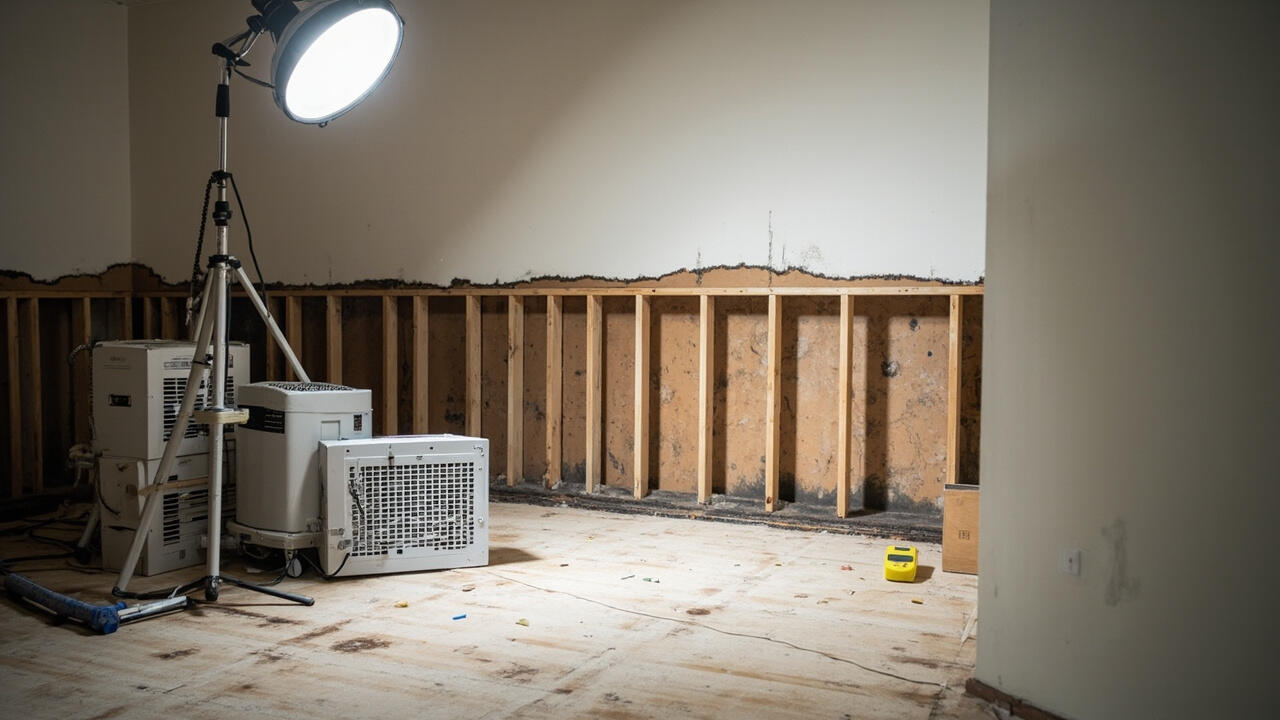
- Equipment days. A commercial dehumidifier rated at 150 to 220 pints a day, plus roughly one air mover per 50 to 100 square feet of affected area, is what actually removes the moisture. Equipment is usually billed per day, so a slow start inflates the number.
- Structural drying versus surface drying. Structural drying runs about $8 to $15 per square foot. A contractor quoting only the low per-square-foot cleaning rate may be assuming the structure is dry when it is not.
- Drywall. Repair or replacement runs $1 to $3 per square foot. Wet drywall has to come off, because you cannot dry behind a sealed face.
- Mold. Mold removal runs $1,100 to $3,400, averaging around $2,200. It is usually a separate line, and it is usually the one that appears after the work has started.
- Scope of the rebuild. Fixtures around $150 to $350, floors $200 to $500, ceilings $350 to $1,250, and plumbing repairs $1,000 to $4,000. These are the reconstruction line items, and they are where two quotes diverge most.
A quote that itemizes these tells you what you are buying. A lump sum does not, and you have no way to tell whether it is a good price or a padded one.
Why Two Estimates for the Same Flood Differ by Thousands
When two estimates for identical-looking water damage come back far apart, the gap is almost never padding on one side and honesty on the other. It is a difference in what each contractor believes is in scope, and it usually comes down to four assumptions.
The category assumption. If one contractor treated the water as clean and the other as gray, their drying rates differ by design, and the black-water reading changes the whole method.
Nobody can settle that from a visual inspection alone. That is why the professional classification happens first, before any of the work begins.
The class assumption. Class 3 and Class 4 differ by an order of magnitude. The gap between them is water that reached the subfloor and insulation versus water that has been sitting for days. How long the water was there, not how much of it there was, is what separates the two.
The removal assumption. Dry and keep, or dry and discard. For anything that touched Category 3 water, this is not a judgment call. It is the difference between a repair and a gut job on the same square footage.
The testing assumption. A contractor who plans to verify dryness with moisture readings, and one who plans to open the wall just to be sure, are pricing different projects. The second is more expensive, and sometimes it is the right one.
So the productive question when comparing quotes is not who is cheaper. It is whether the two describe the same job. Ask each contractor for the water category and damage class they are assuming, and for the two phases broken out separately.
If they agree on all three, the gap is real and worth negotiating. If they do not, you are not comparing anything yet.
Speed, Scope, and Prevention: The Parts You Actually Control
You cannot control the category or the class. A licensed professional sets both, and they are what they are. But you control two things that feed straight into the final number, and both of them are free.
Speed is worth money. Time is the input that converts a clean-water Class 1 job into a Class 2 or Class 3 job. Water that leaves in hours stays a small problem. Water that sits overnight starts soaking into drywall and into the subfloor, and it becomes a different project with a different price.
If you can stop the source and get the area dried quickly, you are the reason your bill is small. This is also why emergency tarping and board-up services exist, and why they cost what they do.
Scope discipline keeps the reconstruction line honest. When a contractor proposes a mitigation plan, ask which materials are being removed versus dried, and whether any of that is optional. Sometimes it is.
A floor you plan to replace in two years may not need the same treatment as a wall you plan to keep. That is a conversation worth having before the work starts rather than after the invoice, and it is the last place you have real leverage.
There is also a prevention note worth making here, because it is the cheapest money in this whole article. Restoring a flooded basement costs far more than protecting it did. If your basement has taken water before, or it sits below grade in a flood zone, the money is better spent on basement waterproofing now.
If you are still working out what the flooding actually came from, start with the signs of foundation water damage. And if the question is how to pay for it, that is a different job, covered in how a storm damage insurance claim actually gets paid.
The honest first step is a written, itemized estimate from a licensed restoration company, and a second one to compare it against.