
The water heater is leaking. You need the water off now, and the thing at the base of the tank is a small oval handle you have never touched. Every plumbing shutoff is one of four basic designs, and each one has its own rule for how it is opened, how it fails, and what it is actually good for.
That matters more than it sounds. A valve you cannot identify is a valve you cannot trust to stop the water, and a valve you force open when it has seized can take your only reliable shutoff away.
The good news is that the four designs are easy to tell apart once you know what to look for, and each one gives you a different answer about your plumbing system.
How to Tell Which Valve You Have Before You Turn It
Start with the handle, because the handle tells you what is inside the body.
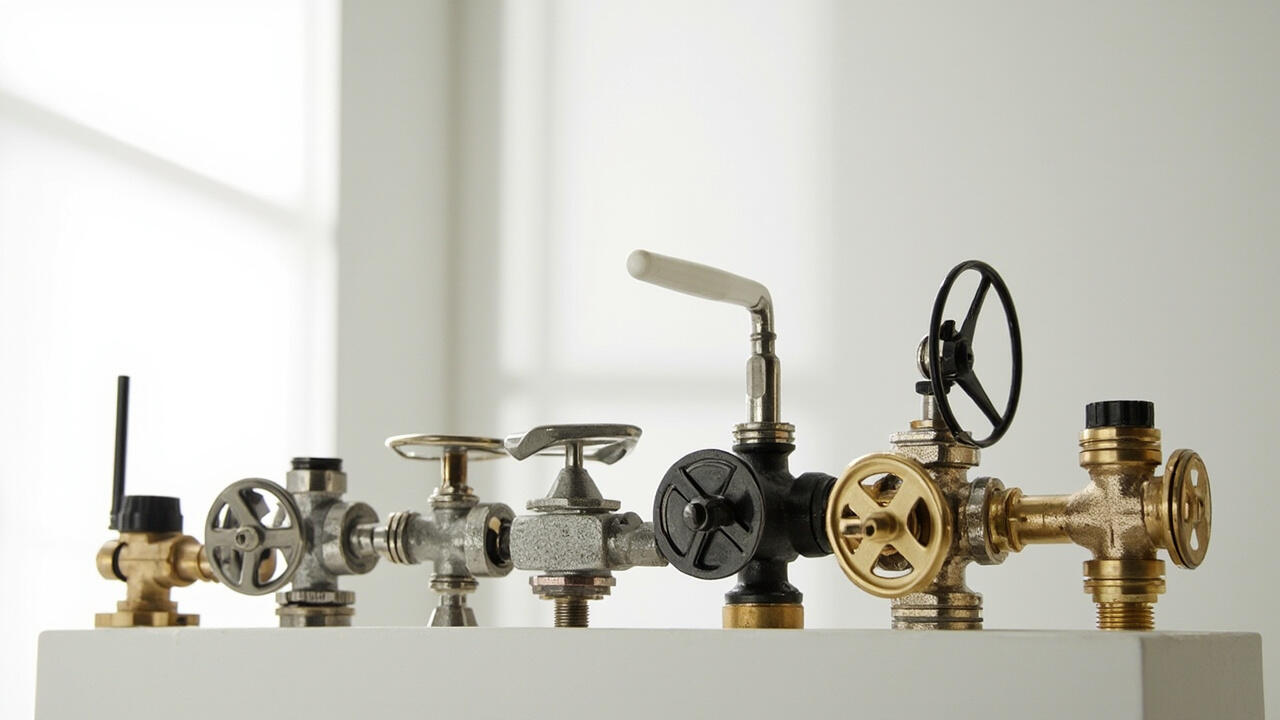
- A flat lever arm means a ball valve. The lever sits parallel to the pipe when open and perpendicular when closed.
- A round handwheel that takes many turns means either a gate valve or a globe valve. You will need to look for a second clue.
- A small oval knob on a short stem, usually under a sink or at a hose bib, means an angle stop.
- A gate valve with a threaded stem that visibly rises above the handwheel when you open it is rising stem, which tells you its position without guessing.
A non-rising stem gate valve gives you nothing to look at. On those, the only reliable indicator is the handwheel itself stopping when it reaches the end of its travel.
Knowing where your main shutoff sits in the rest of the system matters as much as knowing what it is. The wider layout is covered in what a home plumbing system actually does, which is worth reading first so you know which valve stops what.
Quarter-Turn Ball Valves: Fast, Obvious, and the Modern Default
A ball valve is a hollow sphere with a hole bored through it, rotating inside a metal body. Open, the bore lines up with the pipe and water passes through the full opening. Closed, the bore sits across the pipe and blocks it.
That quarter-turn design choice buys you three things a wrench-shaped handwheel cannot. A quarter turn to close means the water stops when you need it to stop. The lever shows the position at a glance, so nobody in the house has to guess. And a ball that never touches the water when it is fully open tends to keep working after years of sitting still.
Plumbers reach for ball valves by default for exactly this reason, and it is why you will find them on new work, on replacements, and on most water heater connections.
There is one genuine weakness, and it is worth knowing because it has cost homeowners real money. A closed ball valve traps a small amount of water in the cavity between the ball and the body. If that water freezes, the expansion can crack the body or damage the seats, and a cracked main shutoff is a genuinely bad week.
Which is why some manufacturers specify leaving a seasonally drained ball valve about 45 degrees open over winter. The half-open position lets that pocket drain instead of sitting there. Freeze-tolerant models go further, with a small sacrificial plug on the side that is designed to rupture before the body does, so a repair is a cheap part rather than a whole valve.
Broader winter preparation for the rest of the system is in how to prevent frozen pipes, which covers where water actually sits in a house during a hard freeze.
Gate Valves: Slow, Corroding, and Still Standard in Older Homes
A gate valve works differently. Inside the body sits a flat metal wedge attached to a threaded stem, and turning the handwheel drives that wedge up and down into the flow path. Nothing is bored through, so an open gate valve gives you an unobstructed path.
The wedge makes contact with the seat every time you close it, and that repeated metal-on-metal contact is the weakness. Corrosion and mineral buildup build on both parts, the stem packing dries out, and a valve that has not been turned in years may refuse to move or may not seal completely.
Forcing it is a bad idea. A seized gate can snap the stem or break the wedge loose inside the pipe, which leaves you with a main shutoff that looks present and closes nothing.
A full-port ball valve is what most plumbers install in its place.
There is one more rule that catches people. A gate valve is an isolation valve, not a regulating valve, so it belongs either fully open or fully closed. Leave it partway and the wedge vibrates against the seat, which wears both parts down and eventually produces the failure you were trying to avoid.
If you find an old gate valve on your main shutoff, replacing it with a full-port ball valve before it fails is the sensible move. That work usually means shutting off water at the curb stop, which in most municipalities means coordinating with the water utility, so this is a job for a licensed plumber rather than an afternoon with a wrench.

Angle Stops and Stop-and-Waste Valves: The Ones You Will Actually Touch
Look under a sink and the small valve feeding the faucet is almost always an angle stop. It has a short oval knob, threads into the wall or the floor stub with a compression fitting rather than being soldered or glued in, and it turns a quarter turn.
Because it uses a compression fitting instead of a permanent joint, an angle stop is one of the few plumbing valves a homeowner can reasonably replace. That flexibility is also exactly why it is the weakest link in most houses. The fitting depends on a rubber ring or a wedge pressing against the pipe, and those parts age faster than brass or copper ever will.
The usual failure is a slow drip at the base of the valve where the stem meets the body, or at the retainer nut where it threads into the supply.
A dribbling kitchen faucet is a nuisance. The same slow drip inside a wall cavity or an unheated crawl space is the kind of hidden leak that does real damage long before anyone notices it.
The older stop-and-waste valve, sometimes called a stop and drain, is a heavier cousin with a cap on the side that lets you drain the line downstream. You will mostly find these in older construction, and they behave more like gate valves, which means they deserve the same suspicion.
If a valve will not close cleanly or is leaking from the body, that is a replacement rather than an adjustment, and the surrounding work is often bigger than it looks. What the repair involves and what it tends to cost is covered in plumbing leak repair cost, which is worth reading before you open a wall.
Globe Valves: Built to Throttle, Not to Shut Off
A globe valve also uses a handwheel and a threaded stem, but the internal part is a disc or a plug, the seat, that seats against a port partway through the body rather than lifting all the way clear.
That throttling design is what makes it useful. It can hold a flow rate somewhere between off and full open, which a gate valve cannot do safely, so globe valves show up where you want to deliberately slow water down: hose bibbards, irrigation branches, and anywhere you would rather not slam water on.
The cost is pressure drop. The internal disc obstructs the pipe even when the valve is wide open, which means a throttling valve is doing an isolation job and adding restriction to the line permanently.
Code reflects this. The International Residential Code treats the main water shutoff and the water heater connection as locations that require a full-open valve, which rules out globe valves in both places. If you find one there, it predates that requirement or it is a mistake worth having corrected.
The practical rule is simple enough to remember. Use a ball valve to switch flow on and off. Use a globe valve only when the job is actually to reduce flow.
Which Valve Deserves Which Job
Once you know what you are looking at, the decision stops being a mystery. Handle shape alone will get you most of the way.
| Valve | Handle | Correct position | Watch out for |
|---|---|---|---|
| Ball | Lever | Open or closed, fully | Water trapped in the body can freeze and crack it |
| Gate | Round wheel | Open or closed, never partway | Seizes from disuse; forcing it can break the stem |
| Globe | Round wheel | Anywhere it is actually throttling | Restricts flow; not allowed at main shutoff or water heater |
| Angle stop | Oval knob | Open or closed, fully | Compression fitting ages out and drips |
Two habits do most of the work of keeping these valves reliable, and both are free. Exercise them every few months so corrosion never gets a long uninterrupted head start. And when you do find an old gate or globe valve on a main line, replace it while you have time to plan rather than while you have a burst pipe.
Neither habit replaces judgment. Any valve on the incoming service, the water heater, or a line feeding an occupied space is a place where a licensed plumber earns their fee, because the failure mode is water in a house rather than a dripping faucet.
Now that you can tell them apart, the rest is knowing what each one controls. Supply, drain, and vent each shut down differently, and that wider map is in how a home plumbing system fits together.