
Every renovation quote eventually reduces to a single number: dollars per square foot. A contractor says $150 per square foot for a kitchen. A designer says $85 per square foot on a basement. The numbers are easy to compare and almost impossible to interpret without context. Cost per unit is a starting point for budgeting, not a decision tool. This guide explains what the number actually measures, what it hides, and how to use it without being misled.
The first thing to understand is that cost per square foot is an average, not a price. It divides the total project cost by the finished area. A 200-square-foot kitchen at $30,000 is $150 per square foot. That same $30,000 spread across a 400-square-foot basement is $75 per square foot. The projects are not comparable, but the per-unit number makes them look like they are.
What “Cost Per Unit” Actually Measures
Cost per unit measures total project cost divided by a single measurable dimension. The dimension can be square feet, linear feet, or individual items. The unit chosen determines what the number means and what it hides.
Per square foot works well for whole-room renovations where the area is the primary cost driver. Flooring, painting, and drywall all scale with area. But plumbing, electrical, and cabinetry do not. A small kitchen with expensive appliances can cost more per square foot than a large kitchen with budget fixtures, even though the total bill is lower.
Per linear foot is common for cabinets, countertops, and trim. A 12-foot run of quartz countertop at $60 per linear foot is $720. This unit is more precise than per square foot for elements that are long and narrow, but it still hides edge profiles, sink cutouts, and installation complexity.
Per unit (per fixture, per door, per window) is the most accurate for discrete items. A toilet replacement at $350 per unit includes the fixture, the wax ring, the supply line, and the labor. The number is specific and hard to manipulate, which is why contractors prefer broader units when quoting whole projects.
The takeaway: always ask what unit the contractor used and what it includes. A number without a defined unit is not a number. It is a guess dressed up as a fact.
How Costs Break Down Per Square Foot
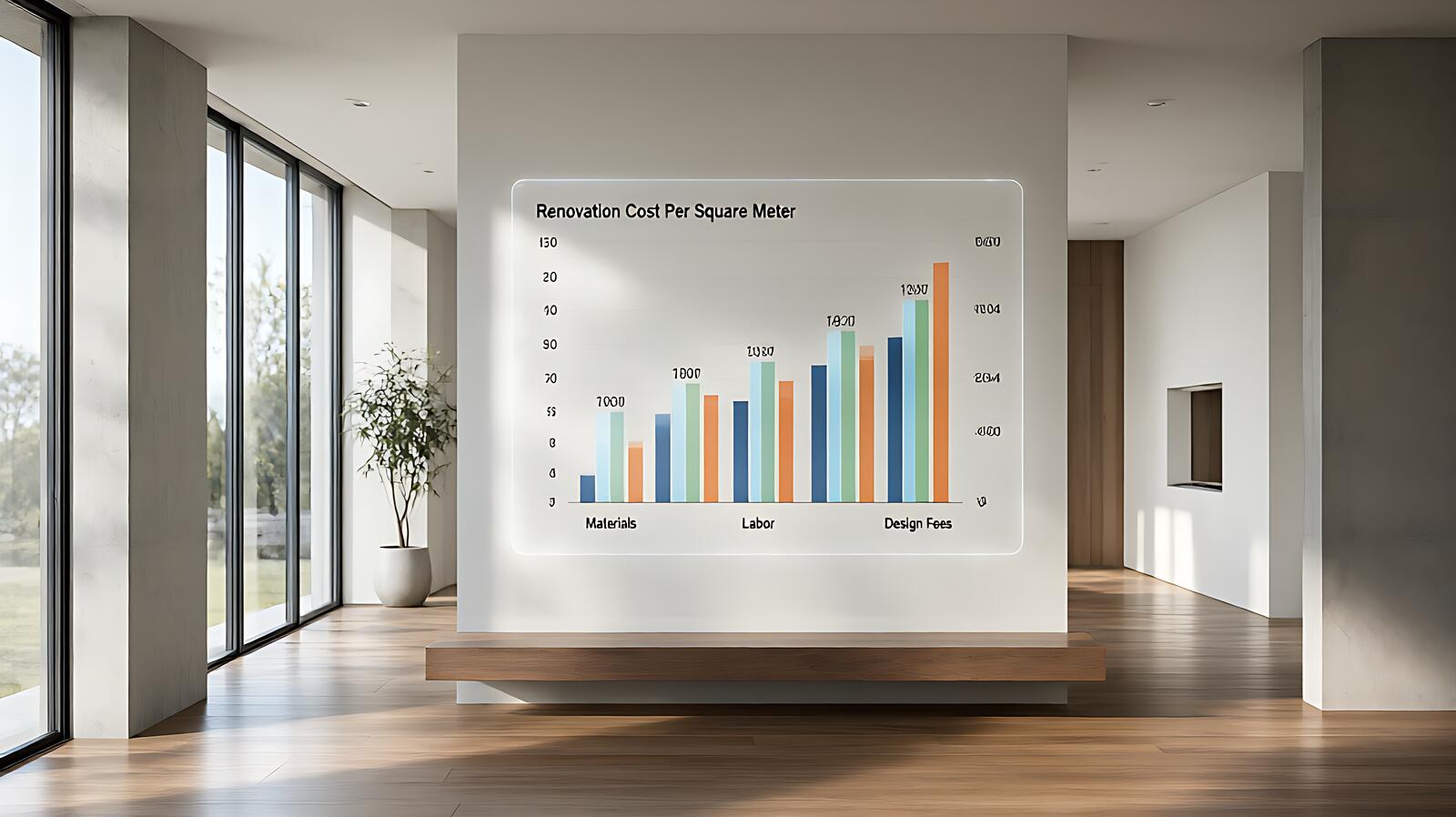
On a typical mid-range renovation, the per-square-foot number breaks down roughly like this. Labor accounts for 35 to 50 percent. Materials account for 30 to 45 percent. Permits, design, and overhead account for the remaining 10 to 20 percent. These ratios shift depending on the trade. A tile-heavy bathroom has a higher material share. A labor-intensive demolition has a higher labor share.
Here is a simplified example for a kitchen renovation at 200 square feet and $150 per square foot, totaling $30,000:
Cabinets and installation: $10,000 (33 percent). Countertops: $4,500 (15 percent). Appliances: $5,000 (17 percent). Flooring: $2,000 (7 percent). Electrical and plumbing: $3,500 (12 percent). Permits and design: $2,000 (7 percent). Contingency (10 percent): $3,000 (10 percent).
Notice that the per-square-foot number ($150) tells you nothing about this distribution. Two kitchens at $150 per square foot can have completely different cost profiles. One might spend heavily on cabinets and save on appliances. The other might do the opposite. The per-unit number is the same. The kitchens are not.
This is why line-item bids matter more than per-square-foot quotes. A line-item bid shows you where every dollar goes. A per-square-foot quote shows you one number and asks you to trust it.
What Drives the Per-Unit Price

Four factors push per-unit cost up or down, and none of them are visible in the number itself.
Material grade. The difference between builder-grade and premium materials is not subtle. Builder-grade laminate flooring runs $1 to $2 per square foot. Premium engineered hardwood runs $6 to $12. The installation labor is nearly the same. The per-square-foot number for the whole room swings by 30 to 40 percent based on this single choice.
Labor market. A general contractor in the San Francisco Bay Area charges $80 to $120 per hour. The same contractor in a mid-sized Midwestern city charges $45 to $65. Material costs are roughly the same nationwide. Labor is what makes renovation cost 40 to 60 percent more in high-cost markets.
Scope complexity. Moving a wall, relocating a plumbing stack, or adding a window where none existed adds cost that does not scale with area. A 50-square-foot bathroom addition with new plumbing rough-in can cost more per square foot than a 200-square-foot bathroom renovation using existing plumbing.
Existing condition. A house with galvanized pipe, knob-and-tube wiring, or asbestos tile will cost more to renovate than a house with modern systems, even if the finished result looks identical. The per-square-foot number does not distinguish between a clean slate and a house full of surprises.
Comparing Per-Unit Costs Across Scopes
Comparing per-unit costs across different renovation types is one of the most common budgeting mistakes. Here is why it fails.
A whole-house renovation might run $100 to $200 per square foot. A kitchen-only renovation might run $150 to $250 per square foot. The kitchen costs more per square foot because it concentrates expensive elements (cabinets, appliances, plumbing, electrical) into a small area. The whole house spreads those costs across more area, including cheaper rooms like bedrooms and hallways.
A bathroom renovation can run $200 to $400 per square foot because bathrooms are small but plumbing-intensive. A basement finishing project might run $50 to $100 per square foot because the space is large and the work is mostly framing, drywall, and flooring.
The point is that per-square-foot numbers are only comparable when the scope, material grade, labor market, and existing condition are identical. In practice, they never are. Use per-unit numbers to build a rough budget, then refine with line-item bids.
If you are deciding whether to replace or repair a specific element during a renovation, the replace vs repair guide walks through the cost ratio and hidden-risk tests that make the decision clearer.
Building Your Own Per-Unit Budget
Instead of relying on a contractor’s per-square-foot quote, build your own budget from the bottom up. Start with the room or element, list every material and labor item, price each one, and divide by the area. This takes longer than using a rule of thumb, but it gives you a number you actually understand.
Step one: define the scope precisely. “Renovate the kitchen” is not a scope. “Remove existing cabinets, install 24 linear feet of semi-custom cabinets, install 30 square feet of quartz countertop, replace sink and faucet, install new dishwasher, tile backsplash to ceiling, refinish hardwood floors” is a scope.
Step two: price materials independently. Visit two or three suppliers. Get written quotes for the specific products you want, not ballpark ranges. Material prices fluctuate, and a quote from six months ago may be 10 to 15 percent low.
Step three: get labor quotes for the defined scope. Give each contractor the same scope document. Ask for a line-item breakdown. If a contractor will not provide one, move on. You need to see where the money goes.
Step four: add contingency. Ten to fifteen percent for modern homes with known conditions. Twenty percent for older homes or projects with significant unknowns.
Step five: calculate your own per-unit number. Divide the total by the finished area. Now you have a number that means something, because you know exactly what it includes and what it does not.
If you are new to renovation terminology, the home renovation terms glossary defines the words contractors use in bids and contracts. Understanding the vocabulary is the first step toward reading a quote critically instead of accepting it at face value.
The goal of per-unit budgeting is not precision. It is understanding. A homeowner who knows what $150 per square foot buys and what it does not buy is in a fundamentally different negotiating position than one who takes the number on faith. The number is a tool. Use it as one. For a broader view of how renovation budgets work, see the renovation budget guide.