Soundproof insulation fights noise, not heat. Thermal insulation slows heat transfer measured in R-value. Soundproof insulation slows sound transmission measured in STC (Sound Transmission Class) and reduces echo measured in NRC (Noise Reduction Coefficient). Pick fiberglass batts, mineral wool, dense-packed cellulose, or spray foam for a wall — each handles sound differently, some absorbing echoes, others adding mass and damping vibration.
What Soundproof Insulation Is and Which Four Types Reduce Noise
Soundproof insulation is any insulation installed in a wall cavity, floor joist bay, or ceiling assembly to reduce sound transmission between rooms or from outside in. It handles two jobs, and a single material does not always do both.
The first job is sound absorption inside a room — reducing echo. That is measured by NRC, a number from 0 to 1 that tells you how much sound a material soaks up on first hit. The second is sound transmission loss through a partition — stopping the neighbor’s stereo. That is measured by STC, tested in a lab under ASTM E90.
A batt that absorbs echo well does not automatically stop transmission. Foam on a wall soaks up mid and high frequencies but adds almost no mass, so it does little to block sound traveling through the assembly. Transmission loss needs mass, air tightness, and damping — not surface absorption.
The four types and their rough installed prices: fiberglass batts and blown insulation at $0.70 to $1.40 per sq ft, mineral wool batts at $1.40 to $2.40, cellulose at $1.20 to $2.00, and foam at $1.50 to $2.80 open-cell or $1.80 to $3.20 closed-cell.
Fiberglass Batts and Blown Insulation
Fiberglass is light and good at absorbing mid-to-high frequencies, which is why exposed fiberglass panels show up in studios and acoustic ceiling clouds. But its low density — about 0.9 to 1.1 lbs per cubic foot — means it adds almost no mass to the wall. It helps STC a little by damping the drywall response, but it is weak against low-frequency structure-borne sound.
Mineral Wool Batts
Mineral wool, also called stone wool, runs 6 to 8 lbs per cubic foot — roughly double comparable fiberglass. That higher density gives better vibration damping and higher STC per inch, and the material is non-combustible, holding its shape around wires and boxes better than fiberglass. It is the upgrade pick when transmission loss and fire performance both matter in a partition wall.
Dense-Packed Cellulose
Cellulose at about 3.5 lbs per cubic foot dense-packed fills cavities without the gaps that cut batts leave at the perimeter. In a wall that gap is where air-borne sound leaks through, so the gap-free fill improves both thermal and acoustic performance over a poorly fitted batt. It is also the best retrofit choice when walls are already closed up.
Spray Foam
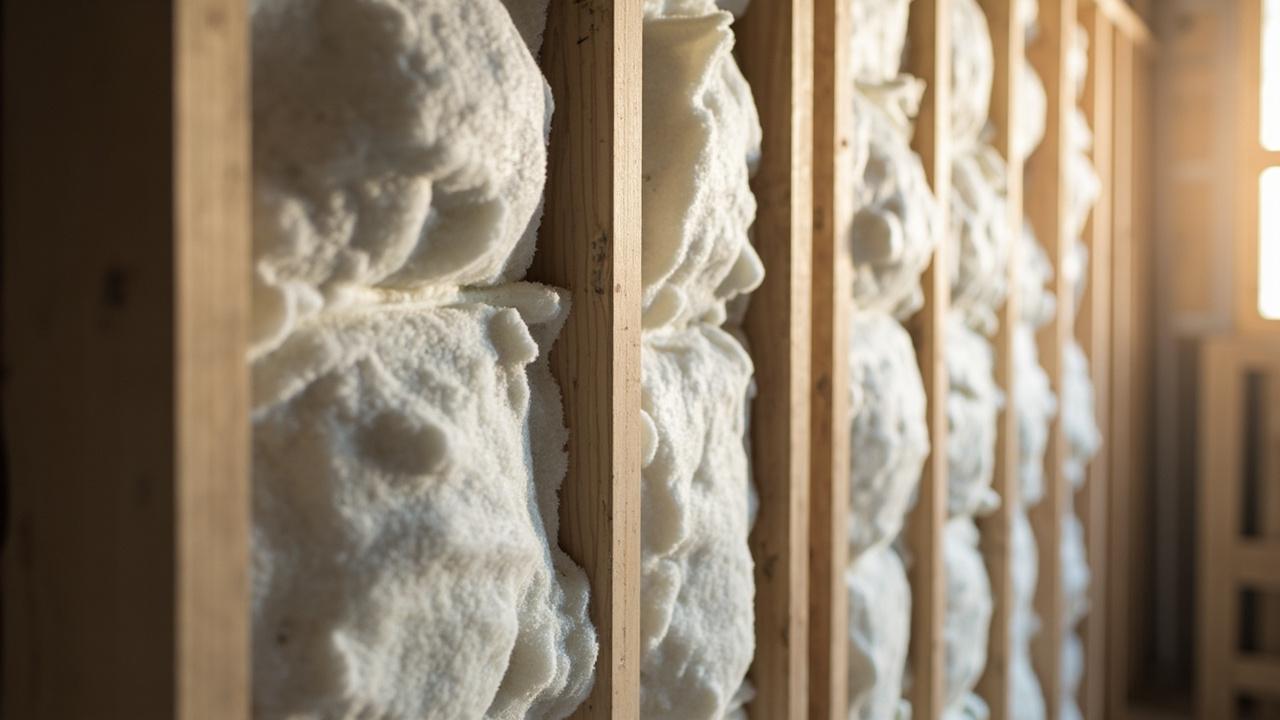
Foam differs from the fiber materials by what it does not do well. Open-cell foam at 0.4 to 0.5 lbs per cubic foot adds almost no mass, so its STC contribution comes from sealing the cavity air-tight, not from damping or mass. Closed-cell foam at 1.5 to 2.0 lbs per cubic foot adds more mass and seals completely, so it contributes to sound reduction with drywall on both faces — but at a higher cost and a shallower cavity friendliness that the fiber products do not match.
How Soundproof Insulation Works: Density, Cavities, and the STC Rating
Sound moves through walls in three ways, and insulation addresses only one of them.
Airborne sound — voices, TV, traffic — vibrates the wall surface, which re-radiates sound on the other side. Heavier, tighter assemblies vibrate less, and cavity fill helps by damping the drywall response and absorbing sound energy that reaches the cavity. Impact sound — footsteps, dropped items — travels through the structure, not the cavity, and wall insulation does almost nothing to stop it. Flanking sound bypasses the insulation entirely, sneaking through chases, ducts, and shared framing.
The STC Rating: What the Number Means
STC rating is the number on product data, tested per ASTM E90. The number is useful for comparing materials under the same lab conditions, but it tells you nothing about low-frequency bass performance, and it does not measure flanking paths at all.
A basic 2×4 wall with drywall on both sides and no insulation runs about STC 33 to 35, which lets normal conversation through clearly. Add fiberglass and it rises to STC 37 to 39. Mineral wool in the same cavity pushes it to STC 39 to 42, because the higher density and fiber structure damp vibration more effectively. Closed-cell spray foam at 2 inches in a 2×4 cavity with drywall reaches about STC 40 to 43 as an air-sealed assembly.
Each material does a different job. Fiberglass and mineral wool absorb sound inside the cavity. Foam mainly seals air leaks and adds assembly mass.
Comparing Soundproof Insulation Types: When Each One Makes Sense
This table lines up the five common material choices against the same criteria — density, NRC, STC with drywall, installed cost, and the sound role each does best — so you can compare them without flipping between product pages.
| Material | Density (lbs/cu ft) | NRC | STC (drywall) | Installed $/sq ft | Best sound role |
|---|---|---|---|---|---|
| Fiberglass batt | 0.9-1.1 | 0.85-0.95 | STC 37-39 | $0.70-1.40 | Cavity absorption, mid-high echo control |
| Mineral wool batt | 6-8 | 0.80-0.90 | STC 39-42 | $1.40-2.40 | Mass damping, fire, low-mid transmission loss |
| Dense-packed cellulose | 3.5 | 0.70-0.80 | STC 38-40 | $1.20-2.00 | Gap-free fill, air-leak reduction |
| Open-cell spray foam | 0.4-0.5 | 0.10-0.20 | STC 38-40 (sealed) | $1.50-2.80 | Air sealing, no standalone mass |
| Closed-cell spray foam | 1.5-2.0 | 0.10-0.20 | STC 40-43 (sealed) | $1.80-3.20 | Mass + seal, shallow cavities |
Fiberglass batts suit a tight budget when the goal is basic cavity absorption and the wall gets drywall anyway — they cost less than any other option and reduce mid and high-frequency echo.
Mineral wool costs more but earns its premium in partition walls where transmission loss and fire performance matter. Stone wool is non-combustible, withstands temperatures above 2,000°F, and holds shape better than fiberglass around wires and boxes.
Cellulose is the best retrofit option when walls are already closed. The dense pack eliminates perimeter gaps that cut batts leave open, improving both thermal and acoustic performance.
Open-cell spray foam suits situations where sealing the cavity matters more than adding mass. It fills irregular cavities completely but contributes little to transmission loss alone, working best combined with drywall mass on both faces.
Closed-cell foam is the premium choice when the cavity is shallow, moisture control matters as much as sound, and the budget allows higher cost. It adds mass at higher density, seals completely, and acts as a Class I or II vapor retarder at sufficient thickness, which matters in mixed climates. For a wider context on how these options compare thermally, the R-value guide by material explains the thermal side, and the mineral wool versus fiberglass comparison lays out the trade-offs between two common cavity-fill options head to head.
Installing Soundproof Insulation: Steps, Common Mistakes, and Safety
Installation follows the same rules as any cavity fill, with one difference: gaps and air leaks hurt sound performance more than thermal performance.
Sound transmission loss depends on the assembly holding together as an air barrier. A cavity full of mineral wool with a 1-inch air gap at the top plate leaks sound almost as well as an empty cavity. The first step, then, is sealing the perimeter — fire-rated caulk at the bottom plate, top plate, and every electrical box or pipe chase that breaks the air barrier. That step costs $0.30 to $0.70 per linear foot and is where the biggest STC gains come from in retrofit assemblies.
Seal the Perimeter First
Walk the wall with a bright light and mark every gap. Use fire-rated caulk for gaps under a quarter inch, expanding foam for larger gaps, and a rigid foam backing rod for deep chases. The goal is a continuous seal so the insulation, once placed, is doing the work of damping and absorption — not compensating for leaks.
Fit the Insulation to the Cavity
Fit the insulation to fill the cavity fully. Mineral wool batts hold their shape and stay in place. Fiberglass batts need splitting around wires and butting tight at edges to avoid convection channels. Dense-packed cellulose needs a professional machine and about 3.5 lbs per cubic foot density to fill a 2×4 cavity fully — the installer drills 2-inch holes, blows to target density, and plugs them. Blown fiberglass in a closed cavity is less common for sound because the low density does not fill as tightly.
Spray foam requires a trained installer, ventilation during cure, and a thermal barrier like drywall over the foam per IRC Section R316, since exposed foam indoors is a fire concern.
Avoid the Mistakes That Look Fine on the Surface
The mistakes are ordinary. Leaving the top plate unsealed lets sound flank over the wall. Compressing a batt around an electrical box leaves a cavity void that transmits sound directly through the partition. Skipping sealant at outlet boxes leaves the thin gap that carries more sound than the whole insulated cavity.
Safety
Any work in existing walls, attics, or floor cavities that may contain historic material requires checking for vermiculite that could contain asbestos before disturbing it — testing before handling is the only responsible path. Choose mineral wool vs fiberglass based on your fire and density needs; both produce irritating dust, so wear a N95 respirator, cover arms and eyes, and ventilate during install.
Spray foam is the most demanding. Installers need chemical-resistant gloves, eye protection, the proper respirator for isocyanate exposure during cure, and active ventilation, because uncured foam vapors are a real respiratory irritant. Electrical boxes and recessed lights need clearance from insulation — IC-rated fixtures can be covered, non-IC fixtures must stay clear per NEC — and any knob-and-tube wiring must be evaluated by a licensed professional before insulating around it.
When Soundproof Insulation Is Not Enough
Insulation inside a single stud wall cavity cannot reach STC 50 on its own, because STC above about 45 requires mass beyond what a standard framed partition provides.
A typical ceiling is a low STC path through a single layer of drywall plus joist cavity fill, and walls shared with a bathroom carry plumbing and duct penetrations that bypass any cavity fill. Impact noise through floors is a structure-borne problem — wall insulation does nothing for footsteps from upstairs; the fix lives in the floor assembly.
Vent shafts, ductwork, plumbing chases, and shared cavities in multi-unit buildings all offer flanking paths that insulation ignores. STC rating also does not measure low-frequency performance well. A wall at STC 42 in the lab at ASTM E90 still transmits bass frequencies — subwoofer vibration, traffic rumble, HVAC low hum — through the structure. If low-frequency noise is the problem, mass alone does less than decoupling.
Decoupling means breaking the rigid connection between the two faces of the partition. Resilient channels, staggered studs, double-stud walls, or a floating partition with no rigid connection between the two sides drop vibration transmission far more than any insulation inside one cavity. Adding a second layer of drywall with a damping compound between the layers raises mass and damping and pushes STC up several points, at a cost that runs $2 to $4 per sq ft for the drywall plus sealant.
The honest decision sequence is simple: identify the sound source and path. For airborne transmission through a wall or ceiling, seal the perimeter first, add insulation in every cavity with full perimeter contact, and add drywall mass on the source side or both sides if you need above STC 45.
For interior echo, add absorption — exposed panels, carpet, heavy curtains, soft furniture — and forget cavity fill, because echo lives on surface reflections. For impact noise, address the floor assembly. For flanking noise, seal those paths individually.
When the source, path, or assembly is unclear, or the project involves historic material, suspect wiring, or multi-unit construction, consult a licensed professional and test before disturbing anything. If you are unsure which cavity-fill material fits your situation, the blown-in versus batt insulation comparison lays out the trade-offs across the most common installation methods.