
Should you blow insulation into the attic or roll out batts between the joists? For most attics, blown-in wins on coverage and speed, while batts win when framing is open, clean, and easy to fit by hand. Your attic shape, wiring, and budget decide the rest. Start with the envelope basics in our home insulation types and costs overview, then match the material to the cavity you have. Blown-in insulation is a loose-fill material that a blower machine spreads across attic floors or into closed cavities to form a continuous thermal layer.
What Blown-In and Batt Insulation Are and Which One Wins Your Attic
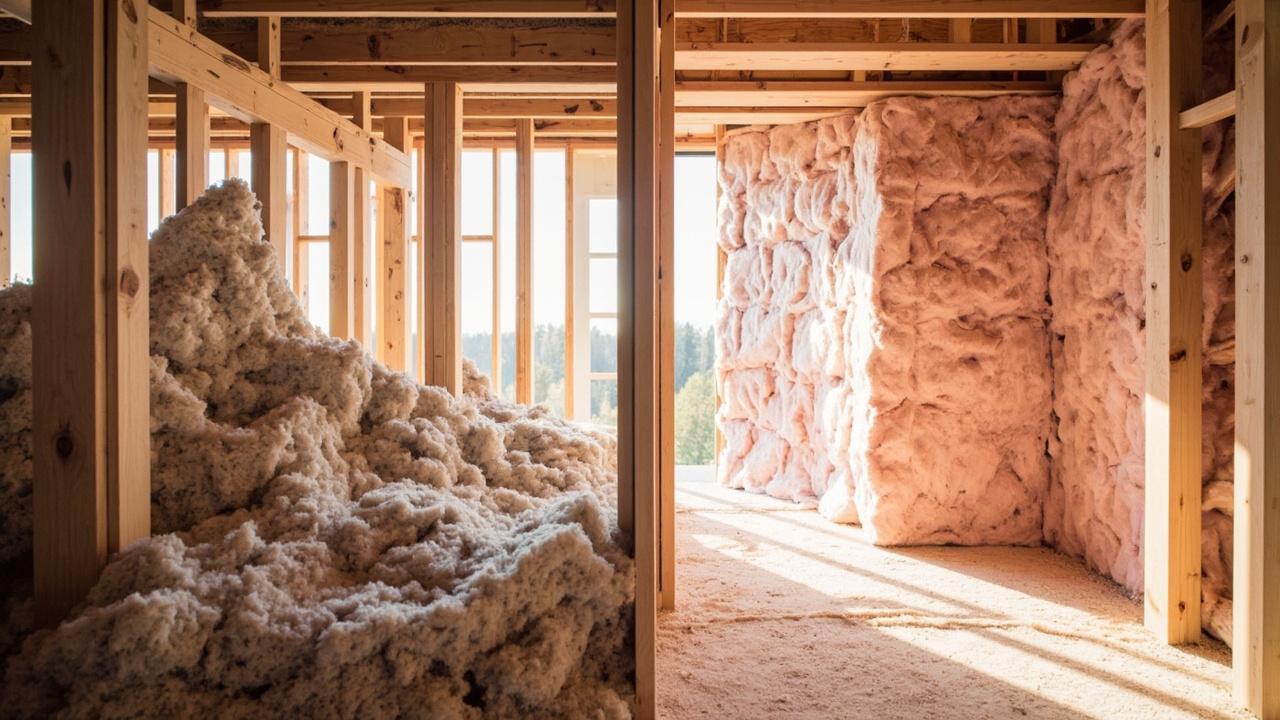
Blown-in insulation coverage in attics reaches R-38 at about 10 inches of cellulose when the attic plane is air sealed before blowing. That sentence holds the whole decision. Blown-in means loose blown-in cellulose or loose fiberglass installed with a hose and machine, and it drapes over joists, pipes, and electrical boxes in one continuous blanket. Batt means pre-cut fiberglass batts sized for standard 16 inch or 24 inch framing, and it performs only when every piece is split around wires and left uncompressed.
Here is the short answer for a typical vented attic. Choose blown-in when the floor is uneven, crowded with penetrations, or getting a top-up over old insulation. The machine fills around obstacles in an hour or two, and the crew checks depth with depth rulers to hit the target. Choose batts when the floor is clean and open or someone in the house is sensitive to the dust that loose fill stirs up.
Walls flip the logic. In open stud bays, batts are fast, cheap, and easy to inspect before drywall closes. In closed walls, blown-in through small holes avoids demolition. Neither fixes a leaky assembly alone, which is why crews seal first and insulate second.
How Each Material Performs: R-Value, Depth, and Air Movement
Batt insulation R-value in standard walls delivers R-13 to R-21 per cavity when batts fit the full bay depth without compression in dry, sealed framing. Blown-in cellulose performs at R-3.2 to R-3.8 per inch settled, while batts perform at R-3.1 to R-3.4 per inch at labeled thickness, so the per inch race is nearly tied. Loose fill buries the small gaps that steal performance, while hurried batts leave them behind.
Depth makes this concrete. Most attics under current energy codes need R-38 to R-60 depending on IECC climate zone, with zones 1 to 3 near R-38, zones 4 to 5 near R-49, and zones 6 to 8 near R-60. In cellulose that means roughly 10 to 14 inches settled depth, and in blown fiberglass roughly 12 to 17 inches because it settles lighter per inch. Batts stack to similar totals, two layers crossed perpendicular, but every wire, box, and brace becomes a cutting exercise. One lazy cut around a junction box can open a half inch channel that leaks heat all winter. For the zone math behind these targets, see our insulation R-value targets by zone guide before you buy material.
Air movement is the quiet divider. Neither product is an air barrier. Air sealing with caulk and foam at top plates, plumbing chases, bath fan housings, and the rim joist comes first, then insulation goes on top. Cellulose has a mild edge because dense fibers slow convective loops inside the layer better than a fluffy batt does. A blower-door test after sealing, before insulating, tells you whether the plane is tight enough for either material to earn its label.
Moisture tolerance differs in ways that matter for old houses. Cellulose is treated with borate for fire and pest resistance, and it can buffer small seasonal humidity swings, then release moisture as conditions dry. It must still stay dry, since a roof leak turns loose fill into a soggy mat that needs removal. Fiberglass ignores water chemically, which sounds reassuring, until water runs straight through it and wets the drywall below while the batt looks fine. Both demand a dry assembly and a sensible vapor retarder strategy for the climate zone.
Cost, Coverage, and the Side by Side Comparison
Blown-in attic pricing in most US markets runs $1.20 to $1.80 per sq ft installed when access is normal and the target is R-38 to R-49. That figure usually includes machine time, material, rulers and depth markers, and baffles at the eaves, with air sealing often billed separately at $0.50 to $1.50 per sq ft. Batt pricing for attics runs about $0.70 to $1.40 per sq ft installed for a single layer, but reaching R-49 with double layers plus careful cutting around every obstacle pushes labor up fast. Material alone favors batts. Installed reality often favors blown-in for attics because the hose is quicker than scissors.
Walls tell a different cost story. Batts in open walls during new construction or a gut remodel run $0.70 to $1.20 per sq ft installed, the cheapest path to code when labor is careful. Dense-packed cellulose in closed walls runs $1.50 to $2.80 per sq ft because each bay gets drilled, filled to about 3.5 pounds per cubic foot, plugged, and patched. You pay to avoid tearing down drywall. If the walls are already open, save the dense-pack premium and spend it on exterior continuous insulation or better windows instead.
| Criterion | Blown-in (cellulose or fiberglass) | Batt (fiberglass) |
|---|---|---|
| Installed attic cost per sq ft | $1.20 to $1.80 to R-38 or R-49 | $0.70 to $1.40 per layer, more for double layer |
| R-value per inch | R-3.2 to R-3.8 cellulose, R-2.5 to R-2.9 blown fiberglass | R-3.1 to R-3.4, labeled per thickness |
| Depth for R-38 attic | About 10 inches cellulose, 13 inches blown fiberglass | About 12 inches in two crossed layers |
| Best location | Vented attics, top-ups, closed wall cavities | Open stud bays, clean attic floors, floors |
| Fit around obstacles | Excellent, hose fills around wires and boxes | Fair, every obstacle needs cutting and splitting |
| Air sealing included | No, seal the plane first in both cases | No, seal the plane first in both cases |
Read the table as conditional guidance, not a trophy ceremony. The blown-in column wins attics with cluttered floors and retrofit walls because continuity beats labeled R-value. The batt column wins open framing where a careful installer can see every bay and the inspector can verify fit before drywall.
Installation Reality and the Mistakes That Erase R-Value
Batt installation quality in real attics drops below label within the first winter when batts are compressed, gapped, or exposed to attic wind. Three failure modes cause most of the damage. Learn them before anyone opens a bag. Wind wash happens at the eaves where soffit vents blow cold air through the edge of the insulation. The fix is attic baffles in every rafter bay, holding a vent channel open while insulation starts back from the plate.
Compression voids are the batt killer. A batt rated R-21 for a 5.5 inch cavity delivers closer to R-15 when squeezed into 3.5 inches, and stuffing a full batt behind wires leaves a hollow channel beside it. Split the batt, half behind the wire and half in front, so the cavity stays filled without crushing. Blown-in avoids this almost entirely, though installers still need rulers every few feet, because a hose drifts thick in the middle and thin at the edges without markers.
Buried electrical is the safety line. Never cover non-IC-rated recessed housings, bare splices, or open junction boxes with any insulation. Only IC-rated recessed lights may contact insulation directly, and even those need their rated clearance, intact thermal protectors, and covers listed for the purpose. Keep insulation at least 3 inches from masonry chimneys and unlisted flues with proper metal flashing and fire blocking, not packed fiber. If wiring looks brittle, spliced with tape, or buried under old vermiculite that might contain asbestos, stop and consult a licensed professional before adding a single inch.
Ventilation sequencing trips up plenty of good jobs. In a vented attic, insulate the floor and keep the roof deck vented from soffit to ridge. In a conditioned attic, where HVAC or finished storage sits under the roof, insulation belongs at the roofline as spray foam or rigid board instead. Mixing the two strategies creates a double vapor trap that rots sheathing quietly. Pick one strategy per attic and commit.
Renting a blower for a weekend is realistic for a simple attic, with one person feeding the hopper and one running the hose, plus dust masks and walk boards so nobody steps through drywall. Batts suit solo DIY better, since the tools are a sharp knife and a straightedge. Either way, an infrared walkthrough after the work finds the thin spots eyes miss, and a half hour of touch-up beats an extra inch everywhere else.
Limits, Safety Notes, and How to Choose for Your House
Blown-in cellulose moisture tolerance in damp houses drops toward zero after weeks of wetting when roof leaks, bath fans venting into the attic, or missing vapor control keep fiber damp. Wet cellulose clumps, loses R-value, and feeds mold on the adjacent wood, so any active leak or fan misvent must be fixed and dried before blowing. Batts have their own honest limit: thermal bridging through every stud and joist means a framed R-13 wall performs closer to R-10 whole-wall, and no batt fixes that without continuous exterior foam. Knowing these ceilings keeps expectations honest.
Fire and pest claims deserve plain language. Borate-treated cellulose resists ignition and insects, but treatment is not waterproofing. Fiberglass does not burn readily, yet its paper facing can, and facing on the wrong side traps moisture in mixed climates. Where fire, sound, or shallow depth dominates, our breakdown of fiberglass and spray foam trade-offs helps. Choose the material whose weakness you can actually manage.
Use this decision ladder. Choose blown-in when the attic floor is cluttered, you are topping up over dry existing insulation, or walls are closed. Choose batts when framing is open and the crew will take time with fitting. Choose neither until air sealing, baffles, bath fan ducting to the exterior, and IC-rating checks are done.
Budget the job in the right order: air sealing first at $0.50 to $1.50 per sq ft, baffles and fan ducting next, then insulation to the IECC zone target of R-38 to R-60, and finally an infrared check. A dry 1,000 sq ft attic in zone 4 moving to R-49 typically lands between $1,500 and $2,500 all in. Get two quotes that itemize sealing separately from insulation. And wherever structure, wiring, or moisture looks questionable, consult a licensed professional before the blower truck arrives.