
You want one number before you call a contractor, and the honest answer is a range, not a sticker price. A 1,000 sq ft attic can cost $1,200 or $6,000 depending on material, depth, access, and how much sealing happens first. The material name is only half the story. Attic insulation types cost per square foot is a comparison metric that shows installed price per material at the depth your climate zone requires.
What Attic Insulation Cost Per Square Foot Covers and What You Should Budget
Attic insulation cost per square foot ranges from $1.00 to $7.00 installed when you compare batts, blown-in, mineral wool, and spray foam in a standard vented attic. That range covers labor, material at target depth, and basic prep, but excludes extras like rewiring, mold remediation, or a new access hatch. Most homeowners in climate zones 4 and 5 land between $1,300 and $2,800 for a 1,000 sq ft attic top-up to R-38 or R-49.
The price follows depth, and depth follows the insulation R-value guide for your climate zone. Current IECC and IRC guidance calls for R-38 in warmer zones 1 through 3, R-49 in zones 4 and 5, and R-60 in cold zones 6 through 8. Blown cellulose needs roughly 10 to 12 inches for R-38, 13 to 15 inches for R-49, and 16 to 18 inches for R-60. Batts need similar thickness but lose performance fast when compressed or gapped around boxes and wires.
Three things move any quote more than the brand on the bag. First, access: a tall attic with a full-size hatch installs fast, while a low-slope attic with tight clearance at the eaves doubles labor time. Second, prep: air sealing around stacks, wires, chases, and top plates adds $0.50 to $1.50 per sq ft and is the highest-return line item on the invoice. Third, existing conditions: wet batts must come out, bath fans venting into the attic must be ducted outside, and recessed lights need IC-rated covers before fresh material goes in.
If you are new to how these materials slow heat flow, the what is home insulation overview explains the assembly behind the numbers: insulation resists conduction, sealing stops convection, and ventilation handles moisture. Keep that trio in mind and every cost below makes more sense.
How Each Attic Insulation Type Performs at Real Installed Depth and Cost
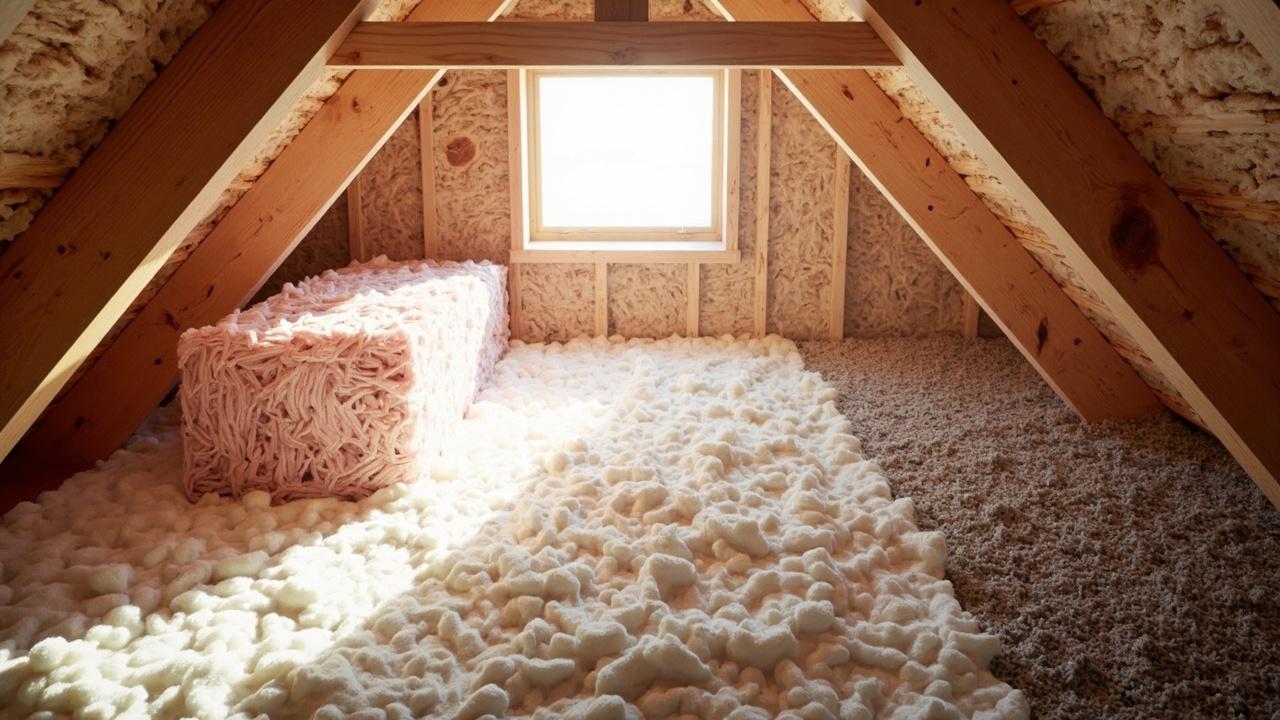
Fiberglass batt cost averages $1.00 to $2.50 per sq ft installed when crews lay unfaced R-30 to R-38 batts across an accessible attic floor with separate air sealing. The material runs about $0.40 to $0.80 per sq ft, with R-value per inch near R-3.1 to R-3.4. What you pay for is careful fitting: fiberglass batts must be split around wires, butted tight at the joists, with a second layer laid perpendicular to cover the framing.
Batts suit an open, rectangular attic floor where a crew can move freely and the sealing below is already done. They struggle in attics full of bracing and ducts, because every gap becomes a convection channel. Choose batts if your bays are clear and your contractor commits to sealing first. Skip them if the attic is an obstacle course, since blown material covers irregular shapes better for similar money.
Blown-in cellulose cost runs $1.20 to $2.80 per sq ft installed for R-38 to R-60 depth when blown over a sealed plane in a vented home. Blown-in cellulose is recycled paper fiber treated with borate for fire and pest resistance, at R-3.2 to R-3.8 per inch. It drapes over plates and pipes without seams and resists wind wash better than loose fiberglass. It settles slightly, so good crews blow about 10 percent extra and leave depth rulers on the joists for verification.
Blown-in fiberglass costs $1.50 to $3.00 per sq ft installed at R-38 to R-60 depth when blown in a vented attic with baffles at the eaves. It offers R-2.5 to R-3.0 per inch, needs a bit more depth than cellulose for the same R, and settles less. Many crews prefer it for top-ups over existing dry fiberglass. Pair either blown option with soffit baffles at every rafter bay so intake air glides over the insulation instead of blowing through it.
Attic Insulation Cost Comparison by Type, R-Value, and Best-Fit Condition
Mineral wool cost reaches $2.00 to $3.50 per sq ft installed when fitted as dense batts across an attic floor or framed knee walls in a home that values fire and sound performance. The stone-fiber batts deliver R-3.3 to R-4.2 per inch, hold shape without slumping, and resist temperatures above 2,000°F. You pay more for material and slower fitting, so mineral wool wins near living space or storage platforms and loses on pure price in a simple empty attic.
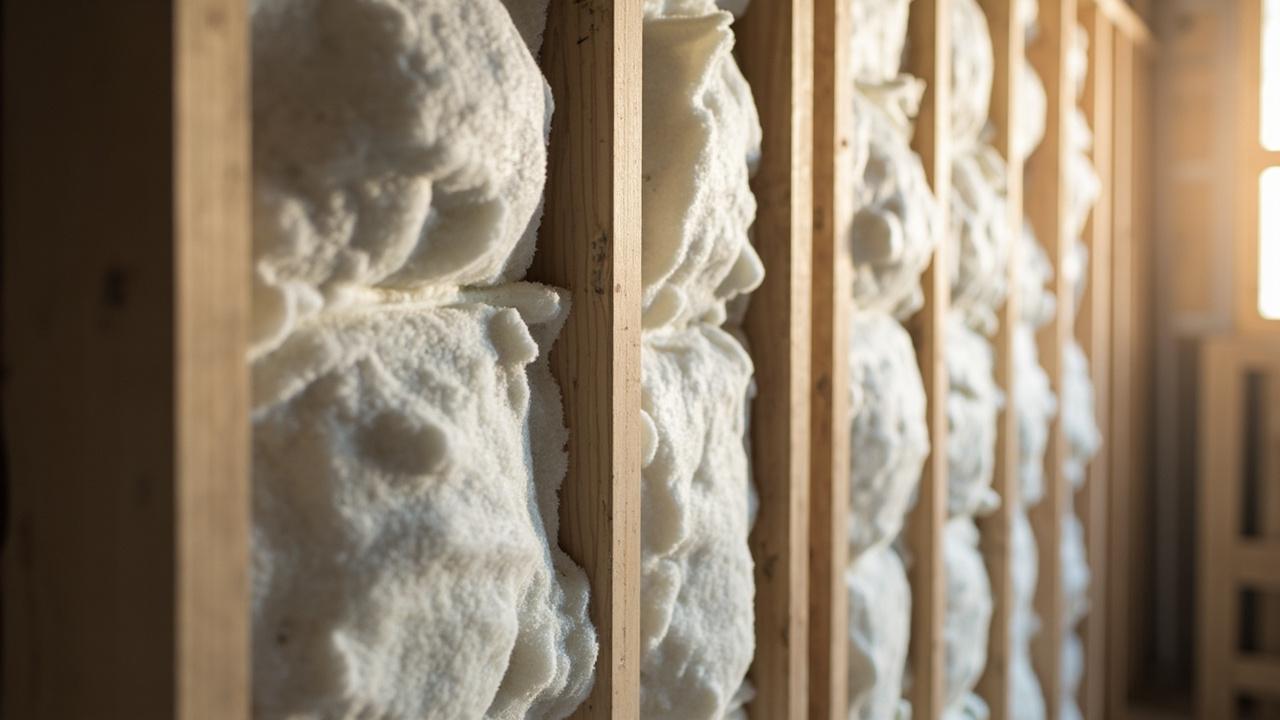
Spray foam seals air and insulates in one pass. Open-cell spray foam costs $2.50 to $4.50 per sq ft installed at typical attic applications when applied at the roofline in a conditioned attic. It is soft and vapor permeable at R-3.5 to R-3.7 per inch, so a 5 to 7 inch pass at the rafters stops stack-effect leakage through the ceiling plane. Closed-cell spray foam costs $4.00 to $7.00 per sq ft installed when sprayed 2 to 4 inches deep where space is shallow and vapor control matters. At R-6.0 to R-6.5 per inch it delivers R-13 in two inches and acts as a Class II vapor retarder at that thickness, but it needs trained installers and a thermal barrier like drywall per code.
Rigid foam board costs $1.50 to $3.00 per sq ft in material per inch of thickness when used as polyiso, XPS, or EPS on knee walls, hatch covers, or above the roof deck during reroofing. It is rarely a standalone attic floor insulation because boards leave seams unless taped layer by layer, at R-4.0 to R-6.5 per inch. Its real job is breaking thermal bridging: a layer over joists or around the hatch lifts whole-assembly R-value in a way thicker cavity fill alone cannot. If you are weighing foam against batts, the fiberglass versus spray foam comparison covers air sealing, moisture behavior, and payback side by side.
| Type | Installed $/sq ft | R per inch | Depth for R-38 to R-49 | Best fit |
|---|---|---|---|---|
| Fiberglass batt | $1.00-2.50 | 3.1-3.4 | 11-15 in, two layers | Open, simple attic floor on a budget |
| Blown-in cellulose | $1.20-2.80 | 3.2-3.8 | 10-15 in blown | Vented attic top-up, irregular bays |
| Blown-in fiberglass | $1.50-3.00 | 2.5-3.0 | 13-18 in blown | Top-up over dry fiberglass, low settling |
| Mineral wool batts | $2.00-3.50 | 3.3-4.2 | 10-14 in fitted | Fire, sound, stiffness near living space |
| Open-cell spray foam | $2.50-4.50 | 3.5-3.7 | 5-7 in at roofline | Conditioned attic, air seal plus insulate |
| Closed-cell spray foam | $4.00-7.00 | 6.0-6.5 | 2-4 in at roofline | Shallow depth, vapor control, rim areas |
| Rigid foam board (material) | $1.50-3.00 | 4.0-6.5 | 2-4 in layered | Hatch, knee walls, above deck |
Read the table as a decision tool, not a shopping list. Pick the row that matches your attic shape, then confirm depth against your IECC climate zones target. A vented attic storing nothing wants blown cellulose or fiberglass to R-49 for the lowest cost per real R. A conditioned attic with ducts inside wants foam at the roofline so equipment sits inside the thermal boundary.
What Installation, Air Sealing, and Ventilation Change About Attic Insulation Cost
Attic insulation performance depends on sealing and ventilation as much as material when the crew arrives at a leaky older home. Sealing comes first: fire-rated caulk and foam around penetrations, dropped soffits, and chimney chases often save more energy than an extra R-11 over a leaky plane. Budget $0.50 to $1.50 per sq ft for that pass, confirm fans duct through the roof, and give the hatch weatherstripping plus a rigid foam cap worth at least R-19.
Ventilation decides where insulation goes. A vented attic keeps soffit-to-ridge airflow, insulates the floor, and leaves the roof deck cold so shingles last. A conditioned attic moves insulation to the rafters with foam and treats the attic as indoor space. Mixing the two, like foaming rafters plus piling batts on the floor, traps moisture and wastes money. Your contractor should state which strategy your attic follows before quoting.
The mistakes that erase R-value are ordinary. Wind wash at the eaves scours insulation when baffles are missing. Compressed batts around boxes perform closer to R-11 than the labeled R-30. Steam venting into the attic mats cellulose. Lights buried without IC-rated covers are a fire risk and a coverage void. Never blow insulation over live knob-and-tube wiring or damaged conductors; consult a licensed professional to evaluate and replace that wiring before insulating.
When Attic Insulation Hits Limits, Safety Flags, and the Right Next Step
Attic insulation limits show up in moisture, structure, and access when the attic has leaks, heavy storage loads, or clearance below workable minimums. Insulation cannot fix an active roof leak, and wet material must dry fully or come out, since trapped moisture cuts R-value and feeds mold on the sheathing. Improvised storage platforms that compress 16 inches of blown fill to 6 inches throw away half the R you just bought. Low-slope sections may need dense-packed or foam approaches instead of a perfect blown blanket.
Safety flags deserve a pause, not a workaround. Active knob-and-tube, scorched boxes, or breakers that trip when the air handler starts all mean the electrician goes first. Vermiculite that may contain asbestos should be tested before disturbance, and mold beyond a small patch calls for remediation first. Around chimneys, keep code-required clearance with flashing and fire-rated caulk, never packing fill tight against a hot flue. When panel work or suspect historic wiring is involved, consult a licensed professional rather than working around it on insulation day.
Here is a simple way to choose. If your attic is vented, dry, and accessible, seal the plane and blow cellulose or fiberglass to your zone target for the best return per dollar. If ducts or an air handler live up there, price open-cell foam at the roofline. If fire resistance or sound tops the list, pay the premium for mineral wool batts where it counts. If depth is shallow or vapor control is the puzzle, closed-cell foam earns its higher installed cost per square foot where nothing else fits, and a post-job infrared scan proves the assembly performs.