
Choose fiberglass batts if your walls are open, your crew can air seal separately, and your budget is tight. Choose spray foam — open-cell for air sealing in deep cavities, closed-cell for shallow cavities and vapor control — if the assembly must do two jobs in one pass and access is limited. The sales pitch that spray foam always pays for itself confuses R per inch with installed performance and air sealing. When this page and the insulation types guide are read together, the decision is about the cavity and the climate, not the brand. For the number behind either choice, the R-value guide sets the zone target, and the drywall guide explains why both go in before board.
Fiberglass vs Spray Foam at a Glance: What Changes the Decision
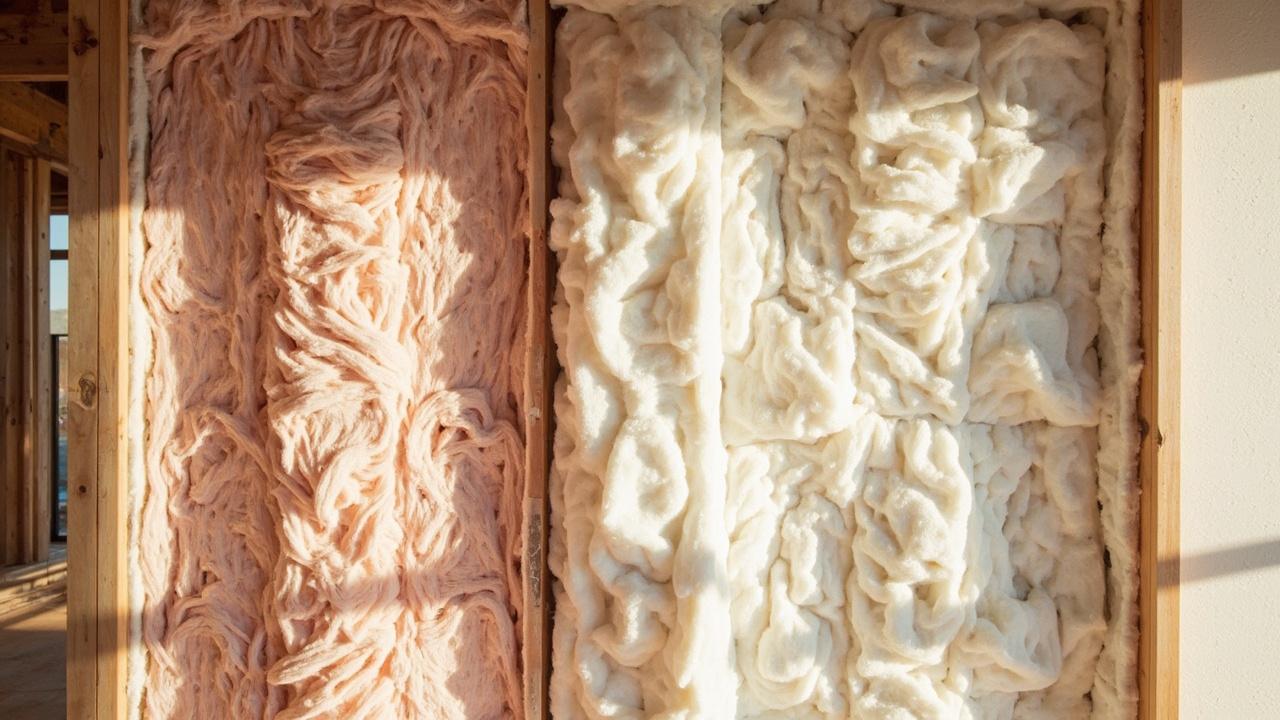
Fiberglass is glass fibers trapping still air. Spray foam is two liquid chemicals expanding into a foam that traps a blowing agent and adheres to framing. Both can hit the same code R when installed correctly; the difference is how they handle air, moisture, space, and labor.
| Attribute | Fiberglass batts / blown | Open-cell spray foam | Closed-cell spray foam |
|---|---|---|---|
| R per inch | 3.1 – 3.8 | 3.5 – 3.7 | 6.0 – 6.5 |
| Air barrier | No — needs separate sealing | Yes at 3.5″ | Yes at 1.5″ to 2″ |
| Vapor retarder | No (permeable) | No — needs smart retarder | Yes — Class II at 2″ |
| Installed cost per sq ft | $0.70 – $1.80 | $1.50 – $2.50 | $1.80 – $2.80 |
| Best cavity | Open, standard depth | Deep, irregular | Shallow, rim joist, basement |
| DIY possible | Yes with care | No — professional + ventilation | No — professional |
| Fire / sound | Noncombustible, modest sound | Needs thermal barrier, good sound | Needs thermal barrier, modest sound |
The quick filter: if the job is an attic floor that can be air sealed first, blown fiberglass or cellulose at $1.00 to $1.80 per sq ft is the value play and often beats spray foam on payback. If the job is a closed wall where the drywall stays, dense-packed cellulose and injection foam are different answers — pure fiberglass batts are not an option without opening the wall.
Cost and R-Value in Real Houses, Not on the Bag
On paper, closed-cell at R-6.5 per inch looks twice as good as fiberglass at R-3.3, but walls are not paper. A 2×4 stud bay is 3.5 inches deep. Fiberglass high-density R-15 fits that depth exactly. Closed-cell at 3.5 inches is about R-22 in the same bay — higher, but not double once the stud bridging is included. In a 2×6 wall (5.5 inches), fiberglass R-21 and open-cell R-20 are essentially tied on R, and the price difference — $1.10 vs $1.90 per sq ft — buys you air sealing, not more R. Closed-cell at 5.5 inches is about R-35, well above code, yet in zones 4-6 the code path is R-20 cavity plus R-5 continuous foam — you don’t need R-35 in the cavity to meet whole-wall performance, and R-35 without exterior foam still leaves the stud thermal bridge.
Whole-attic pricing tells the same story. A 1,000 sq ft vented attic to R-49 blown cellulose is about $1,300 to $1,700. The same attic foamed at the roofline with open-cell (for a conditioned attic) is about $4,500 to $7,000 because every rafter bay, not just the floor, is foamed and ventilation is rebuilt outward. The roofline foam is correct when HVAC and ducts live in the attic — ducts in a vented attic at 130°F in summer lose more than walls ever will — but it is overkill when the attic will stay vented and empty.
Air Sealing and Moisture: Where Spray Foam Justifies Its Premium
Fiberglass does not stop air. Gaps around wires, boxes, and plates blow right through it, and the DOE estimates a typical house leaks 25 to 40% of its heating and cooling energy through air leaks. Sealing those leaks with caulk, foam, and gaskets at $0.50 to $1.50 per sq ft is a separate step when fiberglass is used. Spray foam seals as it insulates — at 3.5 inches open-cell and 1.5 to 2 inches closed-cell it is tested as an air barrier per ASTM E2178 — so the labor merges. That merger is where spray foam’s cost premium often pays back in one winter in older houses with many penetrations, and where it changes comfort immediately by cutting drafts and dust paths.
Moisture decides the retarder. Open-cell foam is vapor-permeable (about 8 to 10 perms at 3.5 inches) and needs a smart vapor retarder — a membrane or paint that is seasonal — or, in cold zones, an added Class II retarder. Closed-cell at 2 inches is about 1.0 perm (Class II) and at 3 inches approaches Class I; it can be the retarder itself, which simplifies basement walls and rim joists where poly would trap moisture. Fiberglass with a smart latex retarder (Class III, 5 to 10 perms) remains the safe permeable choice in mixed-humid zones 3-4 where interior polyethylene causes summer condensation.
Install, Inspection, and When Each Fails
Fiberglass batts fail when they are compressed, gapped, or wind-washed. The fix is workmanship: split batts around wires instead of stuffing, staple to the face of the stud to maintain thickness, install baffles at eaves to keep soffit air above the insulation, and hold an infrared spot check with a 10°F temperature difference before drywall. Blown fiberglass and cellulose fail when density is off — low density settles and leaves voids; too high density wastes material. Require a coverage chart sign-off and depth markers.
Spray foam fails when it is too thin, sprayed onto cold or damp framing, or vented poorly during cure. The job needs a trained crew, substrate above 40°F and dry, proper hose heat, and active ventilation for 24 hours after open-cell (occupants out for that period is standard practice). Retrofits in closed walls with injection foam require infrared verification — no imager, no sign-off. Both open and closed-cell need a thermal barrier — typically 1/2-inch drywall — per IRC R316; spray foam left exposed in an occupied space is a code failure.
Which to Choose by Situation: A Decision Guide
Choose fiberglass batts or mineral wool batts if walls are open, budget is the constraint, you can air seal with foam and caulk separately, and you want the lowest material cost at code R. Pair with R-5 to R-10 continuous rigid foam on the sheathing in zones 4-8 to fix thermal bridging — that assembly at R-13 interior plus R-5 exterior outperforms R-21 batts alone for similar labor when siding is already coming off.
Choose blown-in fiberglass or cellulose if the target is the attic floor and the plane can be sealed first. Dense-packed cellulose is also the retrofit choice for closed walls where drywall stays — it fills better than batts and costs roughly half of injection spray foam.
Choose open-cell spray foam if you need air sealing and insulation in one pass in a 3.5- to 5.5-inch cavity and will add a smart vapor retarder on the interior — excellent for old walls with many penetrations and for attic floors where sealing labor would exceed the foam premium.
Choose closed-cell spray foam if space is shallow (rim joists, 2×4 walls needing higher R without exterior foam, basement walls against concrete), moisture and vapor control must be in the insulation layer, or the assembly needs racking strength. Use it in targeted locations — rim joists, band joists, and the first 2 inches on a concrete wall — then fill the remainder of large attics or bays with a cheaper blown product to hit the R target without paying closed-cell for every inch.
Frequently Asked Questions About Fiberglass vs Spray Foam
Does spray foam save enough energy to pay for itself? Compared to air-sealed fiberglass, the incremental saving from foam’s air sealing is often 8 to 15% on heating and cooling; at $1.00 more per sq ft the simple payback is 5 to 10 years in cold zones, longer in mild zones. Model with your utility rate.
Is closed-cell worth it over open-cell? Only where depth is shallow or vapor control matters. In a full 5.5-inch 2×6 cavity, open-cell at R-20 plus a smart retarder meets code for far less than closed-cell at R-35.
Can I put spray foam over fiberglass? No — remove or compress no; spray foam needs adhesion to solid framing and sheathing. In an attic, air seal, keep dry existing batts, and foam a different plane (roofline) if conditioning the attic is the goal.
Does insulation type affect indoor air quality? Both are safe when installed to spec. Spray foam requires vacating during cure and proper ventilation; fiberglass requires dust control and full coverage without compression.
Which is better for sound? Mineral wool and cellulose lead for sound damping. Between the two in this comparison, open-cell spray foam reduces air-leak noise transfer better than fiberglass, but mass and decoupling matter more than R alone.