
Choose vinyl siding if budget leads the decision and you want the lowest upkeep: it typically runs $4-$8 per sq ft installed ($43-$86 per sq m), never needs paint, and shrugs off rain with simple washing. Choose fiber cement siding if you plan to stay put and want sharper looks plus tougher performance: at $8-$14 per sq ft installed ($86-$151 per sq m), it resists fire, impact, and pests far better, and holds paint twice as long as wood. Either way, detailing around windows, trim, and the ground line matters more than the panel itself.
What Siding Actually Does, and the Short Answer
House siding and exterior cladding is the outer skin that sheds rain, buffers sun and wind, and sets the look of the whole home, while a hidden drainage plane behind it does much of the real waterproofing. Vinyl wins on installed cost and wash-and-forget care, while fiber cement wins on rigidity, fire performance, and a crisp painted finish. Your climate, budget, and how long you plan to stay are the three conditions that settle it.
Start with an honest read of your house. A dry, mild climate with a tight renovation budget points toward vinyl, especially on large two-story walls where installed cost multiplies fast. A home in wildfire country, a hail belt, or a historic street where wood-grain realism matters points toward fiber cement. For the full menu of profiles and materials before you narrow down, browse this overview of house siding types and their defining attributes.
Think of the choice as renting good looks versus owning them. Vinyl keeps monthly effort near zero but hands some control to the material, since dark colors can fade and thin panels can ripple in heat. Fiber cement asks more upfront, in money and in careful installation, then rewards you with decades of stability. Neither option forgives sloppy flashing, so keep reading before you call a contractor.
How Vinyl and Fiber Cement Handle Sun, Water, and Time
Polyvinyl chloride (PVC) panels hang loose on nails so each course can slide as temperatures swing, which is exactly how thin plastic survives seasons without cracking. Portland cement, sand, and cellulose fibers form the dense fiber cement board, which barely moves with heat but must be sealed, flashed, and painted to earn its long life. One floats with the weather, the other stands firm against it.
Vinyl profiles run about 0.04 to 0.055 inch thick (roughly 1 to 1.4 mm), and premium insulated versions add a foam backing up to about 1.25 inches (32 mm) for stiffness and a small thermal bump. Standard lap courses expose 4 to 8 inches (102 to 203 mm) of face to the weather. Color runs through the panel, so scratches barely show, but deep heat can soften bargain panels, and intense sun gradually chalks darker shades. Good news: there is no paint cycle, ever.
Fiber cement arrives as heavy, rigid boards, typically 5/16 inch thick (about 8 mm), in laps exposing 4 to 8 inches (102 to 203 mm), plus shingle and vertical panel styles. Factory-primed boards need a quality topcoat within months of install, and that paint job commonly lasts 12 to 15 years, roughly double a wood repaint cycle. The boards score a Class A flame spread rating, resist woodpeckers and termites, and shrug off hail that would star cracks into vinyl. The price of that toughness is weight and dust: cutting calls for dust control and carbide blades, and crews charge accordingly.
Water behavior separates careful installs from callbacks. Vinyl is a rain screen by nature, with weep holes draining what slips behind, while fiber cement depends on a rain screen gap and kick-out flashing the crew must build on purpose. The International Residential Code (IRC Section R703 on exterior covering) sets the baseline for water-resistive barriers, flashing, and clearances, so ask any bidder how their detail meets it. When either system fails, the culprit is almost always missing flashing, not the panel brand.
Vinyl vs Fiber Cement on the Same Four Criteria
Installed cost per sq ft is the gap that frames everything else: vinyl at $4-$8 against fiber cement at $8-$14, which means a 2,000 sq ft (186 sq m) wall area can differ by $8,000 or more. Durability under impact and fire flips the advantage hard toward fiber cement, while day-to-day maintenance favors vinyl. Judge both on cost, lifespan, upkeep, and moisture behavior, and the right pick for your street usually pops out.
| Criterion | Vinyl Siding | Fiber Cement Siding |
|---|---|---|
| Installed cost (typical) | $4-$8 per sq ft ($43-$86 per sq m) | $8-$14 per sq ft ($86-$151 per sq m) |
| Durability and lifespan | 20-40 years; dents and cracks from hail or ladders, can warp in high heat | 30-50 years; resists hail, pests, and rot; Class A fire rating |
| Maintenance rhythm | Wash yearly; no painting; replace single panels as needed | Wash yearly; repaint every 12-15 years; recaulk joints on schedule |
| Water resistance | Built-in drainage through weeps; vulnerable at poorly flashed trim | Excellent once painted and flashed; cut edges must be sealed |
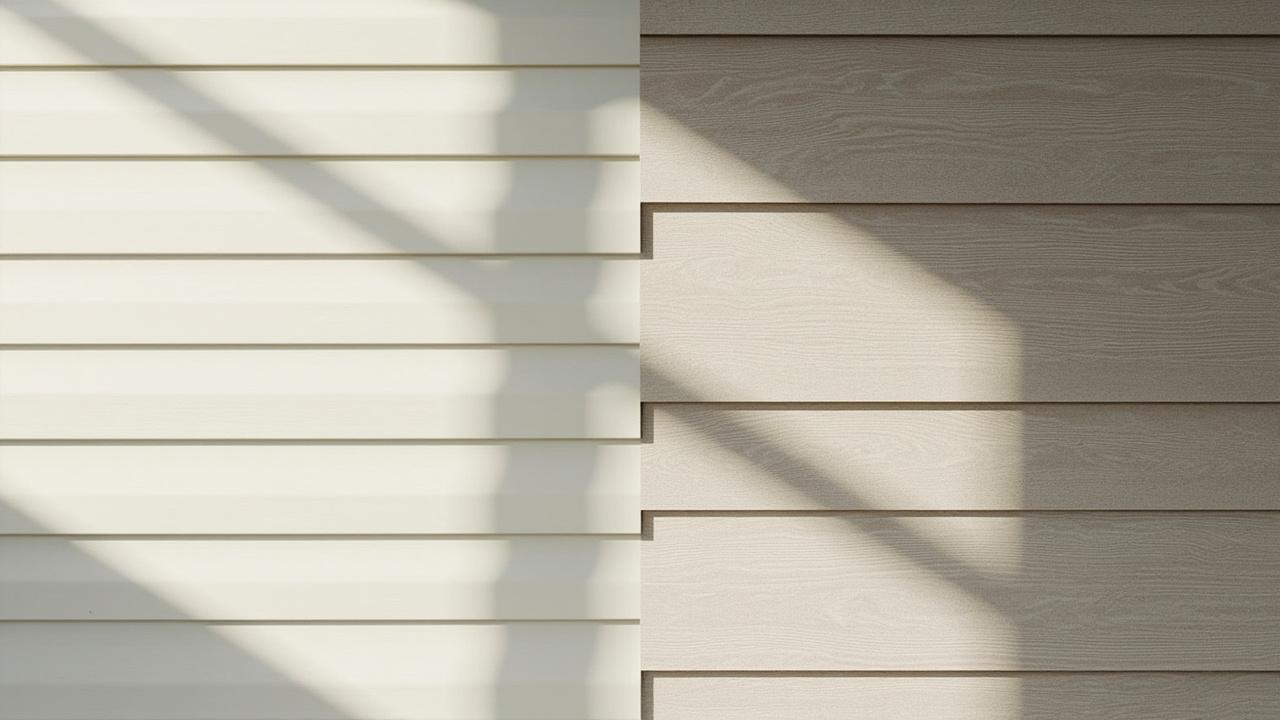
| Looks and finish options | Broad color range, softer detail; dark tones may fade unevenly | Crisp wood-grain edges; any paint color; holds finish longer |
Field math makes the trade vivid. Take a 1,600 sq ft (149 sq m) ranch reclad: vinyl might land near $9,600 at $6 per sq ft, while fiber cement near $17,600 at $11 per sq ft. Spread over 30 years with one fiber cement repaint around $5,000, the lifetime gap narrows but rarely closes. Homeowners who value resale polish in traditional neighborhoods often accept that gap, since buyers read fiber cement as a premium, almost-wood finish.
Material variants beyond these two can sharpen the decision. Real wood and engineered boards each carry their own maintenance story, and comparing them clarifies what you gain or give up; see this take on wood versus engineered siding as an alternative scenario. And because siding never works alone, pairing the cladding choice with the right wall insulation pays off in comfort, as explained in this insulation R-value guide for exterior walls.
Installation Details That Decide Whether Siding Lasts
Expansion and contraction control is the make-or-break skill for vinyl, and installers earn their fee by nailing in slot centers with about 1/32 inch (1 mm) of hang clearance so panels glide. Sealed cut edges play the same role for fiber cement, since every field cut must be primed or painted before it goes up. Get these two habits right and either wall sails past its warranty; skip them and trouble starts within seasons.
Watch the crew on these checkpoints. Vinyl nails should sit centered in their slots, never driven tight, with roughly 1/4 inch (6 mm) of end clearance at trim in cool weather. Fiber cement needs about 1/8 inch (3 mm) gaps at trim, sealed with flexible sealant, plus 6 inches (152 mm) of clearance above grade and 1 to 2 inches (25 to 51 mm) above roofs and decks. Both systems need corrosion-resistant nails hitting studs or solid sheathing, and flashing that kicks water out at every roof-to-wall joint.
The classic mistakes read like a greatest-hits list. Face-nailing vinyl tight so it oil-cans and ripples in July sun. Butting fiber cement hard against trim so seasonal movement pops the sealant. Skipping kick-out flashing where a roof dies into a wall, which soaks the sheathing behind either material. Backfilling mulch against the bottom course, inviting wicking and insects. A bid that spells out clearances, flashing metal, and sealant brand is worth more than a vague promise of premium panels.
Homes with older walls deserve one extra conversation before demo day. Rotten sheathing, missing housewrap, or aluminum wiring near boxes can turn a reclad into a repair project, so budget a contingency of 10 to 15 percent. For anything structural, electrical, or moisture-damaged, consult a licensed professional rather than layering new siding over a sick wall. Good contractors expect this talk and will open a test square to confirm what hides behind the old courses.
Limits, Edge Cases, and Your Next Step
Color retention in harsh sun limits vinyl on south and west elevations in hot states, where deep tones can fade or distort, making lighter shades or heat-rated lines the safer call. 50-year service life claims for fiber cement assume diligent paint and sealant cycles, and coastal salt spray or lawn-sprinkler soaking will punish neglected walls. Neither product rescues a wall with bulk-water leaks, so fix gutters, grading, and flashing first.
Edge cases flip the default advice. In wildfire-prone zones, fiber cement with boxed eaves and tempered vents is the responsible pick, since vinyl softens early in radiant heat. On shaded, damp lots under trees, vinyl with generous ground clearance can outperform poorly maintained fiber cement whose bottom edges stay wet. For strict historic districts, check the review board first: some streets approve fiber cement grain patterns but reject plastic profiles outright. Tight budget with a near-term move? Vinyl protects resale dollars without overbuilding for the next owner.
Your next step is a short, practical sequence. Measure wall areas and photograph problem corners, then collect three itemized bids that separate material, labor, wrap, flashing, and trim. Ask each bidder for clearance numbers, fastener schedule, and how they meet IRC water-management rules. Then pick the material your climate and stay-length point to, and spend the savings or the surplus on detailing, because flashing and trim work is where siding warranties are truly won or lost.