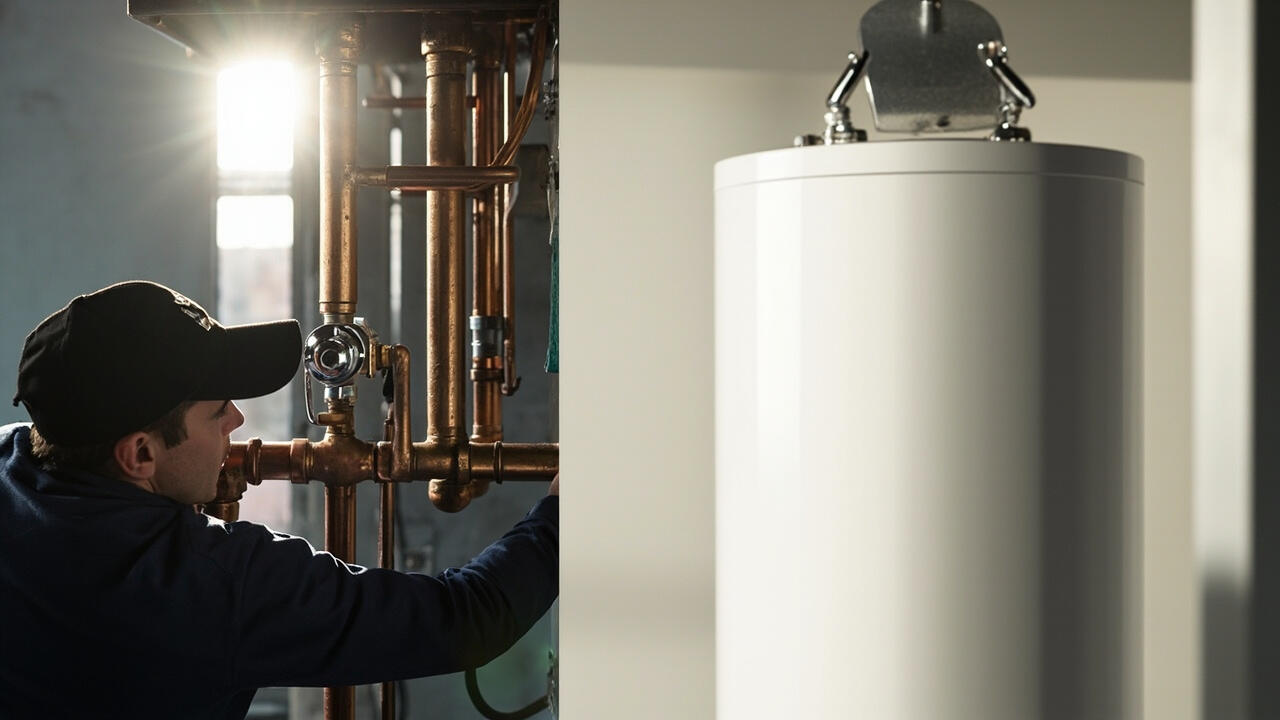

You notice the small puddle under the water heater on a Tuesday afternoon. It is not an emergency yet, but the tank is twelve years old, and twelve years is the age where everything either gets serious or gets expensive.
The plumber who comes out will probably offer two options: a $400 repair today or a $1,500 to $2,500 replacement tomorrow. The decision feels like it has to be made in the next ten minutes, and the two options have very different financial consequences over the next five years.
Water heaters sit in the same general repair vs replacement decision framework as roofs and windows, with a twist: a failing tank does water damage that can dwarf the cost of the unit itself, which moves some calls toward replacement even when the line-item math is borderline.
This guide works through the numbers that decide almost every water heater call, the repairs that still make sense on older tanks, and the moment to stop repairing.
The Three Numbers That Decide Almost Every Water Heater Call
Three numbers carry most of the weight on a water heater decision. Get those right and the choice usually clarifies itself; get any one of them wrong and the rest of the math falls apart.
Age of the unit. A standard tank water heater has an expected service life of 10 to 15 years. Tankless units last longer, often 20+ years, but require descaling every few years.
Once a tank crosses year 10, the risk profile changes because the anode rod (which protects the tank from corrosion) has usually been consumed. From that point on, the tank’s failure curve accelerates. Year 12 is the rough threshold where replacement starts winning on probability-adjusted cost, not just sticker cost.
Repair quote versus replacement quote. The 50% rule applies cleanly here. A $400 repair on a tank that would cost $1,800 to replace is comfortably under the threshold; a $1,000 repair to chase a leak in a year-13 tank is not.
Get both numbers in writing before committing, including the trip charge, permit fees, and any new valve or pan work that shows up on the close-out.
Whether the unit is leaking from the tank itself. This is the most decisive number of the three. A leak from a fitting, valve, or pipe is repairable and the unit is otherwise functional.
A leak from the tank body means the steel has failed and the unit will keep leaking until the tank is empty. There is no patch for a tank-body leak. The moment that diagnosis is made, the decision is replacement, and the only follow-up is how fast.
Read these three together. A nine-year-old tank where the leak is at the fitting is a repair. A 14-year-old tank with a tank-body leak needs replacement within the week. A 12-year-old tank that has lost its thermocouple and shows no leak is the borderline case the rest of this guide handles.
Tank vs Tankless: Why the Decision Gets Rephrased at Replacement
The moment you choose replacement, the question shifts from “fix or replace” to “replace with what”. Two paths exist for most US/CA homes, and the trade-offs matter for both operating cost and project scope.
Standard tank replacement (gas or electric). The simplest swap. A new tank goes in the same footprint with the same connections. Cost runs $1,200 to $2,500 installed for a 40- or 50-gallon unit, more if you upgrade to a high-efficiency or heat-pump model. Permits are routine. The plumbing is the same. Project takes one day.
Tankless (on-demand) conversion. The water heater moves from a tank to a wall-mounted unit that heats water as it flows. Cost runs $3,000 to $5,500 installed for the unit plus gas-line upgrades (tankless units need larger gas supply lines, often 3/4 inch instead of 1/2 inch) and possibly a new vent.
The project can stretch across two days and a building inspection. Operating savings are real but modest for most households: 20-30% lower water-heating energy use, which is meaningful on bills but slow to pay back a $5,000 premium.
The tank-vs-tankless decision comes down to four practical questions: how long you plan to stay in the home, whether the gas line can support tankless without major work, whether the energy savings offset the upgrade premium in your climate, and whether you want the unlimited hot water that tankless delivers. Run those before committing to the conversion, not after.
Five Repairs That Make Sense Even on an Older Tank
Some water heater repairs are so cheap and so routinely the right call that they pay back even on a tank that is otherwise nearing retirement. Five of these show up often enough to memorize.
- Anode rod replacement. $200-$400, often done as part of routine service. A new anode rod resets the corrosion clock on the tank and extends its life by several years. Most homeowners never think about anode rods until they need a new tank; ask at your next service whether yours is still doing its job.
- Thermocouple or igniter replacement. $150-$300 for parts and labor. A pilot that will not stay lit or a gas burner that will not ignite is usually a thermocouple, not a tank problem. Repair is essentially always the right call.
- Dip tube replacement. $200-$350. The plastic dip tube inside the tank mixes cold water with hot and breaks down over time. A bad dip tube lets cold water short-circuit to the output and produces tepid water; replacement restores full performance.
- Heating element (electric) or gas valve (gas). $200-$400. Electric tanks have two heating elements; one fails, you get lukewarm water. Replace the element, the tank works again. Gas valves do fail but less often; diagnose before replacing.
- Pressure-relief valve and expansion tank. $150-$300 combined. These safety devices wear out and need periodic replacement, especially if your home has a closed plumbing system. Most jurisdictions require expansion tanks on closed systems now.
If the failure is one of these five, repair is the answer regardless of tank age. If the failure is something else (leaking tank body, chronic temperature loss, rumbling from sediment buildup, rust-colored water from the hot side), the math changes quickly.
Once two or more repairs land in a 24-month window on a tank past year ten, the tank-procrastination trap has started; the next call is usually replacement rather than repair.
What a Failing Water Heater Actually Does to the Rest of the House
A failing water heater costs more than its replacement invoice. The water damage path is where a deferred replacement can escalate from a $1,800 appliance problem into a $10,000 or $20,000 home repair.
Water heater tank failures typically release 40 to 80 gallons at a time. If the home is occupied, the leak usually gets noticed within minutes; if it happens while you are away, the water runs until the tank is empty, which can be 20 minutes or 20 hours depending on the size of the tank and the drain performance.
The damage envelope is the area of the home within the spill path of the tank: the basement, the utility closet, the closet floor above finished space, and any HVAC equipment, electrical panels, or finished flooring in the path.
Recovery cost for a finished basement water heater failure typically runs $4,000 to $15,000 once you include drywall replacement, flooring, painting, and possibly mold remediation. Recovery cost for a second-story utility closet failure can run higher because the water migrates through the floor structure to the ceiling below.
The decision to replace an aging tank before it fails is partly a numbers question and partly an insurance question. A tank at year 14 with a worn anode rod has a meaningful probability of failure within the next 24 months.
The cost of replacing it now is the tank plus installation; the cost of letting it fail adds water damage on top of those same line items. Most homeowners would rather control the timing.
Comparing Gas, Electric, and Heat-Pump Water Heater Operating Cost
If replacement wins the call, the next question is fuel type. Operating costs vary enough by climate and household size that a quick comparison pays for itself.
The four main fuel types each hit a different combination of equipment cost, install scope, and annual operating cost:
Natural gas tank. The default in most US homes with gas service. Operating cost runs $200-$400 per year for a four-person household at 2025-2026 utility rates. Recovery is fast. Lifespan 10-15 years. Equipment and install are mid-priced.
Electric tank. Default where gas is not available. Operating cost runs $400-$700 per year for the same household, because electricity is more expensive per BTU than gas in most regions. Recovery is slower for a 40-gallon tank. Lifespan 10-15 years. Equipment and install are the cheapest of the three.
Heat-pump (hybrid electric) water heater. Uses a refrigeration cycle to extract heat from the surrounding air and deliver it to the tank. Operating cost runs $150-$300 per year, often 50-65% less than a standard electric tank. Requires a 40-50 gallon tank with adequate surrounding airspace and a condensate drain. Equipment and install run $1,800-$3,500. Lifespan 12-15 years.
In regions with electricity rates above $0.18/kWh and gas rates below $1.50/therm, the heat-pump upgrade pays back its premium within 5-8 years. In regions where gas is cheap and electricity is expensive, the payback stretches past 12 years and standard gas remains the rational choice. Run the math against your last 12 months of utility bills, not industry averages.
The Tank-Procrastination Trap and When to Stop Repairing
One pattern is worth naming because it is how water heater decisions go sideways: the tank reaches year nine, develops a small problem, gets repaired. Year ten, another problem, another repair. Year eleven, the same. Each repair is sensible on its own. Together, they spend two thirds of a replacement price across three years while the tank’s underlying risk keeps climbing.
The signal that you are in the trap: two or more repairs in 24 months on a tank past year ten. Once you cross that line, replacement almost always wins over the third repair.
The signal that you have actually won: a tankless conversion or a high-efficiency heat-pump replacement that drops your water-heating energy use by 30% or more. Those projects pay back, but only if the baseline tank truly needed replacement.
Chasing efficiency on a perfectly good tank is the other trap, and an even more expensive one. Pair the water heater work with a broader shutoff valve and supply-line upgrade while the plumber is on site, and you avoid two more service trips later.
The repair-vs-replacement decision on water heaters narrows to three things: age, leak status, and whether the failure is one of the five named repairs above. Get those right and the answer usually writes itself. Get any one wrong and the rest of the math cannot save the call.