
Uneven gaps around an interior door are usually a geometry problem, not a shortage of sealant. First identify whether the opening is too wide at the hinge side, latch side, top, or bottom. Each shape points to a different cause and a different repair, so measuring before buying trim or weatherstripping saves a frustrating afternoon.
The door may fit the opening yet swing poorly, so the interior door installation guide explains the wider setup. This article focuses on diagnosing the reveal around an existing door.
Know the working clearance and the reveal
Home Decor Bliss gives the working standard as 1/8 inch at the top and sides. It also gives an interior bottom clearance of 1/2 inch to 3/4 inch, depending on the finished flooring.
Sensible Digs gives the same top-and-side target of about 1/8 inch, describes it as roughly 3 mm, and says the bottom is normally undercut by 1/2 inch to 3/4 inch above the floor.
HomeISD reaches the same conclusion for the bottom, recommending 1/2 inch to 3/4 inch for an interior door over a finished floor. EngineerFix describes that figure as the usual interior undercut.
These are working clearances, not decoration. The top and sides need enough room for the slab to swing without binding. The larger bottom space also allows air to return through the room’s duct system.
Home Decor Bliss calls the side gaps stile clearances, the top space head clearance, and the bottom space bottom clearance. EngineerFix uses reveal to describe the visible space between the door and frame. That same window and door guide is the reference for the wider family these doors sit in.
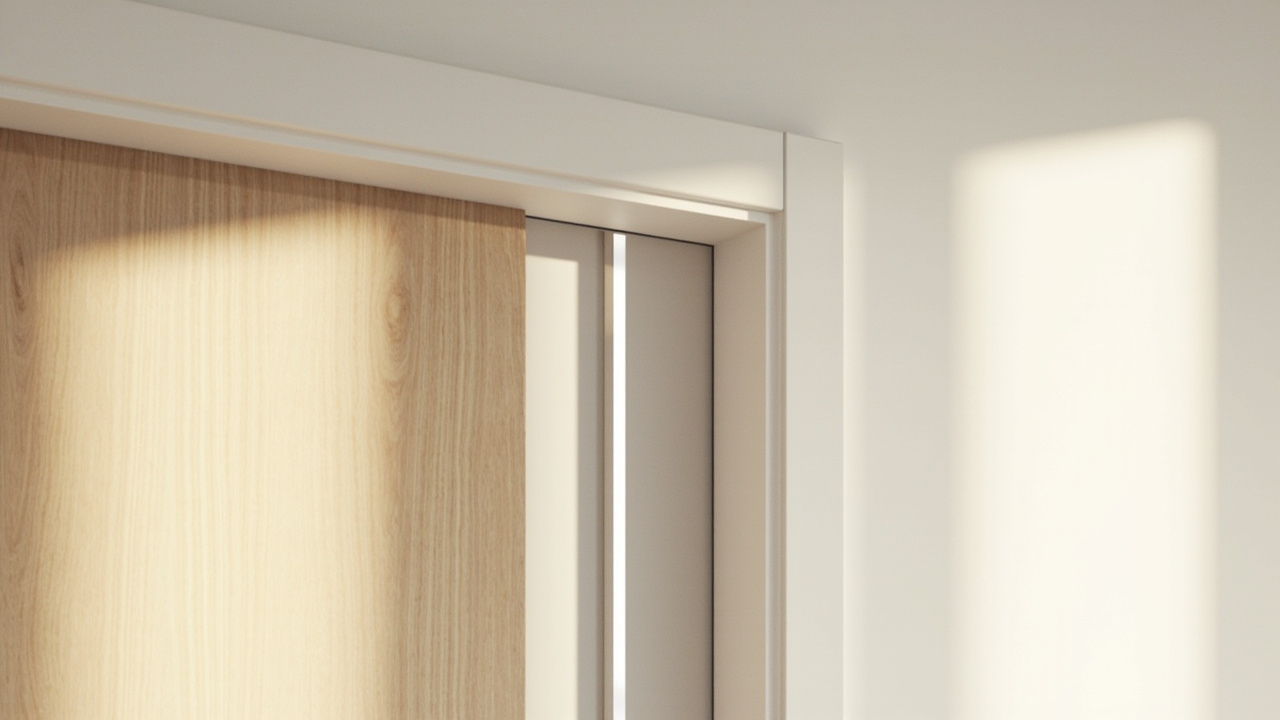
A reveal that stays the same from top to bottom is uniform. If it is wider at the top and narrower near the floor, it is tapered. That taper is the signature of a door that is off-square or a frame that is out of plumb.
Do not judge the gap from one point. Look along both vertical edges and across the head, then check whether the shape changes as the door closes.

Measure four positions before touching the frame
Close the door fully. Use a ruler for narrow gaps or a stiff card as a simple comparison gauge. Then take four readings and write them down before you touch anything.
- Measure the head reveal at both corners, not just the middle. A head that reads wider on one side tells you the opening is out of square.
- Measure the hinge-side reveal near the top, middle, and bottom of the jamb.
- Measure the latch-side reveal at the same three heights.
- Measure the bottom undercut at the middle of the door, not at a corner where the floor may not be level.
Write the four numbers down. You are about to compare them, and the comparison is where the diagnosis comes from.
If you are planning replacement work, the method in how to measure an interior door will help you compare the slab, opening, and frame before ordering parts.
A narrow card can show where a tapered reveal starts. Slide it down the jamb. If it binds high but drops free lower down, the opening is not square.
Now compare the four shapes. EngineerFix says a uniform gap points toward worn perimeter weatherstripping, while a tapered gap points toward door or frame misalignment. That distinction matters because seal strips will not square a crooked door.
Mark the widest point of each reveal too. A single dark line around a door can hide three separate problems, each requiring its own repair.
Match the fix to the gap geometry
A hinge-side gap that widens from bottom to top usually means the door is sagging or leaning away from that jamb. First tighten loose hinge screws. If the screw holes are enlarged, use a longer screw or a solid wood filler before tightening again.
If the hinge-side reveal remains tapered, add a thin shim behind the hinge. EngineerFix describes shimming the hinges as the way to square a leaning door. Sensible Digs likewise lists hinge shims as the repair for a leaning door.
A latch-side gap is usually a strike problem. The latch may be pulling the door away from the jamb, or the strike plate may sit too low, too high, or too far from the frame edge. Move the strike carefully so the latch enters squarely without forcing the door.
If the latch strikes correctly but the gap remains, the door is moving out of plane. Do not keep tightening the strike. Use the dedicated guide on fixing an interior door that will not close to separate latch trouble from alignment trouble.
A gap that is too wide at the top points to a different set of suspects: loose hinge screws, badly cut hinge mortises, a head jamb that is not seated correctly, or a slab hung in an out-of-square opening.
Check the top corners with the door closed, then open it slowly. If the door binds or scrapes during the swing rather than only when closed, use how to fix an interior door that rubs the frame for the swing diagnosis.
A gap that is too wide only at the bottom is not a hinge problem. It usually comes from an oversized undercut, a settling floor, or a door hung for an older floor covering. A sweep works here, but only here.
Adhesive weatherstripping can close a modest, uniform gap. Sensible Digs recommends fitting it to the jamb along the sides and top, and using a sweep to bridge the space at the bottom. Weatherstripping cannot correct a tapered reveal.
Repair the frame without over-packing it
Packing the hinge-side jamb can shift the door outward, tightening the latch side but opening a larger gap at the head. It can also produce a door that closes hard while daylight still shows around the frame.
Over-packing masks the symptom when the real fault is a loose hinge, an off-square opening, or a frame that has moved. Correct the cause first, then add packing material only where the jamb needs support.
If the jamb has separated from the wall, or the head has dropped, the frame may need rebuilding. The door frame installation guide covers the parts and geometry that determine whether a repair is practical.
Planing the door is a later option. It reduces the latch edge so the slab can swing freely, but it does not correct a sagging hinge or an out-of-plumb jamb. A badly warped slab may need re-hanging or replacement rather than repeated packing.
Keep packing material thin and even. Work from the hinge side toward the latch side, closing and checking the reveal after each adjustment.
Re-hanging the slab can solve a geometry problem when the door itself is sound but its position in the opening is wrong. If the frame is correct and the slab remains distorted, replacement is the cleaner repair.
Do not chase a small daylight line with a large repair. Confirm the clearance pattern first, then change the component responsible for that pattern.
Treat the bottom gap as a floor-finish problem
The bottom clearance must suit the finished floor, not the bare subfloor. Home Decor Bliss ties its interior range to the height of the flooring, and Sensible Digs says the undercut clears carpet or a rug.
That creates a common trap. If laminate or hardwood was installed after the door was hung, the floor is higher and the door may now drag or appear to have changed. A shallower undercut is then a symptom of the new floor height.
Open the door and inspect the bottom edge before altering the frame. Look for marks, scuffs, or a tight spot over the highest part of the flooring. A door that no longer clears the floor needs the floor checked first.
Measure from the top edge of the finished floor. Measure from the threshold alone and you may miss the extra thickness of the flooring.
HomeISD explains that the bottom gap supports air circulation between rooms. EngineerFix also describes the undercut as part of the home’s HVAC return-air path. That is why simply filling every opening with rigid trim is a poor answer.
If the gap is too large but the door still clears the floor, an automatic or sweep-style bottom seal can close the draft. Match the sweep to the floor surface and the door thickness. It should seal when closed without buckling the slab.
Do not use a sweep to disguise a gap at the top or along a side. It seals the wrong edge and leaves the real problem untouched.
Know when the assembly should be left alone
Some doors are not simple slabs in a timber frame. A fire-rated assembly may include components that must remain intact and correctly fitted. Changing clearances or adding loose packing can affect how the door performs in a fire.
Do not modify a rated door assembly without checking its identification label and seeking qualified advice. The same caution applies to doors installed as part of a tested smoke or fire barrier system.
In wet or humid rooms, moisture movement and ventilation requirements can influence the fitting. Confirm the door’s intended clearance before packing a jamb or changing the undercut.
Also leave garage, workshop, and unusually thick floor-covering situations to a fitter unless you understand the door type and the floor build-up. A mistake here can make a door hard to open and easy to damage.
If the reveal changes shape, the hinges are sound, and the frame is stable, stop adding material. Have the slab checked for warp or a problem with the door’s core.
After every adjustment, close the door, measure all four positions again, and watch the gap through the swing. The correct result is even clearance without binding, not simply a closed door.
If the pattern still does not make sense, step back and repeat the four measurements. A clean diagram of head, hinge side, latch side, and bottom is usually more useful than another strip of trim.
Two different problems produce a similar-looking gap, and telling them apart saves you from packing a door that needs something else entirely.
If the door binds or scrapes as it swings, the hinges and the frame are the place to look. That is the diagnosis in how to fix an interior door that rubs the frame.
If the door reaches the frame but the bolt never seats, that is a latch and strike problem rather than a clearance one. The door that will not close covers that case.
And when the gap measures right on every side but the door still will not sit square, the frame itself may be the culprit. Get that fixed before you buy any more trim, and the interior door frame guide covers how the jamb should be set.
Once the reveal reads even on all four positions and the door swings without binding, the job is done. Write the four numbers down again and keep them with the door. Next time something shifts, those numbers are the fastest way to tell a changed floor from a moved frame.