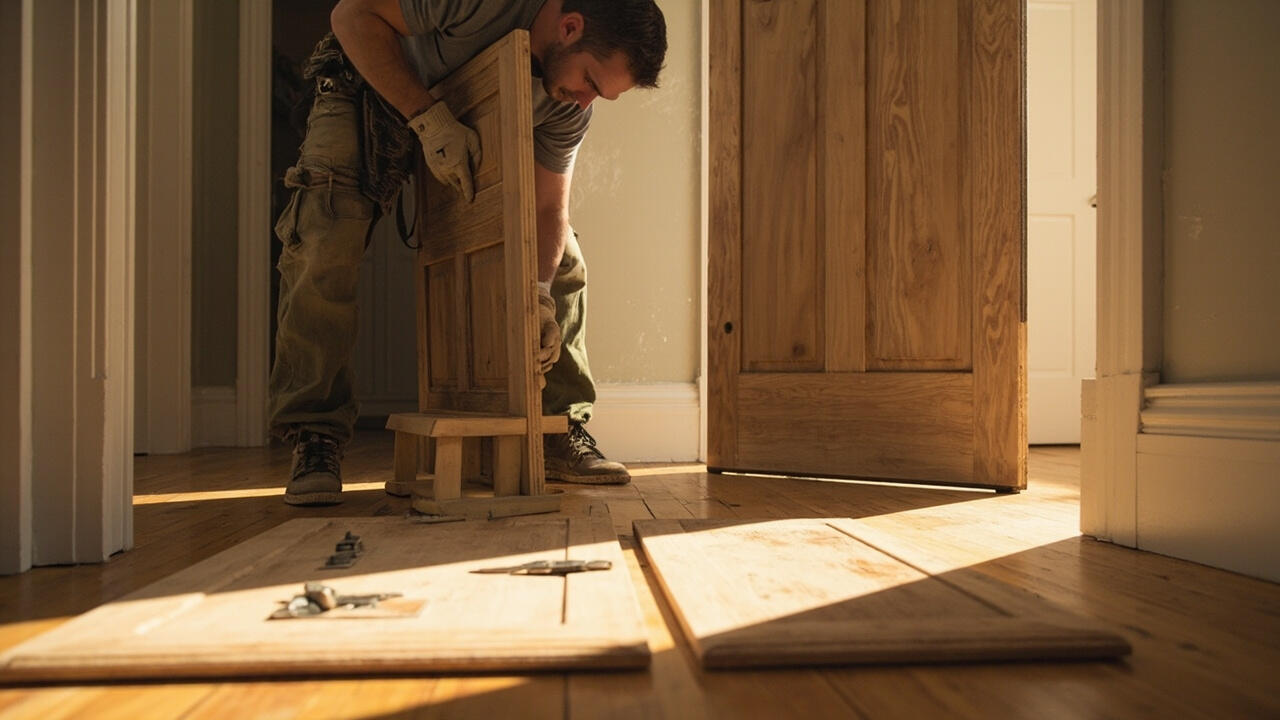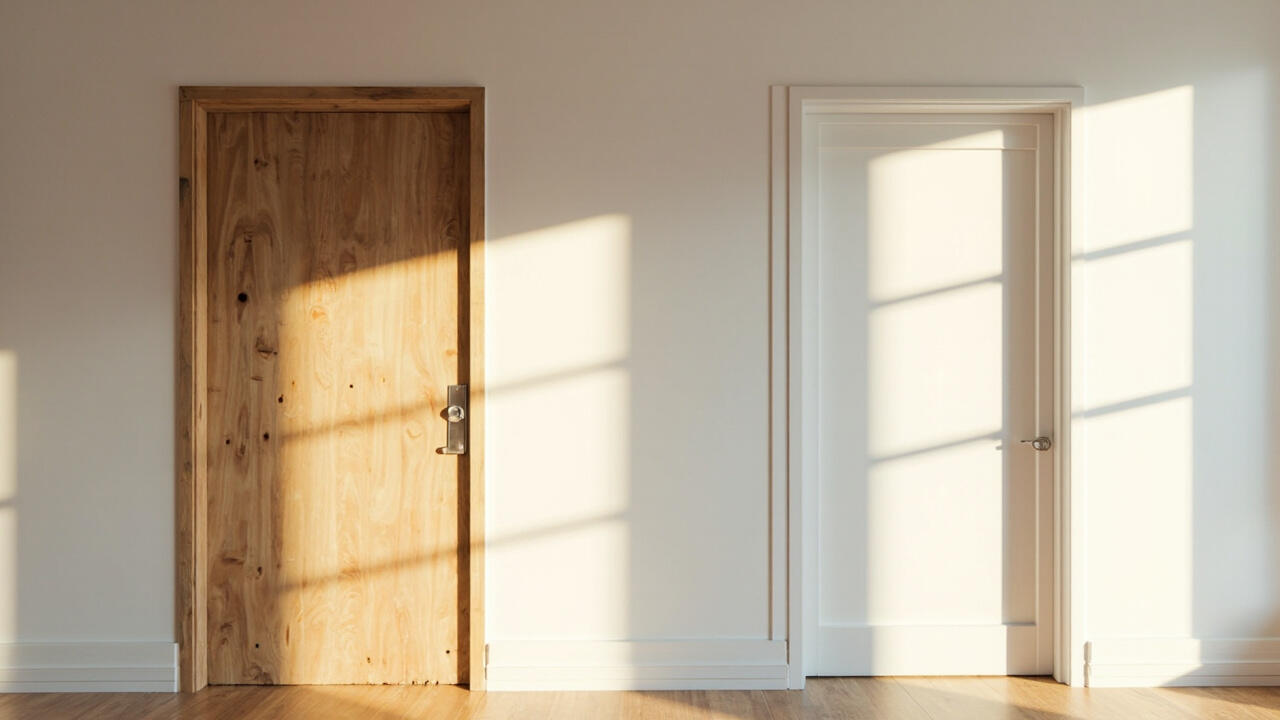

There is a moment, standing in a hallway with a new door leaning against the wall, when the real question arrives. Not how hard is this, exactly. But is this a job I finish today, or one I pay someone to finish?
For interior doors, that question has a clean answer, and almost nobody on the internet gives it to you straight. Most pages are a lead form dressed as advice, or a cost table with no explanation of what the money buys.
Here is the honest version, decided by the condition of the frame rather than your confidence.
Three Tiers of Door Job, and Only One Is a Beginner Job
The door industry treats every interior install as if it were the same job. It is not. Splitting the work into three tiers is the first thing the cost guides and service marketplaces never do, and it settles most of the arguments in advance.
| Tier | What it involves | Realistic time | Who should do it |
|---|---|---|---|
| Slab into a sound frame | Swap the panel, reuse hinges and hardware | 3 to 6 hours for a skilled installer | Most homeowners can own this |
| Prehung unit into a rough opening | Set the frame, shim it plumb, fasten, case it | 45 minutes to 1.5 hours for an experienced DIYer | Intermediate DIYers, or a pro on the first door |
| Build or replace the frame | Cut jambs, set the rough opening, shim and square | Half a day and up, once it goes wrong | Hire a carpenter |
Those time figures come from the sources, not from me. The Doors and Beyond guide puts a slab install at 3 to 6 hours for a skilled installer, and a prehung unit at 45 minutes to 1.5 hours for an experienced DIYer. Lowe’s calls moving a prehung door a two-person job.
Two people is the threshold that decides a lot. A hollow-core prehung unit weighs about 20 to 30 pounds, a solid-core unit runs 50 to 80 pounds, per the cost breakdown in the brief. Bob Vila’s guide notes that even the lightest prehung doors need two people to hold the frame while it is shimmed.
Alone with a door that heavy, you are solving a scheduling problem, not a carpentry one.

What Each Tier Actually Demands of You
The cost pages list hours and prices, but rarely the tools, because the tools are where a beginner discovers the job has changed shape.
Tier one: the slab swap
A slab swap is the most forgiving door work in the world, and the tier most homeowners can reasonably own. The frame stays. The hinges stay. You need a tape measure, a screwdriver, a drill, and a sharp chisel.
The brief puts the DIY cost for a slab at $50 to $150 for hardware and supplies, the door separate. If you own a drill and a level, your out-of-pocket cost is the door plus an hour.
The catch is “sound existing frame”, which is doing a lot of work in that sentence. Check the frame with a level, not by eye. The forum advice is blunt: check before ordering, because an out-of-alignment frame means shimming and planing, and a fun Saturday turns to slog.
Tier two: hanging the prehung unit
This is where most people discover whether they are a beginner or an intermediate. The frame arrives pre-cut and pre-squared, which removes the hardest part of carpentry and replaces it with another: getting that frame plumb in an opening framed by someone else years ago, with its own tolerance.
The tool list runs longer: a 4-foot level, cedar shims, a miter saw for trim, a finish nailer. If you lack the saw, the brief puts a rental at $40 to $60 a day against $150 to $350 to buy it.
Home Depot rates the job as intermediate difficulty at 2 to 4 hours, and the fixupfirst cost guide calls shimming the frame the hardest part. Its advice worth stealing: for out-of-square openings, hire a carpenter for the first door, then do the rest yourself.
Tier three: building or replacing the frame
Here is the line, sharper than most guides draw it. If the job includes cutting jambs, building a rough opening, correcting an out-of-plumb wall, or replacing a rotted frame, you are past the point where a tutorial helps.
The failure mode is not quitting. It is that you keep going, the door gets installed, and it does not work. Then you pay a carpenter to fix a door that should have taken an hour.
What a Beginner Mistake Actually Costs
Every cost guide agrees on the same short list of failures, and the repair prices attached to them are why people hire out. A mistake is not the cost of the door. It is the door plus a return trip.
- The door hangs but will not latch. HomeAdvisor attributes this to not leveling the floor or frame first, which leaves the latch and strike holes mismatched. The repair is re-drilling the holes or re-leveling the framing.
- The frame is out of plumb. The same source notes uneven framing leads to improper closure, and in extreme cases the door will not close at all, which needs a complete reinstall.
- The door gets planed wrong. A door planed too far for clearance will not sit flat in the frame, and the gap it leaves lets drafts through.
- The trim gets ruined. HomeAdvisor flags miter cuts on trim and bad measurements as a way beginners damage work that was fine before they arrived.
Now put a number on it. Fixupfirst puts labor at $75 to $200 for a slab door and $150 to $400 for a prehung door, with DIY savings of roughly $75 to $150 per slab and $150 to $300 per prehung unit. The gap between those lines is the repair bill.
There is a cost that never shows up on a receipt. A door that latches badly and a frame out of square do not stay that way. Wood moves and swells, and the marginal fit you shipped becomes the fit that fails in January.
Where the Money Goes When You Hire
Hiring for door work is not as simple as paying an hourly rate to hang a panel, and the estimate tells you which job you are buying.
HomeAdvisor puts labor for removing an old door and installing a new one at around $350, a typical install running 2 to 5 hours. Ace Handyman lists a prehung interior door at $200 to $400 in labor, Fusion Windows puts flat per-door pricing at $100 to $300.
Thumbtack reports a national average install price of $302 to $937. Builders Surplus is the one to watch for hourly rates: $70 to $120 per hour by region, plus $50 to $200 when an old home forces resizing. Regional labor rates vary, and a marketplace range is a starting point, not a quote.
What a written quote should itemize comes from HomeGuide, which names the trades you might hire: carpenters, general contractors, handypersons, and door companies. It also draws the line between them. A handyperson can be cost-effective for a straightforward replacement, an experienced installer for anything harder. The interior door installation cost guide lays out the line items a quote needs before you can compare two of them.
Ask for the quote to break out these lines before you sign anything:
- Removal and disposal of the old door, frame, and hardware
- Frame work, separated from hanging, so you can see what a rebuild costs as an add-on
- Shimming and correction of an out-of-square or out-of-plumb opening
- Hardware and hinge installation as a separate line
- Trim or casing and any drywall repair, where finish carpentry quietly costs extra
- Paint and stain, or an explicit statement that it is not included
One number for all of that is not saving you money. It is hiding the variable you would want to argue about.
The Middle Path, and How to Vet the Hire
The hybrid sounds clever: hire the carpenter for the frame, do the slab and casing yourself, save on labor you can handle.
It usually costs more than hiring the whole job, and the reason is not greed. It is scheduling. Skilled trades charge by the visit, not only the hour, and a carpenter who comes out to build a frame has already used part of the day getting there, setting up, and finishing.
Coming back weeks later for a slab means a second visit charge for a little work. There is a second cost too. You are coordinating two crews who have never met, and neither can fix the other’s mistake without a return trip.
Where the hybrid genuinely works is when you split along a line the trade already draws. Hauling the old door to the curb, buying the door and hardware, or painting it after it is hung. Those save real money and require nobody to come back.
What does not work is splitting the carpentry. Frame out, slab and casing in, is the worst version, because the halves share the reveal, the hinge placement, and the square of the opening. A small misalignment in the first becomes a visible defect in the second.
Reading the estimate
The services that dominate this search are lead generators dressed as experts. A useful installer tells you things about your house you did not tell them.
Ask what they will do if the opening turns out to be out of square, and what that costs. A good answer names the fix, typically shimming or adding a stud behind the hinge jamb, and says what it adds. A bad answer says everything is standard until the door is out.
Check the estimate against the itemization list above, and check that the installer carries liability insurance. Thumbtack makes that point specifically: professionals carry coverage against accidental property damage or injury.
The Decision Rule You Can Act On
Almost every guide on this topic ends with a shrug. Here is a rule that resolves to an answer, based on the condition of the opening rather than how handy you feel.
Do it yourself if the frame is square, level, and sound, the door is a standard size, you have a level and a drill, and someone can help you hold the door. That is the slab swap tier, where the savings are real.
Go hybrid if the frame is good but you want the trim and casing right, or you want to buy and paint the door yourself and have a carpenter hang it. Keep the split on tasks, not carpentry.
Hire it if the opening is out of square or plumb, the frame is rotted, you are building a new opening, or the door is solid core, oversized, or French. Those are cases where a beginner mistake costs more than the labor you tried to save.
One more case decides it for you: if you have never hung a door before, hire a carpenter for the first door and watch, then do the remaining nine yourself. The window and door buying guide is the reference for where an interior door sits in the wider family. That is the highest-return hour of labor in the project.
If the frame itself is the question, the how to install an interior door guide covers the baseline install, and prehung vs slab door settles which format suits your tier.
Installing an interior door slab is the tier most homeowners can own. Before you buy, measuring an interior door decides whether the slab you bought will fit the opening at all.
For the broader call, the general DIY vs professional renovation comparison covers the wider scope question a door job is only one piece of.