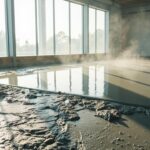

Most concrete problems that show up in the first year of a slab’s life aren’t the concrete’s fault. They’re the cure’s fault. The slab ran out of water before it finished hydrating, and the surface either cracked, dusted, or never quite reached its design strength. The fix for most of those problems isn’t a different mix; it’s a different cure.
Concrete gains strength through a chemical reaction between cement and water, called hydration. The reaction stops when the concrete runs out of water, and concrete loses water to the air faster than most people expect — particularly in summer, on sunny days, and in dry climates. A curing compound is a sprayable liquid film that slows the rate of moisture loss and lets the concrete finish hydrating. It costs $0.10 to $0.40 per square foot and takes minutes to apply.
Some pours need it. Some don’t. Here’s how to tell.
Why Curing Matters More Than Most DIY Guides Say
Concrete’s strength develops over the first 28 days. The most fragile moment is the first day — the slab has set enough to walk on but not enough to resist plastic shrinkage cracking from rapid moisture loss. The second-most-fragile moment is the next 6 days, when drying shrinkage cracking shows up if moisture migrates out faster than hydration can finish.
A curing compound addresses both. It doesn’t add moisture; it keeps the moisture already in the mix, the same way a lid on a pot keeps water from boiling off. Net effects on properly cured concrete:
- Strength comes in at the designed 28-day strength instead of falling short.
- Surface abrasion resistance is higher (the top quarter inch of a slab is where most wear concentrates).
- Crack widths stay small and tight, not wide and separating.
- Surface dusting (a chalky surface that powders under foot traffic) is reduced.
For a typical residential slab, omitting the cure is the cheapest way to leave one of those four performance gains on the table.
What a Curing Compound Actually Is
Most residential curing compounds are water-based acrylic resin emulsions. They go on milky-white from a backpack sprayer, dry clear in 20–60 minutes, and form a thin film that lets water vapor out only slowly. ASTM C309 is the spec that defines their moisture-retention performance; a C309 compound must limit moisture loss to less than 0.55 kg per square meter over 72 hours when applied at the manufacturer’s recommended rate.
A higher-tier spec is ASTM C1315 — better moisture retention, better UV stability, often used on high-performance slabs and decorative work.
You’ll also see these products labeled with a few related categories that confuse the picture:
- Wax / paraffin compounds. Older chemistry, slightly more moisture-retentive than acrylic, can interfere with later sealers and coatings. Common in DOT work.
- Silicate densifiers. Sold in the same aisle but they are different products. They react with the concrete surface to harden it; they don’t qualify as curing compounds for spec’d work. Don’t substitute.
- Chlorinated rubber / resin solutions. High-performers used on bridges and airfield pavements; uncommon and unnecessary in residential.
Where Curing Compound Wins, Where It Loses
The cure method comparison looks like this:
| Method | Cost per sq ft | Best for | Caveats |
|---|---|---|---|
| Water-based acrylic curing compound | $0.10–$0.40 | Large flatwork, hot weather, accessible slabs | Apply while surface is damp; can interfere with later coatings |
| ASTM C1315 high-perf compound | $0.30–$0.70 | Spec’d high-perf slabs, decorative slabs | Premium cost, usually only when required |
| Wax / paraffin curing compound | $0.15–$0.40 | Some older specs, DOT work | Can interfere with sealers |
| Wet burlap / mats (3–7 days) | $0.20–$0.50 | Small slabs, repair patches, high-quality pour | Labor to keep them wet daily |
| Ponded water | $0.10–$0.30 | Small slabs in mild weather | Logistics; works but is fussy |
| Polyethylene sheet (4–6 mil) | $0.10–$0.20 | Small patches, vertical work | Streaky discoloration if condensate pools |
| Curing blankets / insulated mats | $0.30–$0.60 | Cold-weather work | Keeps heat in, not moisture per se |
| Internal curing (pre-wetted LWA in mix) | +$10–$25 per cu yd | Spec’d projects, high-shrinkage mixes | A mix-design choice, not a field-applied step |
| Nothing | $0 | None, in the US — only acceptable for very low-stress cosmetic slabs | Risk of surface cracking, dusting, low strength |
The pattern: curing compound is the right call when you have scale, when weather is hot or dry, or when you don’t have an easy water source. Wet burlap is the right call when you’re pouring a small slab and have time to keep it wet. Curing blankets are the right call when the slab is at risk of freezing in the first night, not when the slab is at risk of drying out.
Specific situations where curing compound is the wrong answer
A few cases where an article should be honest about the limits:
Polished concrete or densifier-only finishes. The film left behind interferes with the densifier reaction. Most finisher specs say wet-cure with burlap, then mechanically prep before the polish or densifier steps.
Painted or film-forming coatings. Many coatings require the substrate to be free of curing compound. Mechanical abrasion (sanding, shot-blasting) is the typical prep step, which adds $0.25 to $1.00 per sq ft. Check the coating manufacturer’s prep instructions.
Color hardener or stamped finishes. These decorative surfaces often require wet cure only, especially in the first 48 hours when the color is still setting. Curing compound can ghost or streak the color.
Cold weather curing. A curing compound doesn’t generate heat. If the slab is at risk of freezing, you need curing blankets or insulated mats, not a film-forming compound.
How to Apply It (and When)
Concrete finishing happens in a fast sequence, and the curing step lands between the final finish and the first walk-on. Here’s the practical rhythm:
- Bull float the slab as it firms up.
- Hand-trowel or broom finish as the project calls for.
- As soon as the surface water (bleed water) has disappeared and the slab is firm underfoot but still damp-looking — typically 30 minutes to 2 hours after finishing — apply the curing compound.
- Spray in two passes at 90 degrees to each other (so coverage misses are visible from a different angle in the second pass).
- Coverage rate matters more than coat thickness: typically 1.0–1.5× the manufacturer’s recommended rate for a smooth steel-troweled finish, slightly higher for a rough broomed finish.
The most common fail is late application — by the time the surface looks dry, hydration is already slowing. Erring on the early side is safer than erring on the late side.
For tools, a standard backpack sprayer works fine. Spray nozzle selection matters: a flat-fan tip (TeeJet 8004 or similar) lays down a uniform fan; cone tips are less reliable on a slab surface. Buy a cheap dedicated sprayer for the cure; the residue clogs other sprayers if you try to use the same tool for herbicide later.
Cost and Project Context
On a typical residential 4-inch slab:
- Curing compound material: $0.10 to $0.30 per sq ft (acrylic C309).
- Backpack sprayer (one-time): $30 to $80.
- Application labor: roughly 0.5¢ per sq ft for DIY; bundled into the slab finish line item for a hired crew.
This is a small line relative to the overall slab cost — well under 10% of the material budget for nearly every project. The compounds aren’t expensive. What’s expensive is omitting them and then paying for repairs later.
If you’re pouring in the same project as a concrete slab pour, confirm with the contractor whether the cure is in the quote and at what spec. ASTM C309 water-based acrylic, applied at the manufacturer’s recommended coverage rate, is the common residential baseline. Some engineers or finishers will insist on wet cure regardless — that’s a valid alternative with its own cost structure, just make sure the methodology is in writing in the project spec.
What Belongs in the Project Spec
The cure line on a well-written concrete spec names:
- Method (compound / wet burlap / blanket / etc.)
- Compound spec (ASTM C309, ASTM C1315, or specific product) where applicable
- Application rate (sq ft per gallon at the manufacturer’s recommended rate)
- Timing relative to finishing
- Number of coats or application passes
- Special precautions — compatibility with subsequent finishes, freeze warnings, hot-weather additional cure requirements
If a contractor’s quote says “we’ll handle the cure” without specifying any of the above, ask. The cure is cheap; a missing spec is a recipe for either overcharging or under-doing.
Things Worth Not Believing
A few recurring myths that aren’t worth carrying:
“Concrete doesn’t need to cure; it’s already strong.” Concrete is strong in compression at the moment it’s set, but the slab hasn’t reached its design strength for 28 days. Without moisture retention, it stops short.
“Misting the surface is enough.” Surface misting helps in the first 4–6 hours (it addresses plastic shrinkage), but it doesn’t keep moisture in the slab for the following days. A curing compound or wet-burlap system is what closes that window.
“A sealer and a curing compound are the same thing.” Some products carry both labels, but the functions are different — curing compounds manage moisture during the cure window, sealers protect the surface after cure. Read the product label.
“If you used synthetic fibers, you don’t need a curing compound.” Synthetic fibers are an additive to address plastic shrinkage cracking; they don’t replace moisture retention. Compound and fibers together is the right combination.
How This Fits the Cluster
The concrete and foundation guide is the umbrella page; rebar covers the tensile reinforcement side of a slab; the per-sq-ft cost page covers the dollars; how to pour walks the placement mechanics; and how to seal covers the after-cure step. Curing is one step, but it’s the step most easily forgotten and most easily regretted when omitted. A $0.20-per-sq-ft product can prevent a slab that dusts, cracks early, or never reaches the design strength — and a credible contractor accounts for it in the quote without being asked twice.