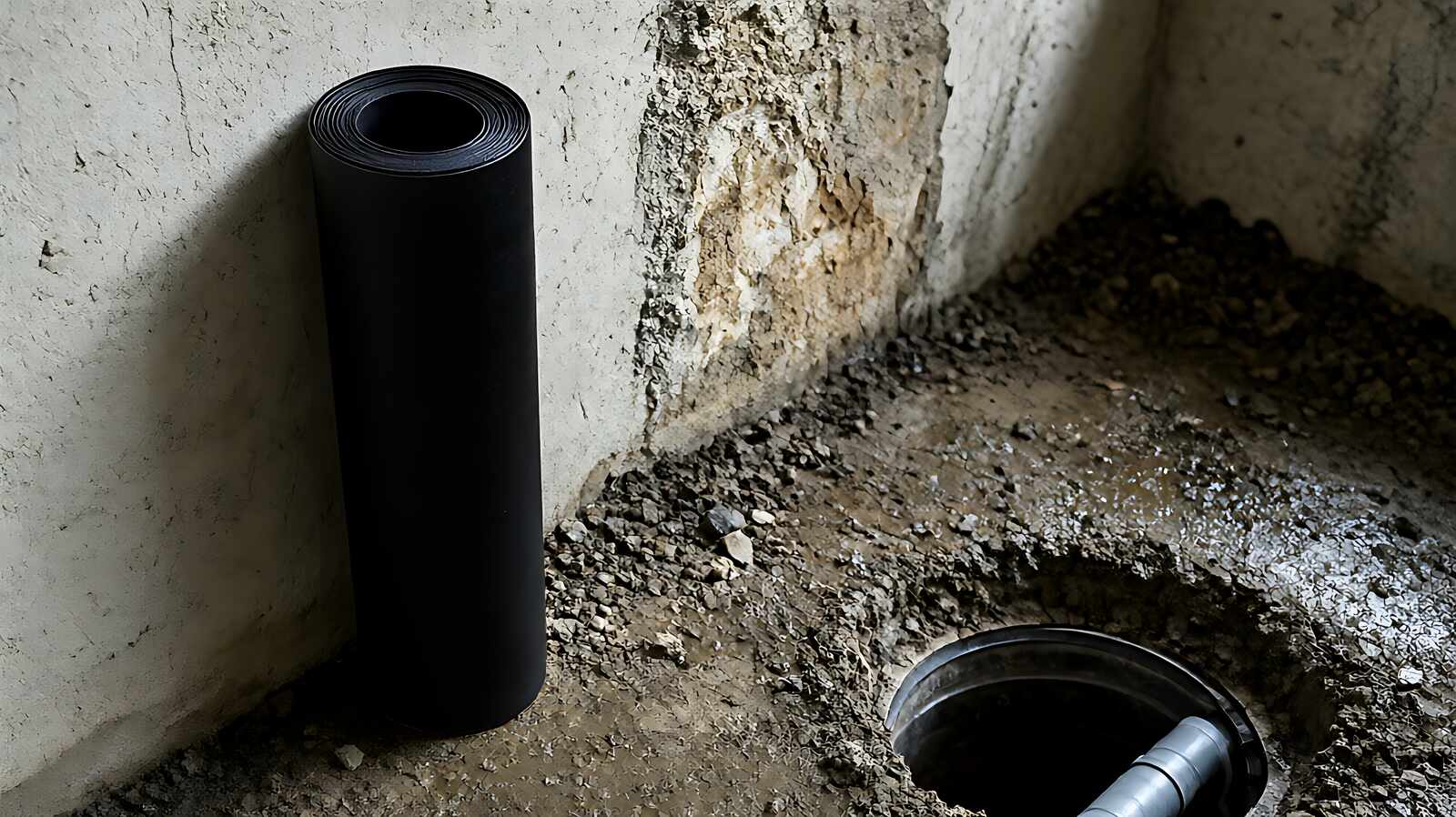

Water shows up in the basement again, and the same question follows: patch this or tear the whole system out? Get the answer wrong and you either spend a fortune replacing a system that was nearly fine, or you pay twice for repairs on a system that was never going to hold.
The answer is not about how much water you are seeing. It is about whether the waterproofing system as a whole still does its job, and that system has three parts: the membrane that blocks water, the drainage that carries it away, and the sump that pumps it out. Repair fixes a weak point. Replacement rebuilds the system. Everything else is detail.
Why the Wet Spots You See Are Not Always the System That Failed
The visible leak is rarely the failed detail. It is the point where water finally found a path into a room, which can be many feet from the crack, the seam, or the drainage failure that let it in.
Before anything else, separate the water into two categories. Storm-linked moisture, appearing within a day or two of heavy rain and drying out afterwards, points at surface water or groundwater. Weather-independent moisture, showing up in the same place every week with no rain at all, points at a plumbing leak, a sewer line, or interior condensation. Patching a membrane will never fix a plumbing leak.
Then trace where the water appears.
One location, on one wall, usually means one weak point. Water arriving along several walls, or repeatedly at the floor-wall cove joint, means the system is carrying more water than it was designed to move, and no patch will change that.
There is a code question hiding here too. If the original installation was dampproofing rather than waterproofing, there is no waterproofing system to repair. Dampproofing retards soil moisture and offers no resistance to hydrostatic pressure, so a wall that was only dampproofed has never been protected against a water table. That changes the answer before any money is spent.
Repair Is the Right Call When the Rest of the System Still Works
Repair is correct when the membrane is fundamentally sound and one component has failed. The symptom list is short and specific, and it is worth matching against your own basement before you call anyone.
The leak is limited to a single crack, a single corner, or one short stretch of wall. The sump pump failed while the drain system still moves water reliably to the pit. The discharge line is blocked, frozen, crushed, or draining too close to the foundation.
Or the membrane is still within its useful life and the damage is confined to one detail, with exterior grading sending every rain straight at the wall.
That last point matters. A patch is only as good as the sound membrane it bonds to. If the coating around a failed area has lost adhesion or gone brittle, a new patch over it is a patch that will fail next winter.
Repairs are also the sensible move when the structure has moved past the point where a whole new system would help. A frozen discharge line or an undersized sump is a plumbing and drainage decision, and no amount of membrane work touches it.
Replacement Is the Right Call When the System Cannot Keep Up
Replacement becomes the right answer when the system, not the detail, is the problem. Look for these signals together rather than one at a time.
Water enters along multiple walls, or at the same cove joint in different places. The space leaks after most heavy rains even after previous repairs. Water is bypassing the drainage system entirely, arriving without the drain ever seeing it.
The interior drain is collapsed, inaccessible, poorly pitched, or undersized. The sump pit cannot keep up with incoming water during a storm. Or the whole assembly was never designed to handle hydrostatic pressure in the first place.
Age is a second signal, and it depends on the family of membrane you have. EPDM rubber typically carries a 20 to 30 year service life, so somewhere around ten to fifteen years old it deserves serious attention.
TPO and PVC sheets run 15 to 25 years, which puts the replacement conversation at eight to twelve years. That is roughly the halfway point, and it is where a whole-system conversation becomes reasonable even without an active leak.
Extent matters as much as age. Ponding that persists more than 48 hours after a one inch storm over more than 10 percent of the area, blistering or cohesion loss covering more than 5 percent of the surface, seam separations longer than about six inches, or insulation saturation confirmed by moisture scan across more than 20 percent of the deck all point the same way.
There is a middle option people forget. Partial replacement, rebuilding one wall or one area while leaving the rest alone, is legitimate when damage is confined and the adjacent membrane is still sound.
It is the option that fits a system with a clear, bounded failure and a good installation everywhere else.
What Repair and Replacement Each Cost You
Repairing a membrane area typically runs in the range of $2 to $10 per square foot, and the spread tracks access. A patch reachable from inside a finished basement sits at the low end. Anything that means excavating the exterior sits at the high end, and excavation is what pushes many homeowners toward interior systems instead.
Timing moves the number more than product choice does. The same work done during the initial build runs roughly 30 to 50 percent cheaper than retrofitting it later, because the structure is open and no finishes have to be removed. That is the strongest argument for replacing a marginal system during a larger renovation rather than waiting.
Replacement buys two things that do not show up on a materials list. It restores the full system warranty, since manufacturers offer 10 to 20 year warranties on new installations that no repair can restore.
And it removes the escalating interior damage risk, which grows every time a leak reaches framing, drywall, or insulation.
One number on the contract side is worth watching. If the evaluated repair runs more than roughly 40 to 50 percent of a credible replacement estimate, replacement is normally the better long-term value. You are not comparing repair against replacement there. You are comparing two rounds of repair plus the damage in between against one clean system.
The 50 Percent Rule: Turning Symptoms Into a Decision
Here is the order of checks that gets you to an answer. Run them in sequence, because each one can end the conversation.
- Is the moisture storm-linked or weather-independent? Weather-independent means plumbing or condensation, not waterproofing.
- Is the water arriving at one location or at many? One location suggests a detail. Many locations suggest a system.
- Does the drainage path still work end to end, from the wall to the pit to a discharge point that actually drains away?
- Was the original installation waterproofing or dampproofing, and does the age fall past the halfway point of the membrane’s service life?
- What percentage of the area is affected, and is there any single dominant failure driving it?
Two thresholds finish the reasoning. If you have needed service more than twice in twelve months, the pattern itself is the answer. And if the repair estimate lands above roughly half the replacement estimate, replace.
One more consideration tilts the same way: how long you plan to keep the home.
If the answer is more than five years, a new system with a fresh warranty is worth more than a repair on a system already past the halfway point of its life.
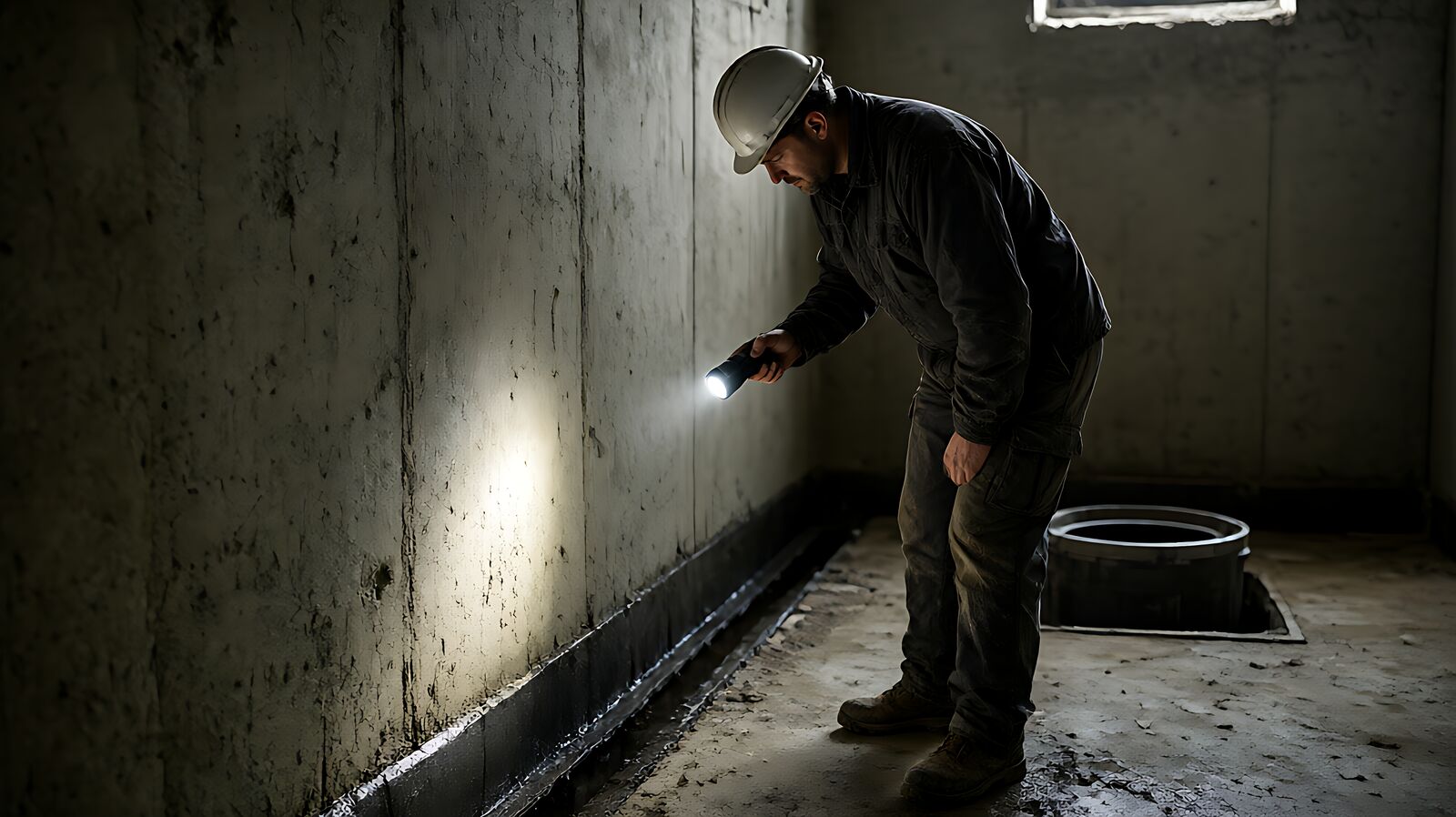
Before you sign anything, ask for the failure diagnosis in writing, not just the proposed scope. You want to know which of the three parts failed, what evidence supports that, and what the repair is intended to accomplish. A contractor who can only describe the wet area is going to keep treating the symptom.
If the diagnosis comes back saying the drainage is fine and the membrane is the problem, you are in the repair column. If it says the drainage cannot carry the water, you are in the replacement column, no matter how good the membrane looks.
Whichever column you land in, the next step is the same: get the diagnosis, then read how that system is built. Start with types of waterproofing systems so you can tell a membrane problem from a drainage problem, then pick the repair or replacement path from there.
For the mechanics of a repair that holds, our guide to waterproofing failure repair covers the overlap, thickness, and cure detail.
If you are weighing where the new membrane should go, interior versus exterior waterproofing works through the trade-offs, and types of waterproofing systems covers how each family fails so you can read the diagnosis correctly. For the money side, waterproofing membrane cost gives you the baseline to test an estimate against.