
Choosing the right insulation is not about picking the highest R-value on the shelf. It is about matching the material to the cavity, the climate, and the way your house actually loses heat. Attic insulation and wall insulation face different challenges: attics deal with extreme temperature swings and air movement from below, while walls must fit within narrow cavities without compressing or leaving gaps. This guide covers every major insulation type, where it belongs, and what it costs per square foot.
What Insulation Does and Why R-Value Alone Misleads
Insulation slows heat transfer through conduction, convection, and radiation. The R-value measures thermal resistance: higher R means slower heat flow. But R-value is measured in a lab under ideal conditions. In a real wall cavity, gaps, compression, and moisture reduce effective R-value by 20-40%. A perfectly installed R-13 batt performs better than a poorly installed R-19 batt. Air sealing matters as much as insulation. A house with R-30 attic insulation and leaky ducts wastes more energy than a house with R-20 insulation and tight ducts.
Thermal bridging is the other hidden factor. Wood studs conduct heat faster than insulation. In a standard 2×4 wall, studs cover about 25% of the wall area. The effective R-value of a wall with R-13 batts between studs is closer to R-10 when you account for stud bridging. Continuous exterior insulation (rigid foam or mineral wool) breaks the thermal bridge and raises the effective R-value significantly.
Attic Insulation: The Biggest Energy Lever in Your House
Heat rises, and the attic is where the most energy escapes. The Department of Energy recommends R-38 to R-60 for attics in most US climate zones. Upgrading from R-19 to R-49 in a typical 1,500 square foot attic saves $200-400 per year in heating and cooling costs.
Blown-In Fiberglass and Cellulose
Blown-in insulation is the most common attic upgrade. A machine blows loose fibers into the attic space, filling gaps and covering joists uniformly. Fiberglass blown-in costs $1.00-1.50 per square foot for R-38. Cellulose costs $1.20-1.80 per square foot and has higher recycled content (80%+). Both perform similarly at the same R-value.
Cellulose has an advantage in air sealing: the dense fibers resist airflow better than fiberglass. Fiberglass has an advantage in moisture: it does not absorb water and dries faster. For attics with minor air leaks, cellulose fills gaps better. For attics with roof leaks, fiberglass is more forgiving.
Batt Insulation in Attics
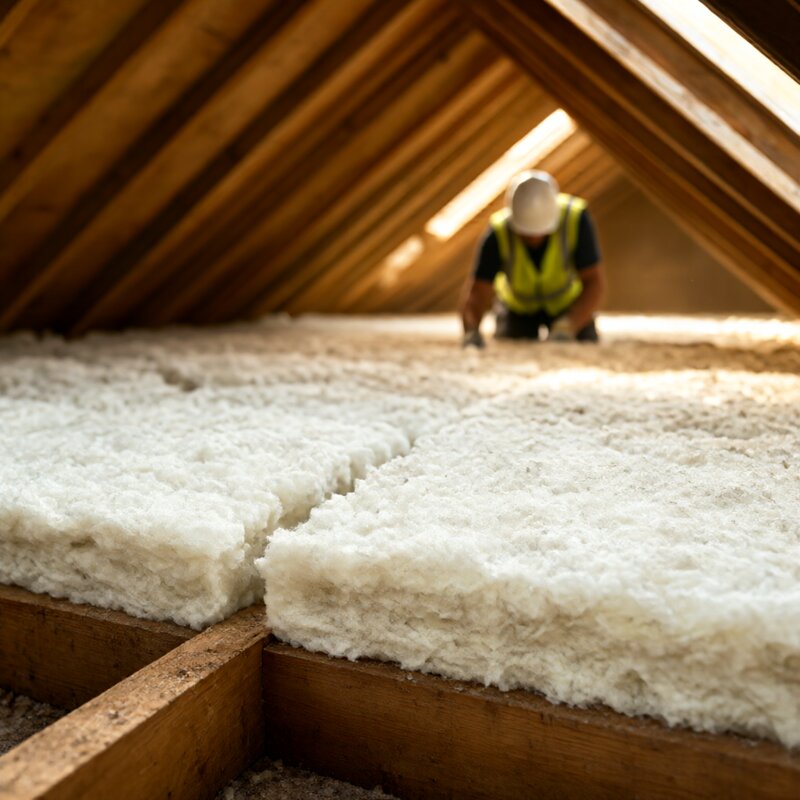
Fiberglass batts work in attics with accessible floor joists and no obstructions. Install batts between joists, then add a second layer perpendicular to the first to cover the joists and reduce thermal bridging. Cost: $0.80-1.20 per square foot for R-38. Batts are DIY-friendly but require careful fitting around wires, pipes, and electrical boxes. Gaps and compression reduce performance by 20-30%.
Spray Foam in Attics
Open-cell spray foam (R-3.7 per inch) and closed-cell spray foam (R-6.5 per inch) are applied to the underside of the roof deck, creating an unvented attic. This approach seals air leaks and prevents ice dams. Cost: $1.50-3.00 per square foot for R-38 (open-cell) or $2.50-4.50 per square foot (closed-cell). Spray foam is the most expensive option but delivers the best air sealing and moisture control.
Unvented attics with spray foam work best in hot-humid climates (zones 1-3) where attic ventilation can introduce moisture. In cold climates (zones 5-7), vented attics with blown-in insulation are usually more cost-effective.
Wall Insulation: Fitting the Cavity Without Compromising
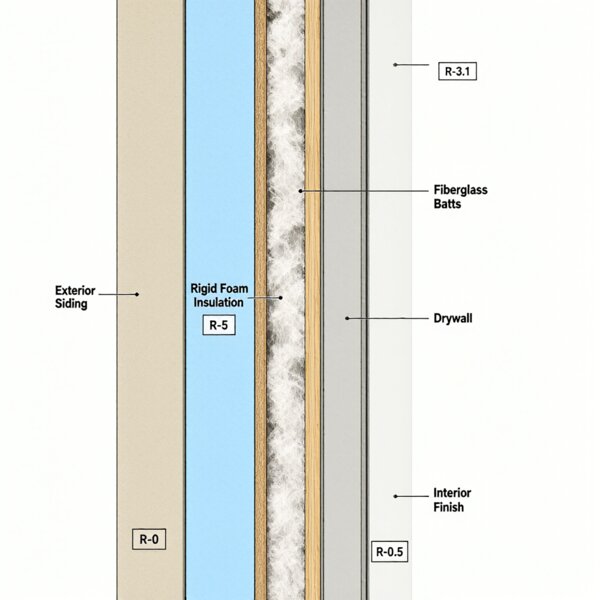
Wall insulation must fit within the stud cavity without compression or gaps. Standard 2×4 walls have 3.5 inches of cavity depth. 2×6 walls have 5.5 inches. The insulation must fill the cavity completely while leaving room for electrical boxes, pipes, and wiring.
Fiberglass Batts
Fiberglass batts are the most common wall insulation. R-13 fits 2×4 walls, R-19 fits 2×6 walls. Cost: $0.50-0.80 per square foot. Batts are pre-cut to standard stud spacing (16 or 24 inches on center). Installation requires cutting around electrical boxes and pipes. Gaps around obstructions reduce performance. Kraft-faced batts include a vapor retarder on one side; install with the facing toward the conditioned space in cold climates.
Mineral Wool (Rockwool)
Mineral wool batts have higher R-value per inch (R-4.2 vs R-3.7 for fiberglass), better fire resistance (melts at 2,000°F+), and superior sound absorption. Cost: $1.00-1.50 per square foot for R-15 in 2×4 walls. Mineral wool is denser and holds its shape better than fiberglass, reducing gaps and compression. It is also water-resistant and does not support mold growth.
Mineral wool is the best choice for exterior walls in fire-prone areas, sound-sensitive rooms (bedrooms, home offices), and high-moisture areas (bathrooms, kitchens).
Spray Foam in Walls
Open-cell spray foam fills wall cavities completely, sealing air leaks and providing R-3.7 per inch. Cost: $1.50-2.50 per square foot. Closed-cell spray foam provides R-6.5 per inch and adds structural rigidity. Cost: $2.50-4.00 per square foot. Spray foam is overkill for most walls but justified in tight spaces, irregular cavities, and high-performance homes targeting net-zero energy.
Rigid Foam Board (Continuous Exterior)
Rigid foam (EPS, XPS, or polyiso) installed on the exterior of the wall sheathing breaks thermal bridging and adds R-value. Cost: $0.50-1.50 per square foot depending on thickness and type. Polyiso has the highest R-value per inch (R-6.0) but loses R-value in cold temperatures. XPS (R-5.0 per inch) performs consistently across temperatures. EPS (R-3.8 per inch) is the most affordable.
Continuous exterior insulation is required by code in many climate zones (IECC 2021 requires R-5 to R-10 continuous insulation for 2×4 walls in zones 4-8). It is the single most effective upgrade for reducing thermal bridging in new construction.
Insulation Comparison Table
| Type | R-Value per Inch | Best Location | Cost per Sq Ft | DIY-Friendly |
|---|---|---|---|---|
| Fiberglass batts | 3.2-3.8 | Walls, attic floors | $0.50-1.20 | Yes |
| Blown-in fiberglass | 2.5-3.0 | Attic floors | $1.00-1.50 | No (machine needed) |
| Blown-in cellulose | 3.2-3.8 | Attic floors | $1.20-1.80 | No (machine needed) |
| Mineral wool batts | 4.0-4.3 | Walls, sound-sensitive rooms | $1.00-1.50 | Yes |
| Open-cell spray foam | 3.5-3.7 | Attic roof deck, walls | $1.50-3.00 | No (professional) |
| Closed-cell spray foam | 6.0-6.5 | Attic roof deck, rim joists | $2.50-4.50 | No (professional) |
| Rigid foam (XPS) | 5.0 | Exterior walls, basement | $0.80-1.50 | Yes |
| Rigid foam (polyiso) | 6.0 | Exterior walls (warm climates) | $0.80-1.50 | Yes |
Climate Zone Recommendations
The IECC divides the US into 8 climate zones. Insulation requirements increase with zone number.
Zones 1-3 (hot-humid and hot-dry): Attic R-30 to R-49, walls R-13 to R-15. Focus on air sealing and radiant barriers in attics. Spray foam on roof deck prevents moisture issues.
Zones 4-5 (mixed-humid and cold): Attic R-38 to R-60, walls R-13 to R-20 plus R-5 continuous exterior. This is where most US homes are. Blown-in attic insulation plus fiberglass or mineral wool batts in walls is the cost-effective standard.
Zones 6-8 (cold and very cold): Attic R-49 to R-60, walls R-20 to R-21 plus R-5 to R-10 continuous exterior. Higher R-values justify the cost because heating seasons are long. Closed-cell spray foam on rim joists and foundation walls prevents moisture and air infiltration.
Common Insulation Mistakes
Compressing batts to fit a smaller cavity reduces R-value by 30-50%. A compressed R-19 batt in a 2×4 cavity performs like R-13 or worse. Always use the correct R-value for the cavity depth.
Leaving gaps around electrical boxes and pipes creates thermal bypasses. Use spray foam or caulk to seal gaps around penetrations before installing insulation.
Blocking attic ventilation with insulation causes moisture buildup and mold. Install baffles at the eaves to maintain airflow from soffit vents to ridge vents.
Ignoring the vapor retarder causes condensation in walls. In cold climates, the vapor retarder goes on the warm side (interior). In hot-humid climates, it goes on the exterior. Some materials (spray foam, rigid foam) act as their own vapor retarder.
Not air sealing first wastes insulation. Air leaks through gaps and cracks account for 25-40% of heat loss. Seal gaps with caulk and spray foam before adding insulation.
Choosing the Right Insulation for Your Home
For most homes, the best value is blown-in cellulose or fiberglass in the attic (R-49) plus fiberglass or mineral wool batts in walls (R-13 to R-15) with continuous exterior rigid foam (R-5). This combination costs $2-4 per square foot and delivers 80% of the energy savings of a high-performance home at 30% of the cost.
Spray foam is justified for unvented attics, rim joists, and irregular cavities. Mineral wool is justified for fire-prone areas, sound-sensitive rooms, and moisture-prone walls. Rigid foam is justified for thermal bridging reduction in cold climates.
Start with an energy audit. A blower door test identifies air leaks, and an infrared camera reveals missing insulation. Fix the leaks, then add insulation. Insulation without air sealing is like wearing a sweater with the zipper open.