
Roof replacement in small spaces costs more per square than the same roof on a big house, and the reason is arithmetic rather than roofing. Every job has fixed costs: mobilization, permits, disposal, inspection. On a twenty-square roof those costs spread thin. On a six-square roof, they pile up.
Access makes it worse. If a boom truck cannot reach your wall, bundles get hand-carried, and the schedule grows by days. If a debris container will not fit on the driveway, the waste goes somewhere less convenient, at more cost.
None of this is unusual and none of it is a scam. It is simply the part of a small roofing job that nobody explains, and it is what you want to know before you sign.
Here is the practical version. A small ranch roof of 14 to 18 squares runs roughly $9,000 to $13,000 in 2026, while a very small roof under 1,000 square feet carries a minimum job cost of about $4,500 to $6,500, no matter how little material goes on it.
Small Roofs Cost More Per Square for a Reason Nobody Explains
A roof is priced in squares, and one square is 100 square feet. Material and labor scale with the count. But the costs around the job do not.
Think about what has to happen on every roofing job regardless of size. Somebody has to drive the truck, unload the ladder and the compressor, and stage the bundles. Somebody has to pull the permit. Somebody has to bring a dumpster, and somebody has to haul it away. An inspector has to come out.
On a big roof, that overhead is invisible. On a small one it is most of the invoice. This is the same principle that makes a bathroom remodel cost more per square foot in a small bathroom than in a large one.
The numbers make it concrete. A small ranch or bungalow with 14 to 18 squares typically runs $9,000 to $13,000 in 2026.
That works out to roughly $500 to $900 per square, which looks high until you compare it with a large home at $300 to $500 per square for a comparable material and scope.
The floor is where it gets sharper. For a very small roof, under about 1,000 square feet, the realistic minimum job cost runs $4,500 to $6,500. That covers a shed, a small cottage, or the main roof of a tiny home. You are not paying for material at that point. You are paying for the crew to show up.
Mobile homes make the range obvious. A single-wide home of 500 to 1,200 square feet runs $1,500 to $6,000 with asphalt shingles, $2,500 to $19,200 with metal, and $2,000 to $12,000 with a TPO membrane. A double-wide of 1,000 to 2,000 square feet runs $3,000 to $10,000 in asphalt.
Material choice moves the number far more than size does, because material is a per-square cost while mobilization is not.
Our roof replacement cost guide has the full per-square ranges for every material, which is the right place to compare options. What this page adds is the arithmetic of why your own numbers will not match the national average.
Access Is the Hidden Variable: Narrow Lots, Boom Trucks, and Hand Carrying
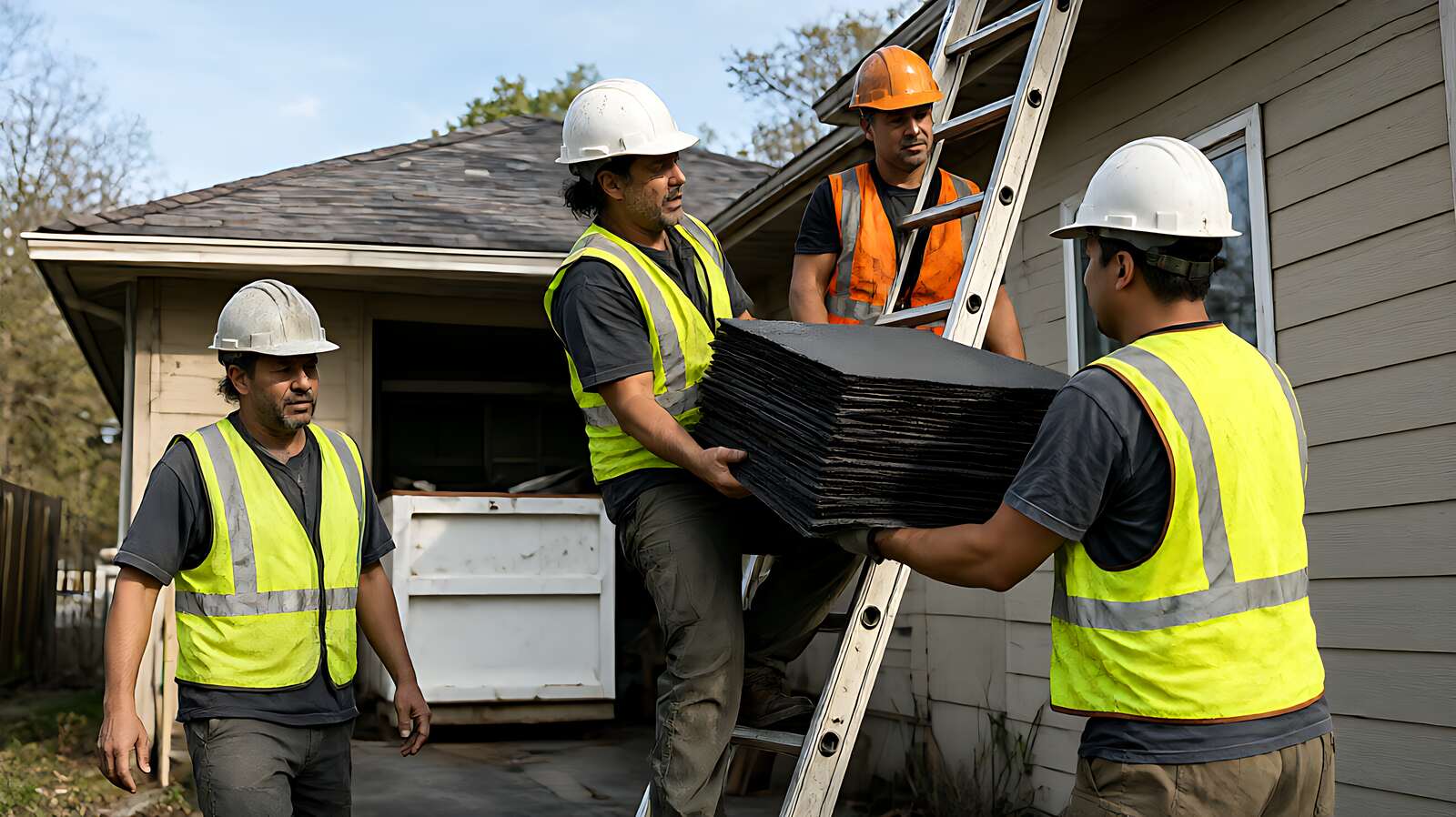
A boom truck is a truck with a conveyor arm that lifts bundles of shingles up to the eave. It is the difference between a crew unloading 30 bundles from the driveway in twenty minutes and a crew carrying each one up a ladder themselves.
Each bundle of asphalt shingles weighs 60 to 80 pounds. Hand-carrying that up a ladder, pitch after pitch, adds hours to the labor line and days to the schedule.
On a big open lot with a driveway, it is invisible. On a narrow row-house lot with a sidewalk between the truck and the wall, it can be the largest single line item on the estimate.
That is why the pre-quote measurement matters. Before anyone prices the job, somebody needs to know the narrowest width of the path, the overhead clearance height, and the run length from the street to the wall.
You also need the gate opening width and which way the gate swings, plus the location of low branches, planters, meters, and any hoop a neighbor left in the yard.
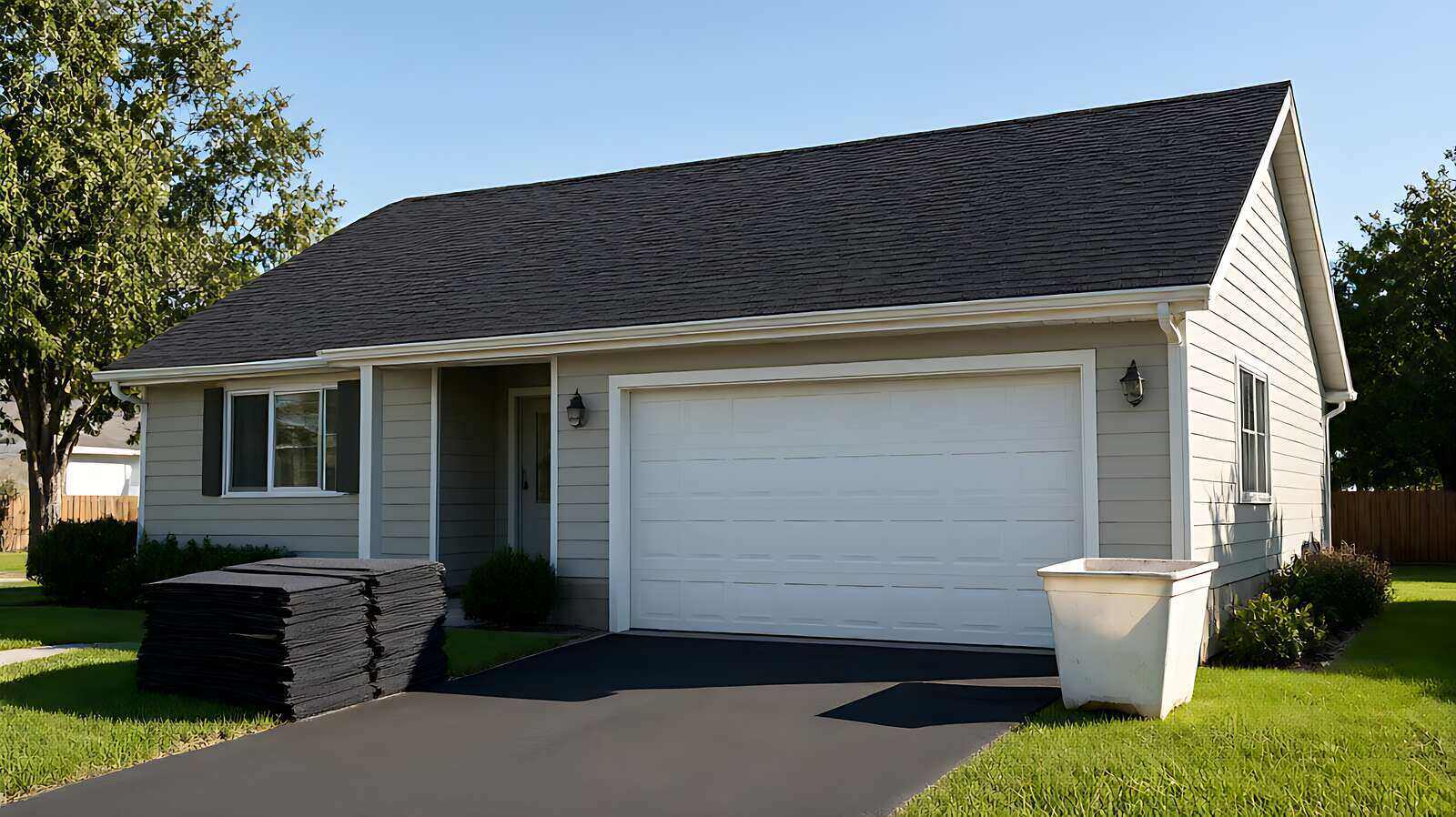
The same logic applies to waste. A debris container needs driveway space for the length of the job plus one to two days for pickup. When that space does not exist, the contractor switches to a smaller box, a trailer that gets swapped, or direct hauling.
Each option costs more and adds a trip.
Two more logistics items catch people out. First, split deliveries: on a tight lot, the supplier can deliver material to the curb in smaller loads rather than one full truck, which changes both your staging plan and the schedule. Second, street staging is governed by local street-use rules, and in many cities you need a permit to reserve curb space for a project vehicle.
Ask the contractor directly how material gets to the roof and how debris gets off it. A contractor who has already thought about your access is worth more than one whose estimate assumes the driveway is clear.
The Scope Decision Changes on Small Roofs: Full, Partial, or Recover
On a large roof, partial replacement is often a sensible way to spend money, because mobilization is spread over a lot of squares anyway. On a small roof, the arithmetic flips.
Because labor mobilization is the same whether the crew works on three squares or thirty, a partial job on a small roof can cost nearly as much as a full one while leaving you with a mismatched seam and a warranty that does not apply. If the roof is small enough that a full replacement is affordable, a full replacement is usually the better call.
A roof recover deserves its own look here. Overlaying instead of tearing off saves money per square and skips the disposal cost entirely, which is real money on a small job.
But it adds roughly 2 to 4 pounds per square foot of dead load, and it is only legal where the existing covering qualifies under IRC R908.3.1. Our guide to the four types of roof replacement covers that code path in full.
One more small-roof-specific note. On a small footprint, the roof often has several sections: the main house, a garage wing, a porch, a dormer. Each section that gets its own material order or its own crew setup adds a fixed cost. Sometimes combining them into one order, even with different materials, is simply cheaper.
What to Measure Before You Get Quotes for a Small or Tight-Access Roof
Ten minutes of measuring before the first quote gives you a much better conversation than ten minutes of arguing after it. Here is what to gather.
- Roof area in squares. Measure the ground footprint of the house and the garage, then multiply by a pitch factor. A 4/12 pitch needs roughly 1.1 times the footprint; a 6/12 pitch about 1.2 times. Divide by 100 for squares.
- Number of separate sections. House, garage, porch, dormer. Each one is a potential extra order and an extra setup.
- Path width and clearance. Narrowest point from the street to the wall, and the lowest overhead obstruction. Measure with the actual delivery vehicle in mind, not a car.
- Gate and yard obstacles. Gate opening width, swing direction, low branches, planters, meters, sheds.
- Disposal space. Where a container can sit, and for how long.
- Occupancy. Whether anyone is home, whether there is street parking, whether there is an HOA with rules about noise, hours, and vehicles on the drive.
Bring those six answers to the estimate meeting. A contractor who asks about them unprompted is telling you they have done small jobs before, which is the single most useful signal you can get.
How to Keep a Small Roof Replacement on Schedule and on Budget
Once the estimate is in hand, the way you manage it decides whether it stays on budget. A few habits carry a lot of weight on a small job.
Get three bids that name the same scope. On small roofs the spread between bids is often about access and mobilization assumptions, not about roofing. If one bid is much lower, ask what they assumed about material delivery and waste removal.
Ask for the mobilization line item separately. It should be visible, not buried. If a contractor will not separate it, you cannot tell whether their price is low because they are efficient or because they have not thought about your driveway yet.
Confirm the material delivery plan in writing. One truck or several, and where it will sit. On a small lot, a single delivery of the full order is usually simpler than three smaller ones.
Agree on the disposal approach before the first tear-off. Container, trailer, or direct haul, and who moves it. This is the item most likely to cause a surprise charge mid-job.
Confirm the scope in the contract. Tear-off, recover, partial, or conversion, how many layers come off, and what happens if the deck turns out to be bad. If you are still deciding between scopes, our page on the four types of roof replacement walks through which one your roof actually needs.
And plan for the ordinary unknowns. Small roofs have proportionally more flashing and trim detail per square than big ones, because a small roof has proportionally more edges. That detail is where a small job quietly runs over.
None of this makes small roof replacement a bad idea. A roof is a roof, whatever the square footage. It just means the conversation you should be having with the contractor is a slightly different one, and it starts with the driveway rather than the shingle color.