
Crack Orientation Tells You the Cause — Read the Pattern First
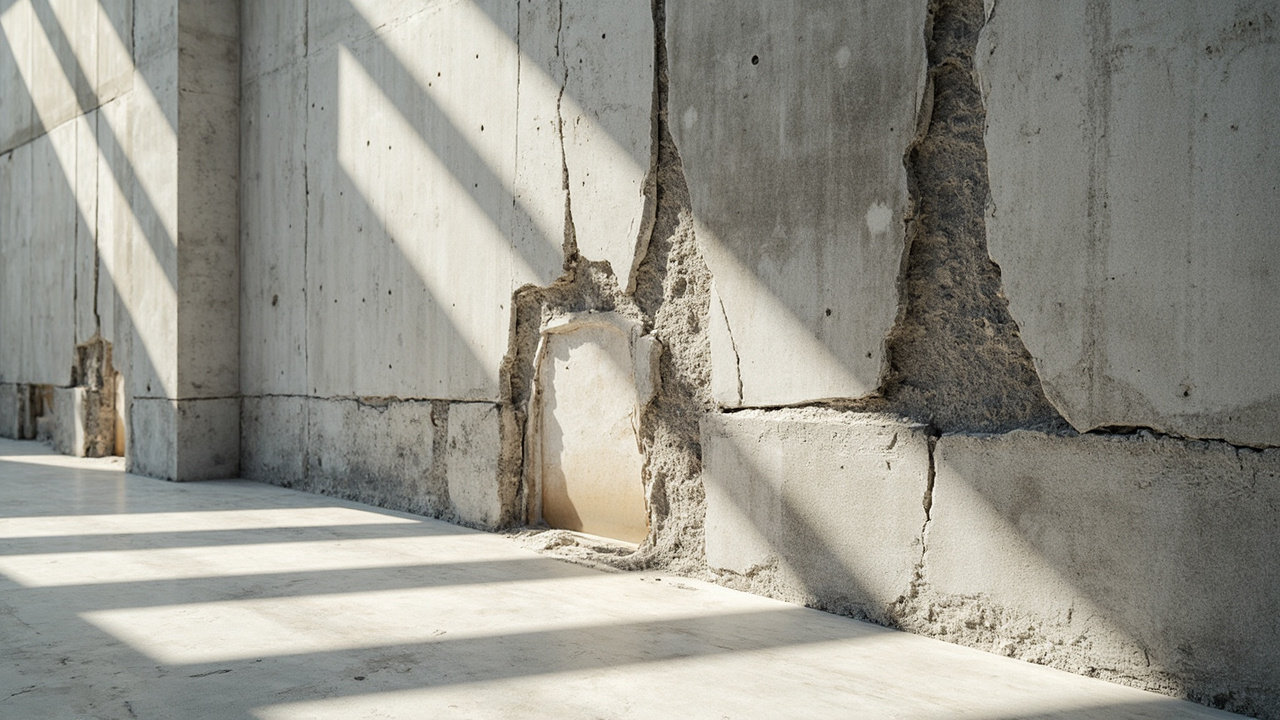
Not all foundation cracks are created equal. Shrinkage cracks — hairline fractures 0.5-2mm wide, random in pattern — form as concrete cures and loses moisture. They are cosmetic, not structural. They don’t threaten your home. But a vertical crack wider at the top or bottom signals differential settlement — one section of footing is sinking while another holds. That matters.
A horizontal crack in a basement wall is the most serious pattern. It comes from lateral earth pressure pushing inward — saturated clay, frost expansion, or inadequate backfill. If the wall bows even 1/4 in, the load path is compromised. Stair-step cracks running through mortar joints in block walls follow the same differential settlement pattern, just in a different material.
| Crack Pattern | Likely Cause | Urgency |
|---|---|---|
| Shrinkage (hairline 0.5-2mm, random) | Concrete curing — moisture loss | Low — cosmetic |
| Vertical, wider at top or bottom | Differential settlement — footing sinking | Medium — monitor |
| Horizontal mid-wall | Lateral earth pressure — saturated soil/frost | High — structural risk |
| Stair-step through block joints | Differential settlement in block wall | Medium — monitor |
| Diagonal at window/door corners | Point-load settlement — footing under lintel | Medium — monitor |
The decisive test is activity — is the crack growing? A dormant shrinkage crack can be sealed and forgotten. A growing settlement crack demands stabilization first, cosmetic repair second. If you skip the activity test, you seal a crack that keeps moving and reopens within a year.
How to Test If a Crack Is Active or Dormant
Buy a crack monitor — a simple glass-epoxy gauge with overlapping scales, $15-30 at any concrete supply house. Bond it across the crack with the zero line centered. Check every 30 days for three months. If the crack crosses the zero line in either direction, it’s active.
DIY method: run clear packing tape along the crack. Mark the endpoint with a fine pen date. Inspect weekly. If the tape tears or the mark moves, the crack is moving. If it stays intact for 90 days through a full freeze-thaw cycle, the crack is dormant.
Active threshold: growth greater than 1/4 in per year. Below that, the crack is likely dormant or moving within seasonal thermal expansion range. Above it, the foundation is still adjusting — and you need to find out why before sealing anything.
Repair Methods Matched to Crack Class
Epoxy Injection — Dormant Non-Structural Cracks
Epoxy injection fills hairline to 3mm vertical cracks that are dormant. The process: surface ports every 6-8 in along the crack, seal the face with paste epoxy, then inject low-viscosity structural epoxy at 30-60 psi. The epoxy bonds the concrete back to monolithic strength — and blocks water pathways.
Key limitation: epoxy is rigid. If the crack reopens, the epoxy cracks with it. Only use this on verified dormant cracks. Don’t use epoxy on active horizontal cracks — you’ll just get a new crack six inches away.
Carbon Fiber Straps — Horizontal Cracks with Bowing
When a basement wall bows inward from lateral pressure, carbon fiber straps prevent further deflection. The strap is bonded to the wall surface with structural epoxy at 48-in centers across the cracked zone. Tensile strength of 250,000 psi restrains the wall — but it doesn’t straighten it.
Straps work if bowing is under 1 in. Beyond that, the wall needs steel I-beam reinforcement or excavation and rebuild. Carbon fiber is the middle option: stronger than nothing, less invasive than a full rebuild.
Polyurethane Foam — Active Leaking Cracks
If water is actively seeping through a crack, hydro-active polyurethane injection seals it. The resin reacts with water and expands to 20 times its volume, filling the crack and surrounding voids. Unlike epoxy, polyurethane stays flexible — it tolerates minor crack movement without tearing.
Use polyurethane for waterproofing, not structural restoration. For a crack that’s both leaking and structural, use polyurethane first to stop water, then assess whether structural reinforcement is needed separately.
Underpinning — Continuing Settlement
If a vertical or stair-step crack is actively growing, underpinning is the only repair that addresses the root cause. A contractor installs driven piers or drilled concrete piers beneath the existing footing down to stable bearing stratum — typically 10-20 ft deep in expansive clay regions.
Cost: $1,200-3,000 per pier, spaced every 6-8 ft along the settling wall. It’s not cheap. But it’s the only method that stops settlement — epoxy, carbon fiber, and polyurethane all assume the movement has stopped.
When to Call a Structural Engineer
Hire a licensed structural engineer when any of these red flags appear:
- Crack width exceeds 1/2 in — indicates significant movement, not just shrinkage
- Visible displacement — one side of the crack is higher or bowed relative to the other
- Horizontal crack with more than 1/4 in of bowing — wall is actively deflecting
- Multiple stair-step cracks in the same wall — settlement is widespread, not localized
- Water intrusion through an active crack — moisture accelerates damage
The engineer specifies the repair method, footing dimensions, and pier depth based on your soil report and crack survey. Budget $1,500-5,000 for analysis — cheaper than the wrong repair repeated twice.
After the Repair: Waterproofing, Monitoring, and Prevention
Sealing the crack is step one. Keeping it sealed requires addressing the water and soil conditions that caused it.
Exterior waterproofing membrane on foundation walls blocks groundwater before it reaches the concrete. Pair it with drain tile at the footing level — perforated pipe in gravel, sloped to a sump pump or gravity outlet. The system intercepts water and moves it away before hydrostatic pressure builds.
Grade the soil around your home to slope 1/4 in per ft away from the structure for at least 6 ft. Downspouts extend 4-6 ft beyond the footing. These two details prevent 80% of the water that causes cracking.
Set up an annual crack survey: photograph and measure every visible crack in basement, slab, and crawl space. Track growth. Catch a crack when it moves from dormant to active — that’s your window for stabilization before major damage.
Next step: see our foundation waterproofing guide for membrane selection and drain tile installation. If you need to hire, our contractor vetting guide covers license checks and reference questions specific to foundation work.