

Hail damage vs wind damage is a question worth ten minutes of your attention, because the two events leave completely different fingerprints and insurers treat them differently. Getting the wrong answer does not mean no claim. It means a claim that gets argued about, line by line, while your roof sits open to the weather.
Here is the practical version. Hail hits and scatters. Wind lifts and peels. One leaves round bruises and dented gutters, the other leaves curled tabs and missing pieces. Once you can see which pattern you are looking at, you know what to photograph and what to tell the adjuster.
There is a third possibility hiding underneath both, and it is the reason more claims get denied than any other factor. Sometimes the damage is not the storm at all. It is the roof’s age, wearing out on the same schedule it always has.
Hail and Wind Leave Different Evidence: A Field Guide to Telling Them Apart
The fastest way to separate the two is to study the pattern rather than any single mark. Scattered and random points to hail. Directional and clustered points to wind.
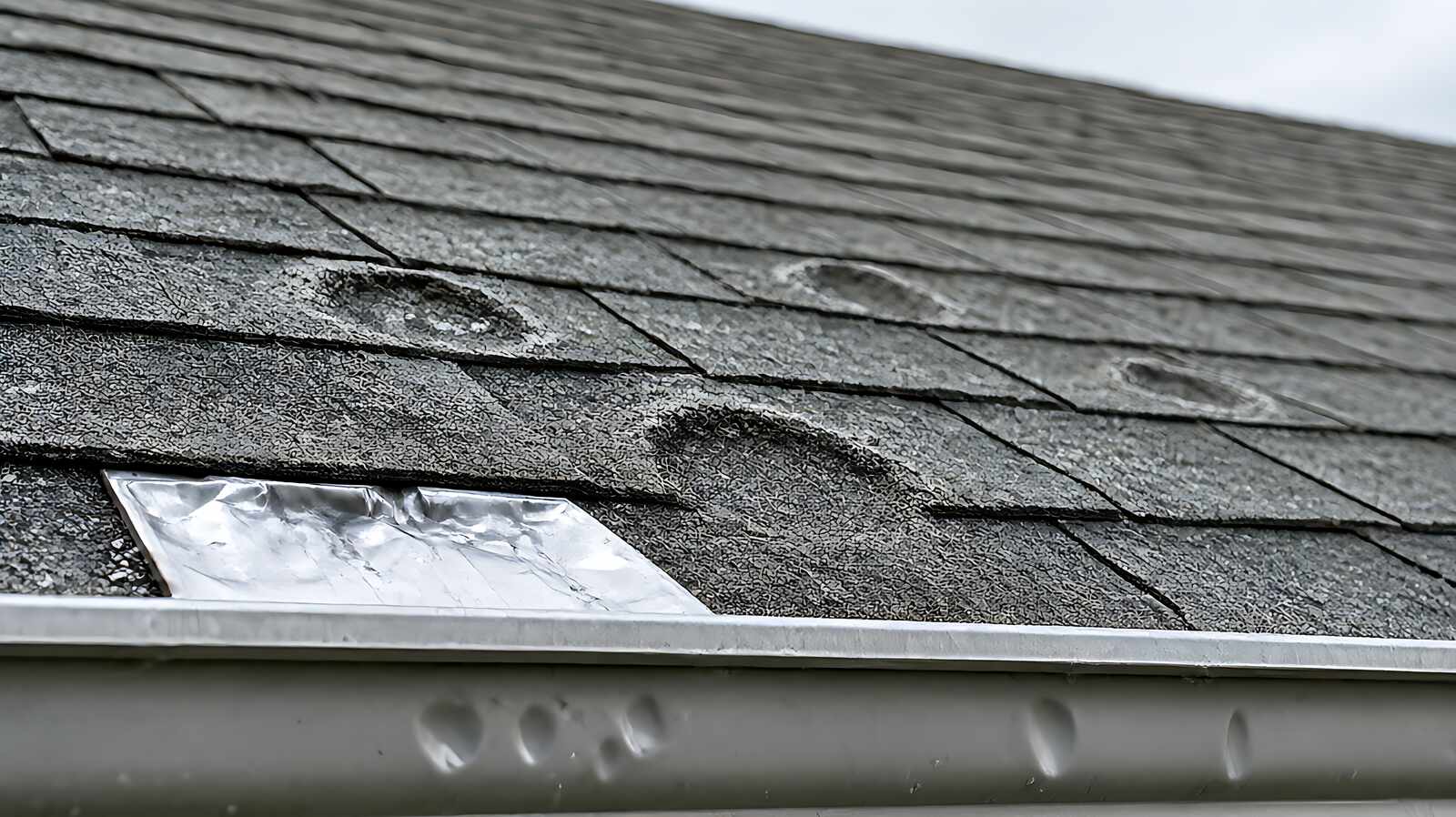
Start on the slope face and work outward. For hail, watch for round bruises and dents you can feel under the granules, plus patches of granule loss where the surface grit has been knocked loose and the darker mat underneath shows through.
On the other hand, wind leaves tabs that have lifted, curled, or disappeared entirely, and it creases shingle courses over on themselves. A crease is a fold. A bruise is a crush. That single difference in shape tells you which force did the work.
Then check the edges, because that is where the two events part company most clearly. Corners and rakes are where wind catches a roof, so wind damage concentrates there first. Hail scatters evenly across a slope and pays little attention to where the edges are.
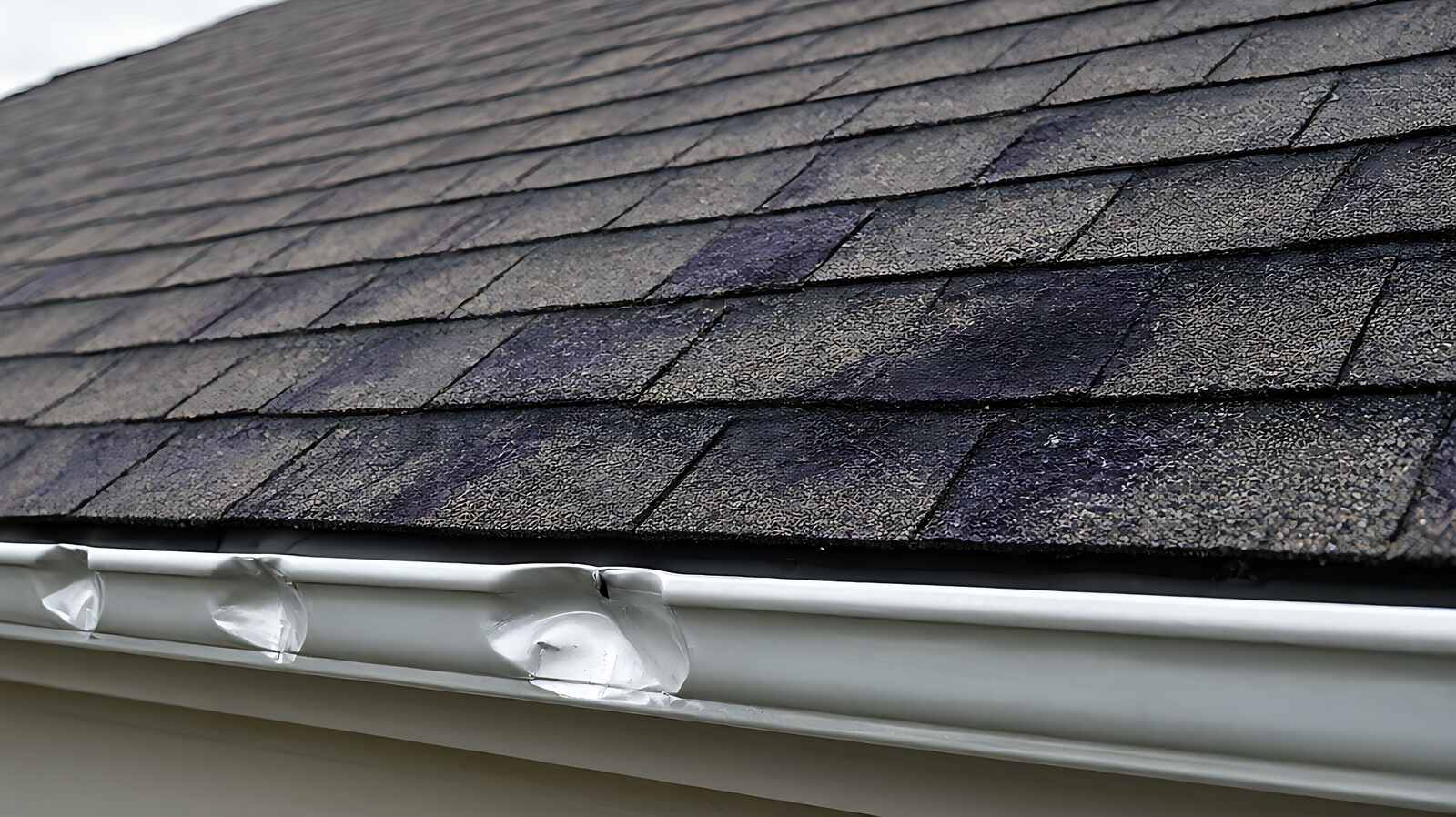
Read the low, exposed metal before you climb anything. Gutters, downspouts, and vent covers dent far more easily than a shingle because they are thin and have nothing behind them. They also never lie about which force hit them.
Hail Bruises, Dents, and Cracks: What Each Strike Leaves Behind
Hail is a point impact event. Every drop is a discrete strike, and the result is a scatter of small, round wounds rather than an organized pattern of failure.
On the shingles themselves, three things matter. Look for round bruises where the granules have been crushed into the mat, soft spots that give under your palm, and patches of granule loss exposing the black mat. Larger hail cracks the mat and the shingle face outright.
Now look at the soft metals, because this is where the evidence is strongest. Vents, flashing, gutters, and an air conditioner condenser all dent far more easily than a shingle, because they are thin and have nothing behind them. If the dents are on the metal while the shingles look vaguely rough, you have your answer.
Gutters do you another favor. They catch the granules that washed off the slope, so a gutter full of gritty debris after a storm is a strong hail signal. Wind does not produce that, because wind tears pieces off instead of sanding them down.
Size is what turns this from cosmetic damage into functional damage. Hail in the one to two inch range is where you typically see damage that affects the shingle’s ability to shed water rather than just its appearance. Smaller hail only bruises the surface, and that distinction matters, because cosmetic-only damage is often excluded or prorated under the policy.
Hail also throws collateral damage as it goes. Window screens, vinyl siding, and gutters take hits on the side of the house facing the storm. Small holes in the screens are part of the same event.
Wind Lifts, Creases, and Tears: Lifted Tabs and Missing Pieces
Wind does not strike. It pulls. That is why wind damage is directional and why it starts at the perimeter of the roof rather than in the middle of a slope.
The signature is uplift. A tab raised along its bottom edge with the nail heads showing underneath is the classic sign. So are courses that are creased or folded over in a line, along with tabs torn clean away.
Direction is the giveaway here. Wind damage does not scatter evenly. It follows the rake and the ridge, it concentrates on the corner where two walls meet, and it tends to be worst on the side facing the incoming weather. Check the rake and ridge lines first.
Exposure requirements for wind uplift on asphalt shingles in the US run roughly 90 to 130 mph, with hurricane-region coastal areas sitting at the top of that band. A storm that clears that bar for your exposure zone produces the kind of damage you are looking at.
One more thing wind does that hail does not: it opens the roof. A raised tab is a path for the next rain to get under the shingles. If a storm tore pieces off, there is now an entry point for water, which is a different kind of urgency than a dented gutter.
Also look for what the wind brought with it. A branch or a section of cladding driven through a shingle field is not hail or uplift, and it changes both the cause you report and the repair the roofer scopes.
Why the Distinction Changes Your Claim, Scope, and Payout
Knowing which event happened is not a party trick. It changes three practical things, and each one is worth a few hundred dollars at least.
It changes how the claim is evaluated. Hail damage is relatively straightforward to support when the weather is documented, because the pattern is unambiguous. Wind damage sits much closer to the line, so insurers push hard on wear and tear and on pre-existing granule loss.
It changes what gets replaced. Hail that crossed the functional threshold tends to support a full-slope replacement, because shingle manufacturers generally do not warrant piecemeal repair on storm-damaged shingles. Uplifted tabs from wind often get scoped as a repair instead.
What the two outcomes cost
The price gap between a patch and a full replacement is large enough to matter. Installed asphalt shingles run roughly $3.50 to $4.50 per square foot for 3-tab and $4.00 to $7.00 per square foot for architectural material.
- Wind uplift, repairable scope – re-nailing and resealing lifted courses, plus replacement of the pieces that tore away.
- Hail, functional threshold crossed – full slope replacement, because the mat is compromised across the field.
- Cosmetic only – no functional claim, and usually no payout.
The roof replacement cost breakdown covers what drives those per-square-foot numbers on a normal job.
It changes the evidence you need. The documentation step is where the money is won or lost, and it is where knowing the difference pays off. This is the part homeowners can do entirely on their own.
Photograph each slope of the roof, the ridge line, and every rake and corner. Get close on the vents, the flashing, the gutters, and the downspouts, because dented metal is the evidence that survives. Photograph the air conditioner condenser. Get the granule debris in the gutters on camera. And capture the screens and siding for collateral damage.
Then check the objective record. The NOAA Storm Events database is a public record of reported storms by date and location, including hail size. Your insurer uses it too.
If a storm is recorded for your address on the date you are claiming, that is a fact working in your favor, and it is worth knowing before the adjuster arrives rather than after.
One number on your policy does more work than most people realize. Wind claims frequently carry a percentage deductible, commonly two, five, or ten percent of the dwelling coverage, while hail claims more often carry a flat dollar amount. Knowing which one you have tells you whether the estimate you are being handed is being measured against the right number.
You do not need to be able to classify damage for a claim. Only a licensed professional or the insurer’s own inspection can do that. What you can do is document clearly and let the professional make the call.
If you want the safe way to look at a roof, how to inspect a roof for damage safely covers what is reasonable from the ground and where you should stop.
Telling Hail Damage and Wind Damage Apart From Age and Wear
Here is the part that catches experienced homeowners. A roof that is twelve to fifteen years old shows granule loss from ultraviolet exposure, curling from thermal cycling, and brittle cracked tabs that look remarkably like storm damage.
When an adjuster sees that, they are not being difficult. They are applying the most common denial in storm claims: pre-existing wear and tear rather than storm damage. The burden shifts to you on that point, which is why the documentation in the previous section matters so much.
The way claims get resolved is usually simple arithmetic on the roof’s age. If the shingles were already at the end of their service life on the morning the storm arrived, the insurer’s position is that the weather accelerated something that was going to happen anyway, and that means a much smaller payment.
Roofing data puts the typical service life of an asphalt shingle roof in the range of 15 to 30 years, so age on the invoice is a number the adjuster is definitely looking at.
Three things work in your favor here, and none of them take long. The first is the date of the storm, which the NOAA record can confirm. The second is evidence of damage that wear cannot explain: metal that is dented, shingles that are cracked through rather than curled at the edge, and collateral damage to screens and siding. Age does not dent a downspout.
The third is timing. A roof photographed within days of a storm, before any cleanup or repair, is far better evidence than one photographed three weeks later, after a contractor has been on it or after rain has moved things around.
And if the damage turns out to be age rather than weather, that is worth knowing too. A roof at the end of its life is a planning conversation, not a claim.
Either way, the documentation habit is the same.
The repair versus replacement decision covers how to think about that, and how a storm damage insurance claim actually gets paid covers what happens once the adjuster has been out.
Your next step is deliberately small. Get on the ground, walk the perimeter, and look at the metal before the shingles. Write down which pattern you see and photograph it the same day. Then let a licensed roofer or the adjuster make the call on cause, because that part is genuinely theirs to make.