
Hinges look like a solved problem until the door you ordered arrives and the hinge box holds a type that will not work on it. Most interior hinge confusion comes down to three questions: which bearing is inside, what the hinge is sized to fit, and how many of them the door needs. Answer those before you spend anything.
Answer those before you spend anything, and the rest of the job is mechanical.
The good news is that the hardware shelf in a home centre carries only a handful of options that matter for interior work. Everything else on that peg wall is for cabinets, gates, or exterior doors that see weather.
This guide covers the hinges that matter for a door slab going into an interior frame, and it lines up with the sizing work in how to measure an interior door. If you are still working out what kind of door you have, read prehung versus slab door first, because that choice changes what hardware you need.
Three hinge bearings, and the one your door actually needs
 prehung installation guide covers where the hinge positions land on the frame, and the spacing between them matters as much as the total.
Adding hinges is not a substitute for a fix. If a door sags because the hinges are too few or too light, a stronger hinge at the same position helps only a little.
The sag has to be corrected at the top hinge first, and that is a separate job.
Radius, finish, and the details that get ordered wrong
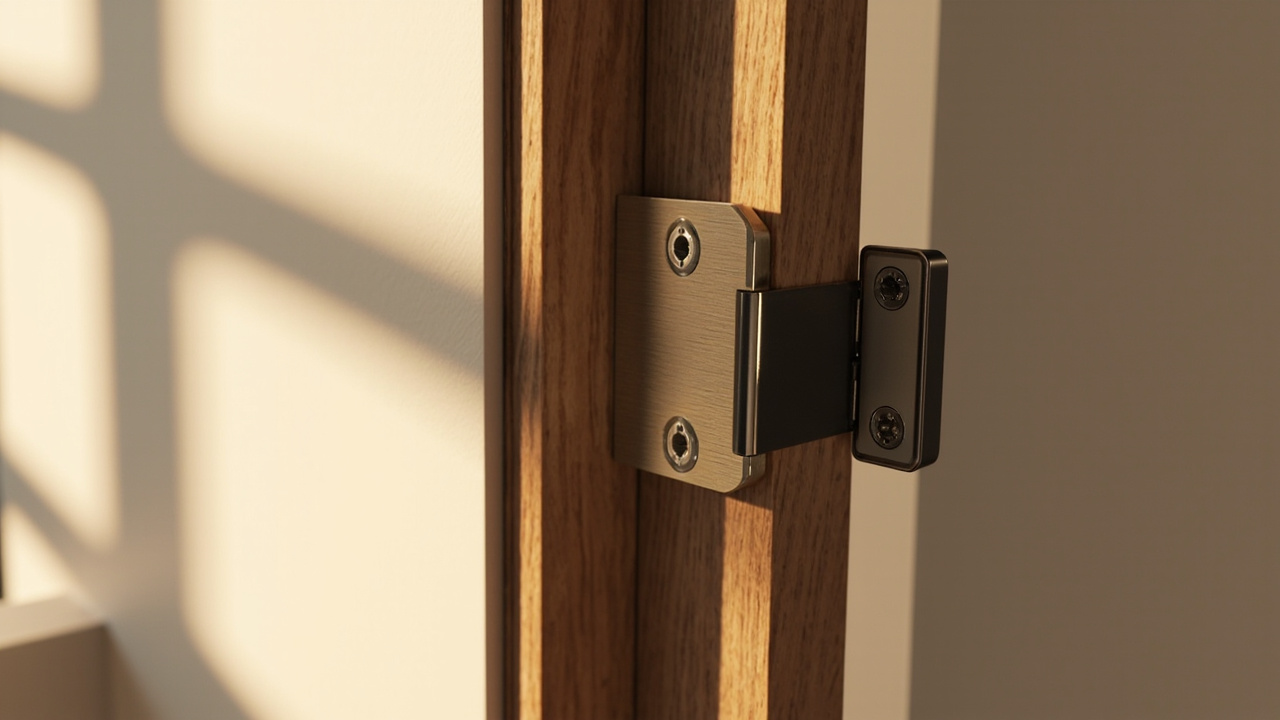
The corner radius of a hinge is the shape of the knuckle end. Three are common: square corner, quarter inch radius, and five eighths inch radius.
The radius has to match the frame you already have, because it is cut into the hinge recess. A mismatch shows as a visible gap at the corner of the door edge.
There is a test for this that does not require a catalogue. Take a coin and press it into the corner of the old hinge.
A quarter inch radius matches a dime. A five eighths radius matches a quarter. If the coin sits in the corner with the curve matching the metal exactly, you have found the right one.
Next is whether the hinge can be removed without damaging the door. A remove the pin hinge has a pin that lifts straight out, so the door comes off without pulling the hinge leaves out of the recess.
A nonremovable pin is riveted or bonded in place, and those hinges are meant to stay. Replacing one means damaging the door edge to get at it.
Third, the finish. Hinges are sold in the same finishes as the hardware on the door, and mismatched hinges are the most visible mistake on a new installation.
The door is only open half the time, and the hinge is what you see when it is. Brushed nickel, aged bronze, polished brass, and black are the finishes most doors in North American homes actually use.
Fourth, and least obvious, the screw holes. The holes on the door edge have to line up with the ones on the hinge, or the hinge sits proud and the door will not close.
This is why you should not order hinges by appearance alone. A photo of the old hinge, taken square to the leaf with a coin for scale, settles it in a second.
What to check before you buy, in one pass
Run through this list before you order, and it takes about two minutes.
- The leaf length, which for a standard interior door is 4 inch.
- The leaf thickness that matches your door, 1-3/8 inch or 1-3/4 inch.
- The bearing type, which is where most people should spend an extra few dollars and move up to ball bearing.
- The finish, matched to the knob and the other hardware on the door.
- The closing speed if you want a self-closing spring hinge, and the swing of it, because a spring hinge set too fast is worse than none at all.
- The screw hole pattern. Hold the new hinge against the old one before you pay for it.
Two of those six items decide whether the hinge will physically fit. The other four decide whether the door works properly for the next fifteen years.
Getting the bearing and the thickness right matters more than the finish, and the fit matters more than both.
Once the hinges are right, the rest is a straightforward sequence: mortise the recesses, hang the leaf, and set the pin. The handle and latch guide covers the other half of the hardware on the same door, and it is worth reading in the same sitting so the two jobs do not fight each other over the same 2 inches of door edge.