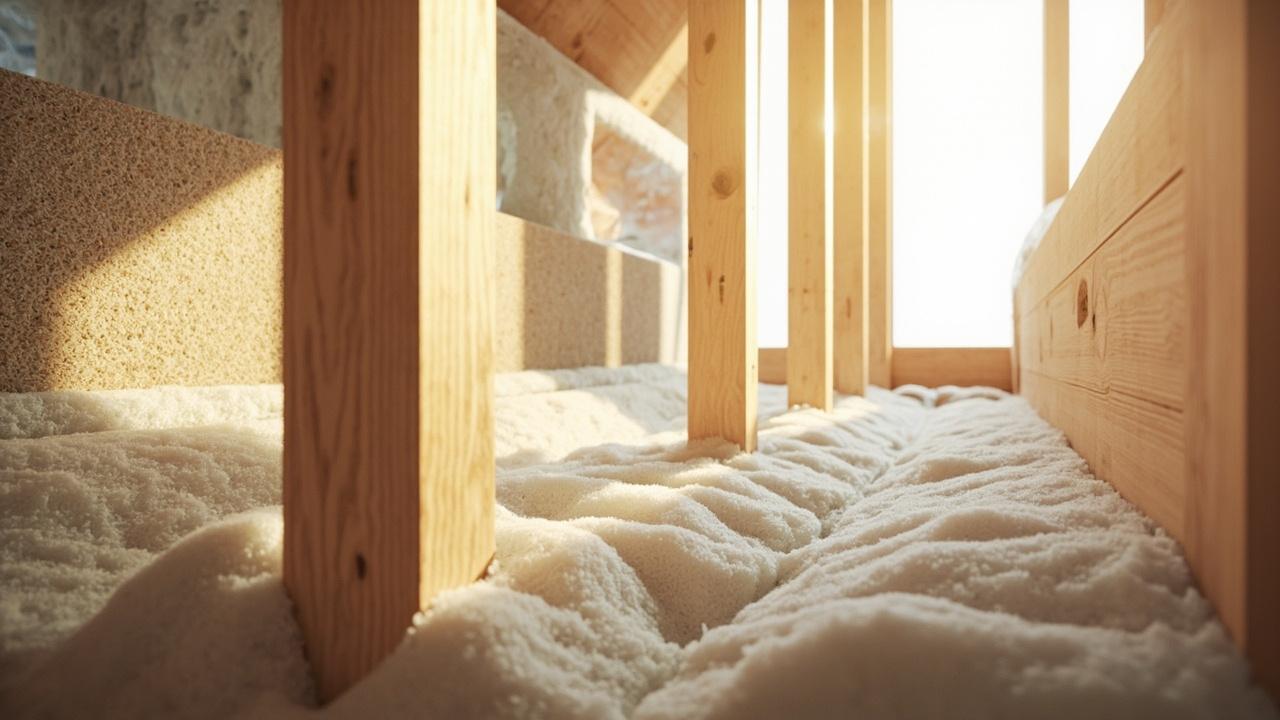

Home insulation is not a blanket you tuck into a wall — it is a controlled resistance to heat flow that only works when air movement, moisture, and structure are handled as a single assembly. Choose fiberglass batts, spray foam, blown-in cellulose, mineral wool, or rigid foam board and the label matters less than the cavity you put it in, the R-value you actually achieve after compression and gaps, and whether the vapor retarder and air sealing match your climate zone. Get those three right and a $1.20 per sq ft attic top-up pays back in two winters. Miss them and R-38 on paper performs like R-19 in the house. If you are sequencing this with windows and roof work, the window energy ratings guide and roofing shingles overview set the envelope context before you insulate, and the drywall guide explains why insulation always happens before board goes up.
What Home Insulation Actually Is and Why the Material Name Is Smaller Than You Think
Home insulation is the material layer that slows conductive, convective, and radiant heat flow between inside and outside, measured as R-value — higher number means higher resistance per inch. That resistance is an assembly property, not a product claim on a bag. The same fiberglass batt rated R-13 in a 2×4 stud bay drops to about R-10 when it is compressed around wires or leaves a 1-inch gap at the plate, and the same closed-cell spray foam rated R-6.5 per inch loses half its advantage if the rim joist above it still leaks outside air.
For most US homes under the IRC, the realistic shortlist is fiberglass batts and rolls at $0.70 to $1.30 per sq ft installed, blown-in fiberglass or cellulose at $1.00 to $1.80 per sq ft, mineral wool batts at $1.40 to $2.20 per sq ft, open-cell spray foam at $1.50 to $2.50 per sq ft (R-3.5/inch), and closed-cell spray foam at $1.80 to $2.80 per sq ft (R-6.0 to 6.5/inch). Rigid foam board — polyiso, XPS, or EPS — runs $1.20 to $2.50 per sq ft per inch and is usually used as continuous exterior insulation, not as a cavity fill. The bag price is the small part. Labor, access, air sealing, and whether walls are open or closed drive the final cost per square foot.
How Insulation Works: R-Value, Air Movement, and the Moisture Rule
Heat moves three ways and insulation only directly stops one. Conduction slows as R-value rises. Convection must be stopped by air sealing first — caulk, foam, and gaskets at plates, penetrations, and top plates. Radiation is handled by reflective surfaces and ventilation in the attic, not by thicker batts. That is why the DOE and Energy Star both start an insulation job with air sealing: sealing the attic plane at $0.50 to $1.50 per sq ft often saves more energy than adding another R-19 where air still bypasses it.
R-value adds when layers are continuous. R-13 in the stud bay plus R-5 continuous rigid foam on the sheathing is about R-18 effective for that wall, and it avoids the thermal bridging that makes a framed R-13 wall perform closer to R-10 whole-wall. U-factor, which you see on windows, is simply 1/R, so a window at U-0.30 is about R-3.3 — which is why walls and attics need far higher numbers than glass ever delivers. Moisture then decides the retarder strategy: in climate zones 1-3 (hot-humid) the vapor retarder faces outward or is omitted in favor of a Class III permeable paint; in zones 5-8 (cold) it faces the warm interior side or is handled by the foam itself. Put the retarder on the wrong side in the wrong zone and you trap moisture inside the cavity.
| Material | R per inch | Installed cost per sq ft | Best use |
|---|---|---|---|
| Fiberglass batt | 3.1 – 3.4 | $0.70 – $1.30 | Open stud bays, attic floor over air-sealed plane |
| Blown cellulose | 3.2 – 3.8 | $1.00 – $1.80 | Attic top-up, dense-packed walls |
| Mineral wool batt | 3.3 – 4.2 | $1.40 – $2.20 | Walls and floors, fire and sound benefit |
| Open-cell spray foam | 3.5 – 3.7 | $1.50 – $2.50 | Air sealing + insulation in one pass |
| Closed-cell spray foam | 6.0 – 6.5 | $1.80 – $2.80 | Rim joists, small cavities, vapor control |
| Rigid polyiso | 5.5 – 6.5 | $1.20 – $2.50 / inch | Continuous exterior, basement walls |
Main Types for US Homes: What Each Does Well and Where It Falls Short
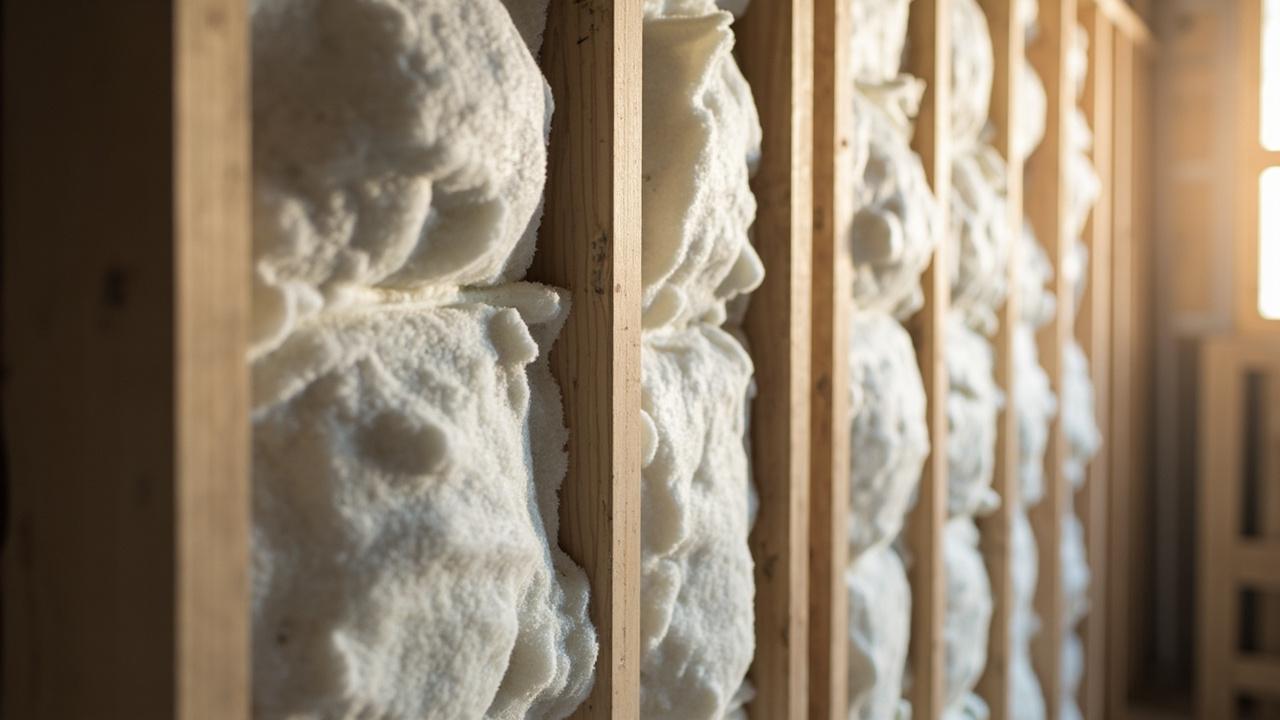
Fiberglass batts are the budget workhorse. They are forgiving when walls are fully open and the crew takes time to split around wires and avoid compression. They are a poor choice when the top plate is not sealed, because air washing through the batt strips its effective R-value fast. Blown-in fiberglass or cellulose wins in attics: a machine fills joist bays evenly, covers the plates, and reaches 10 to 14 inches for R-38 to R-49 in most zones 4-7 at about $1.20 to $1.60 per sq ft. Cellulose, made from recycled paper treated with borate, dense-packs walls at 3.5 lbs/cu ft and provides better air resistance than batts at similar R.
Mineral wool (Rockwool/Stone wool) holds its shape, resists fire to over 2,000°F, and provides sound damping that fiberglass cannot — useful in interior walls and floors. It costs more and needs precise cutting. Spray foam is two different products: open-cell is soft, vapor-permeable, and excellent as an air barrier in attics and walls where a separate vapor retarder will be added; closed-cell is rigid, adds structural racking strength, and is a Class II vapor retarder at 2 inches, which simplifies assemblies in mixed climates but raises material cost and requires professional installation with proper ventilation during cure. Rigid foam board belongs on the outside of the sheathing or below a slab, breaking thermal bridges; on its own inside a stud bay it leaves air gaps and is not a substitute for cavity insulation.
Where Each Type Fits by Location: Attic, Walls, Floors, and Foundation
The attic floor is the highest-return location in most houses. If the attic will remain vented and unfinished, air seal first, then blow R-38 to R-60 (about $1.00 to $1.80 per sq ft) depending on zone — zones 1-3 target R-38, zones 4-5 R-49, zones 6-8 R-60 per DOE. If the attic will be conditioned (HVAC or storage inside), spray foam or rigid foam goes at the roofline, not the floor, and the ventilation path moves outward. Do not bury can lights or exhaust fans without IC-rated covers.
In open walls (new construction or gut), R-15 batts in 2×4 plus R-5 continuous exterior foam outperforms R-23 batts alone because it stops bridging. In closed walls (retrofit), dense-packed cellulose or injected foam through 2-inch holes is the realistic option at $1.50 to $2.50 per sq ft — it avoids tearing off drywall but requires an infrared check afterward for voids. Floors over crawlspaces get R-19 to R-30 batts held tight to the subfloor, or R-10 continuous rigid on the crawl walls if the crawl will be conditioned. Basement walls get rigid foam or closed-cell spray to the interior, not fiberglass against concrete — fiberglass against concrete wicks moisture and grows mold.
Choosing Without Rework: Conditions That Flip the Answer
Choose fiberglass batts or mineral wool if walls are open, budget is tight, labor is careful, and you can air seal separately — this is the lowest lifecycle cost when the assembly is accessible. Choose blown cellulose or fiberglass if the attic is the target and the plane can be sealed first. Choose open-cell spray foam if you need air sealing and insulation in one pass in a vented attic or wall where a smart vapor retarder will be painted on the interior. Choose closed-cell spray foam if space is shallow (2 inches for R-13 in a 2×4), the rim joist or basement wall needs both R and vapor control, or the wall cannot be wrapped with exterior foam.
Avoid the three common failures that erase R-value after inspection: wind wash at the eaves where soffit vents blow air through the batt edge (fix with baffles), compression around wiring and boxes (split batts, don’t stuff), and interior polyethylene in mixed-humid zones 3-4 where it traps summer moisture (use a Class III latex vapor retarder instead). For cost planning, an attic top-up from R-19 to R-49 in a 1,000 sq ft attic at $1.30 per sq ft is about $1,300 and typically cuts heating and cooling load 10 to 15% — the audit after, with blower-door and infrared, is what proves the assembly actually performs.
Frequently Asked Questions About Home Insulation
What R-value do I need in my attic? Climate zones 1-3: R-38, zones 4-5: R-49, zones 6-8: R-60 per DOE. Always air seal first, then insulate to the zone target.
Is spray foam worth the extra cost over fiberglass? If you need air sealing, shallow depth, or vapor control in one step — yes. If walls are open and you can seal separately, batts at half the cost achieve similar effective R.
Can I put new insulation over old attic insulation? Yes, if the old layer is dry, not moldy, and not blocking soffit vents. Add baffles, air seal penetrations, then blow perpendicular to joists to the new R target.
Does insulation need a vapor barrier? Not always. In cold zones a Class II retarder or closed-cell foam provides it. In hot-humid and mixed zones a permeable Class III retarder often performs better than polyethylene.
What is the cheapest way to improve insulation now? Seal the attic plane ($0.50-$1.50/sq ft), add baffles, then blown cellulose to R-38. That sequence beats premium material in a leaky assembly.
When should I choose mineral wool over fiberglass? When fire resistance, sound damping, or dimensional stability in walls and floors matters — mineral wool holds shape and resists slump.